All posts by Admin

‘Believing You’re a Winner’ Gives Men a Testosterone Boost and Promiscuous Disposition

‘Believing you’re a winner’ gives men a testosterone boost and promiscuous disposition

source: www.cam.ac.uk
New findings suggest that the male body tries to “optimise” self-perceived improvements in social status through hormonal shifts that promote “short-term mating”.

Our results show that both testosterone and its corresponding psychological effects can fluctuate quickly and opportunistically

Danny Longman

A new study shows that men only have to believe they’ve bested another man in competition to get raised testosterone levels and an inflated sense of their own value as a sexual prospect.

Scientists found that this hormonal and psychological shift made men more inclined to approach new potential partners.

The research team measured hormone levels, as well as self-perceived attractiveness and confidence in approaching women, in 38 men in their twenties before and after competing in head-to-head battles on rowing machines.

Unbeknownst to participants, the competitions in the study were rigged to randomly declare the winner, regardless of who was the stronger rower.

While previous studies have shown that winning can affect male hormones, it was not known whether this was down to the efforts it takes to win or the belief that one is victorious.

The latest study, led by biological anthropologists from the University of Cambridge and published today in the journal Human Nature, reveals that just being convinced you have won, or indeed lost, is enough to cause male hormonal fluctuations that can influence sexual behaviour.

Researchers say this is an example of “plasticity”: the body adapting quickly – without altering genetic make-up – to suit a change in circumstance. In this case a perceived change in social status, due to the men believing they have defeated a rival.

The body attempts to take advantage of this apparent status improvement by inducing chemical and consequently behavioural changes that promote a “short-term” approach to reproductive success, say the researchers. Namely, more sex with new and different partners.

“Much of evolution consists of trade-offs in energy investment,” said study lead author Dr Danny Longman, from Cambridge’s Department of Archaeology.

“A common trade-off for males both across and within species is between mating strategies. One reproductive approach is short-term, investing time and energy in attracting and pursuing many mates, and fighting off competition. Another approach is long-term, investing energy in raising offspring with a single mate.”

“We found that a perceived shift in social status can cause male physiology to adapt by preparing to shift mating strategies to optimise reproductive success.”

Longman points out that in many animal populations, male social hierarchies correspond with reproductive success, and social status is determined by competition between males.

The study used a simple proxy for social and sexual competition by pitting athletic young men against each other to see who was the most powerful rower.

“Victory in a rowing contest strongly implies the possession of greater physical strength than the opponent, a trait found to be valued by women in our evolutionary past when choosing a mate,” said Longman.

He took saliva samples to test hormone levels before and after the races. A number of psychological questionnaires were also administered, designed to gauge self-esteem, ‘sociosexuality’ (willingness to engage in casual sex), ‘self-perceived mate value’ and mating behaviour (e.g. the likelihood of approaching attractive women). Crucially, Longman and colleagues then manipulated the results of the races.

The men who believed they had won received an average testosterone increase of 4.92%, while those convinced they had lost dropped by an average of 7.24%. Overall, men who thought they were winners had testosterone levels 14.46% higher their deflated opponents.

The men who thought they had lost showed no difference in their perceived value as a mate or confidence approaching women. However, the men who felt like winners had a ‘self-perceived mate value’ that was 6.53% higher, on average, than their rivals, and were 11.29% more likely to approach attractive women in an effort to instigate sexual relations.

“The endocrine system that controls hormones is responsive to situational changes. Previous research has shown that testosterone is lower when men are in a committed relationship, or have children, to promote long-term mating strategies,” said Longman.

“Our results show that both testosterone and its corresponding psychological effects can fluctuate quickly and opportunistically, shifting towards short-term mating in response to a perceived change in status that may increase mating value.”

Male social status has less to do with physical strength in many modern societies, and Longman would be curious to see if similar results arise from intellectual challenges more familiar to the office-based culture many men now inhabit. There is always the issue of free will, however.

“Male physiology may shift to take advantage of certain situations, but ultimately a man’s decisions are up to him.”


Creative Commons License
The text in this work is licensed under a Creative Commons Attribution 4.0 International License. Images, including our videos, are Copyright ©University of Cambridge and licensors/contributors as identified.  All rights reserved. We make our image and video content available in a number of ways – as here, on our main website under its Terms and conditions, and on a range of channels including social media that permit your use and sharing of our content under their respective Terms.

Lost Norse of Greenland Fuelled the Medieval Ivory Trade, Ancient Walrus DNA Suggests

Lost Norse of Greenland fuelled the medieval ivory trade, ancient walrus DNA suggests

source: www.cam.ac.uk

New DNA analysis reveals that, before their mysterious disappearance, the Norse colonies of Greenland had a “near monopoly” on Europe’s walrus ivory supply. An overreliance on this trade may have contributed to Norse Greenland’s collapse when the medieval market declined.

The very thing which gave the society its initial resilience, may have also contained the seeds of its vulnerability

James Barrett

The Icelandic Sagas tell of Erik the Red: exiled for murder in the late 10th century he fled to southwest Greenland, establishing its first Norse settlement.

The colony took root, and by the mid-12th century there were two major settlements with a population of thousands. Greenland even gained its own bishop.

By the end of the 15th century, however, the Norse of Greenland had vanished – leaving only abandoned ruins and an enduring mystery.

Past theories as to why these communities collapsed include a change in climate and a hubristic adherence to failing farming techniques.

Some have suggested that trading commodities – most notably walrus tusks – with Europe may have been vital to sustaining the Greenlanders. Ornate items including crucifixes and chess pieces were fashioned from walrus ivory by craftsmen of the age. However, the source of this ivory has never been empirically established.

Now, researchers from the universities of Cambridge and Oslo have studied ancient DNA from offcuts of tusks and skulls, most found on the sites of former ivory workshops across Europe, in order to trace the origin of the animals used in the medieval trade.

In doing so they have discovered an evolutionary split in the walrus, and revealed that the Greenland colonies may have had a “near monopoly” on the supply of ivory to Western Europe for over two hundred years.

For the latest study, published today in the journal Proceedings of the Royal Society B, the research team analysed walrus samples found in several medieval trading centres – Trondheim, Bergen, Oslo, Dublin, London, Schleswig and Sigtuna – mostly dating between 900 and 1400 CE.

The DNA showed that, during the last Ice Age, the Atlantic walrus divided into two ancestral lines, which researchers term “eastern” and “western”. Walruses of the eastern lineage are widespread across much of the Arctic, including Scandinavia. Those of the western, however, are unique to the waters between western Greenland and Canada.

Finds from the early years of the ivory trade were mostly from the eastern lineage. Yet as demand grew from the 12th century onwards, the research team discovered that Europe’s ivory supply shifted almost exclusively to tusks from the western lineage.

They say that ivory from western linage walruses must have been supplied by the Norse Greenlanders – by hunting and perhaps also by trade with the indigenous peoples of Arctic North America.

“The results suggest that by the 1100s Greenland had become the main supplier of walrus ivory to Western Europe – a near monopoly even,” said Dr James H. Barrett, study co-author from the University of Cambridge’s Department of Archaeology.

“The change in the ivory trade coincides with the flourishing of the Norse settlements on Greenland. The populations grew and elaborate churches were constructed.

“Later Icelandic accounts suggest that in the 1120s, Greenlanders used walrus ivory to secure the right to their own bishopric from the king of Norway. Tusks were also used to pay tithes to the church,” said Barrett.

He points out that the 11th to 13th centuries were a time of demographic and economic boom in Europe, with growing demand from urban centres and the elite served by transporting commodities from increasingly distant sources.

“The demands for luxury goods produced from ivory may have helped the far-flung Norse communities in Greenland survive for centuries,” said Barrett.

Co-author Dr Sanne Boessenkool of the University of Oslo said: “We knew from the start that analysing ancient DNA would have the potential for new historical insights, but the findings proved to be particularly spectacular.”

The new study tells us less about the end of the Greenland colonies, say Barrett and colleagues. However, they note that it is hard to find evidence of walrus ivory imports to Europe that date after 1400.

Elephant ivory eventually became the material of choice for Europe’s artisans. “Changing tastes could have led to a decline in the walrus ivory market of the Middle Ages,” said Barrett.

Ivory exports from Greenland could have stalled for other reasons: over-hunting can cause walrus populations to abandon their coastal “haulouts”; the “Little Ice Age” – a sustained period of lower temperatures – began in the 14th century; the Black Death ravaged Europe.

Whatever caused the cessation of Europe’s trade in walrus ivory, it must have been significant for the end of the Norse Greenlanders,” said Barrett. “An overreliance on a single commodity, the very thing which gave the society its initial resilience, may have also contained the seeds of its vulnerability.”

The heyday of the walrus ivory trade saw the material used for exquisitely carved items during Europe’s Romanesque art period. The church produced much of this, with major ivory workshops in ecclesiastical centres such as Canterbury, UK.

Ivory games were also popular. The Viking board game hnefatafl was often played with walrus ivory pieces, as was chess, with the famous Lewis chessmen among the most stunning examples of Norse carved ivory.

Tusks were exported still attached to the walrus skull and snout, which formed a neat protective package that was broken up at workshops for ivory removal. These remains allowed the study to take place, as DNA extraction from carved artefacts would be far too damaging.

Co-author Dr Bastiaan Star of the University of Oslo said: “Until now, there was no quantitative data to support the story about walrus ivory from Greenland. Walruses could have been hunted in the north of Russia, and perhaps even in Arctic Norway at that time. Our research now proves beyond doubt that much of the ivory traded to Europe during the Middle Ages really did come from Greenland”.

The research was funded by the Leverhulme Trust, Nansenfondet and the Research Council of Norway.

Creative Commons License
The text in this work is licensed under a Creative Commons Attribution 4.0 International License. Images, including our videos, are Copyright ©University of Cambridge and licensors/contributors as identified.  All rights reserved. We make our image and video content available in a number of ways – as here, on our main website under its Terms and conditions, and on a range of channels including social media that permit your use and sharing of our content under their respective Terms.

Size Matters: If You Are a Bubble of Volcanic Gas

Size matters: if you are a bubble of volcanic gas

source: www.cam.ac.uk

The chemical composition of gases emitted from volcanoes – which are used to monitor changes in volcanic activity – can change depending on the size of gas bubbles rising to the surface, and relate to the way in which they erupt. The results, published in the journal Nature Geoscience, could be used to improve the forecasting of threats posed by certain volcanoes.

At first, we couldn’t understand how the gases could emerge much colder than the molten lava sloshing in the lake.

Clive Oppenheimer

A team of scientists, including a volcanologist and mathematician from the University of Cambridge, discovered the phenomenon through detailed observations of gas emissions from Kīlauea volcano in Hawaii.

At many volcanoes around the world, gas emissions are monitored routinely to help with forecasting eruptions. Changes in the output or proportions of different gases – such as carbon dioxide and sulphur dioxide – can herald shifts in the activity of a volcano. Volcanologists have considered that these chemical changes reflect the rise and fall of magma in the Earth’s crust but the new research reveals that the composition of volcanic gases depends also on the size of the gas bubbles rising up to the surface.

Until the latest spectacular eruption opened up fissures on the flank of the volcano, Kīlauea held a vast lava lake in its summit crater. The behaviour of this lava lake alternated between phases of fiery ‘spattering’ powered by large gas bubbles bursting through the magma, and more gentle gas release, accompanied by slow and steady motion of the lava.

In the past, volcanic gases have been sampled directly from steaming vents and openings called fumaroles. But this is not possible for the emissions from a lava lake, 200 metres across, and at the bottom of a steep-sided crater. Instead, the team used an infrared spectrometer, which is employed for routine volcano monitoring by co-authors of the study, Jeff Sutton and Tamar Elias from the Hawaiian Volcano Observatory (US Geological Survey).

The device was located on the edge of the crater, pointed at the lava lake, and recorded gas compositions in the atmosphere every few seconds. The emissions of carbon- and sulphur-bearing gases were measured during both the vigorous and mild phases of activity.

Each individual measurement was used to compute the temperature of the volcanic gas. What immediately struck the scientists was that the gas temperatures ranged from 1150 degrees Celsius – the temperature of the lava – down to around 900 degrees Celsius. “At this temperature, the lava would freeze,” said lead author Dr Clive Oppenheimer, from Cambridge’s Department of Geography. “At first, we couldn’t understand how the gases could emerge much colder than the molten lava sloshing in the lake.”

The clue to this puzzle came from the variation in calculated gas temperatures – they were high when the lava lake was placid, and low when it was bubbling furiously. “We realised it could be because of the size of the gas bubbles,” said co-author Professor Andy Woods, Director of Cambridge’s BP Institute. “Larger bubbles rise faster through the magma and expand rapidly as the pressure reduces, just like bubbles rising in a glass of fizzy drink; the gas cools down because of the expansion.” Larger bubbles form when smaller bubbles bump into each other and merge.

Woods and Oppenheimer developed a mathematical model to account for the process, which showed a very good fit with the observations.

But there was yet another surprising finding from the gas observations from Hawaii. As well as being cooler, the emissions from the large gas bubbles were more oxidised than expected – they had higher proportions of carbon dioxide to carbon monoxide.

The chemical balance of volcanic gases such as carbon dioxide and carbon monoxide (or sulphur dioxide and hydrogen sulphide) is generally thought to be controlled by the chemistry of the surrounding liquid magma but what the new findings showed is that when bubbles get large enough, most of the gas inside follows its own chemical pathway as the gas cools.

The ratio of carbon dioxide to carbon monoxide when the lava lake was in its most energetic state was six times higher than during the most stable phase. The scientists suggest this effect should be taken into account when gas measurements are being used to forecast major changes in volcanic activity.

“Gas measurements are critical to our monitoring and hazard assessment; refining our understanding of how magma behaves beneath the volcano allows us to better interpret our observations,” said co-author Tamar Elias from the Hawaiian Volcano Observatory.

And there is another implication of this discovery – not for eruptions today but for the evolution of the Earth’s atmosphere billions of years ago. “Volcanic emissions in Earth’s deep past may have made the atmosphere more oxidising than we thought,” said co-author Bruno Scaillet. “A more oxygen-rich atmosphere would have facilitated the emergence and viability of life on land, by generating an ozone layer, which shields against harmful ultraviolet rays from the sun.”

Reference:
Clive Oppenheimer et al “Influence of eruptive style on volcanic gas emission chemistry and temperature” Nature Geoscience (2018). DOI: 10.1038/s41561-018-0194-5

​Inset image: Clive Oppenheimer in Hawaii. Credit: Clive Oppenheimer


Creative Commons License
The text in this work is licensed under a Creative Commons Attribution 4.0 International License. Images, including our videos, are Copyright ©University of Cambridge and licensors/contributors as identified.  All rights reserved. We make our image and video content available in a number of ways – as here, on our main website under its Terms and conditions, and on a range of channels including social media that permit your use and sharing of our content under their respective Terms.

Scientists Measure Severity of Drought During the Maya Collapse

Scientists measure severity of drought during the Maya collapse

source: www.cam.ac.uk

The severity of drought conditions during the demise of the Maya civilisation about one thousand years ago has been quantified, representing another piece of evidence that could be used to solve the longstanding mystery of what caused the downfall of one of the ancient world’s great civilisations.

The role of climate change in the collapse of Classic Maya civilisation is somewhat controversial, partly because previous records are limited to qualitative reconstructions.

Nick Evans

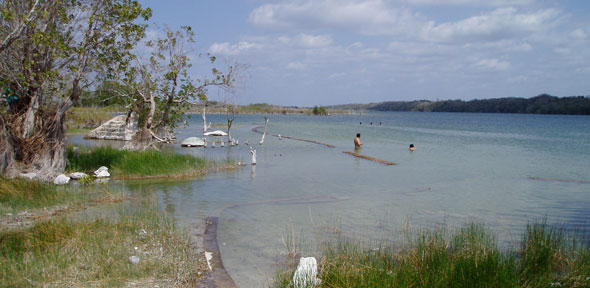
Researchers from the University of Cambridge and the University of Florida developed a method to measure the different isotopes of water trapped in gypsum, a mineral that forms during times of drought when the water level is lowered, in Lake Chichancanab in Mexico’s Yucatán Peninsula where the Maya were based.

Based on these measurements, the researchers found that annual precipitation decreased between 41% and 54% relative to today during the period of the Maya civilisation’s collapse, with periods of up to 70% rainfall reduction during peak drought conditions, and that relative humidity declined by 2% to 7% relative to today. The results are reported in the journal Science.

“The role of climate change in the collapse of Classic Maya civilisation is somewhat controversial, partly because previous records are limited to qualitative reconstructions, for example whether conditions were wetter or drier,” said Nick Evans, a PhD student in Cambridge’s Department of Earth Sciences and the paper’s first author. “Our study represents a substantial advance as it provides statistically robust estimates of rainfall and humidity levels during the Maya downfall.”

Maya civilisation is divided into four main periods: the Preclassic (2000 BCE – 250 CE), Classic (250 CE – 800 CE), terminal Classic (800 – 1000 CE) and Postclassic (1000 CE – 1539 CE). The Classic period was marked by the construction of monumental architecture, intellectual and artistic development, and the growth of large city-states.

During the 9th century however, there was a major political collapse in the central Maya region: their famous limestone cities were abandoned and dynasties ended. And while the Maya people survived beyond this period, their political and economic power was depleted.

There are multiple theories as to what caused the collapse of the Maya civilisation, such as invasion, war, environmental degradation and collapsing trade routes. In the 1990s, however, researchers were able to piece together climate records for the period of the Maya collapse and found that it correlated with an extended period of extreme drought.

Professor David Hodell, Director of Cambridge’s Godwin Laboratory for Palaeoclimate Research and the senior author of the current paper, provided the first physical evidence of a correlation between this period of drought at Lake Chichancanab and the downfall of the Classic Maya civilisation in a paper published in 1995.

Now, Hodell and his colleagues have applied a new method and estimated the extent of this drought. Using a new geochemical method to measure the water locked within gypsum from Chichancanab, the researchers have built a complete model of hydrological conditions during the terminal Classic Period when the Maya collapsed.

The researchers analysed the different isotopes of water trapped within the crystal structure of the gypsum to determine changes in rainfall and relative humidity during the Maya downfall.

They measured three oxygen and two hydrogen isotopes to reconstruct the history of the lake water between 800 and 1000 CE. When gypsum forms, water molecules are incorporated directly into its crystalline structure, and this water records the different isotopes that were present in the ancient lake water at the time of its formation. “This method is highly accurate and is almost like measuring the water itself,” said Evans.

In periods of drought, more water evaporates from lakes such as Chichancanab, and because the lighter isotopes of water evaporate faster, the water becomes heavier. A higher proportion of the heavier isotopes, such as oxygen-18 and hydrogen-2 (deuterium), would indicate drought conditions. By mapping the proportion of the different isotopes contained within each layer of gypsum, the researchers were able to build a model to estimate past changes in rainfall and relative humidity over the period of the Maya collapse.

This quantitative climate data can be used to better predict how these drought conditions may have affected agriculture, including yields of the Maya’s staple crops, such as maize.

The research was supported by the European Research Council.

Reference:
Nicholas P. Evans et al. ‘Quantification of Drought During the Collapse of the Classic Maya Civilization.’ Science (2018). DOI: 10.1126/science.aas9871

Inset image: Lake Chichancanab, the site of the study. Chichancanab means “Little Sea” in Yucatec Maya, reflecting its relatively salty water composed dominantly of calcium and sulfate. (Credit: Mark Brenner)


Creative Commons License
The text in this work is licensed under a Creative Commons Attribution 4.0 International License. Images, including our videos, are Copyright ©University of Cambridge and licensors/contributors as identified.  All rights reserved. We make our image and video content available in a number of ways – as here, on our main website under its Terms and conditions, and on a range of channels including social media that permit your use and sharing of our content under their respective Terms.

Scientists Identify Exoplanets Where Life Could Develop As It Did On Earth

Scientists identify exoplanets where life could develop as it did on Earth

source: www.cam.ac.uk

Scientists have identified a group of planets outside our solar system where the same chemical conditions that may have led to life on Earth exist.

This work brings us just a little bit closer to addressing the question of whether we are alone in the universe.

Paul Rimmer

The researchers, from the University of Cambridge and the Medical Research Council Laboratory of Molecular Biology (MRC LMB), found that the chances for life to develop on the surface of a rocky planet like Earth are connected to the type and strength of light given off by its host star.

Their study, published in the journal Science Advances, proposes that stars which give off sufficient ultraviolet (UV) light could kick-start life on their orbiting planets in the same way it likely developed on Earth, where the UV light powers a series of chemical reactions that produce the building blocks of life.

The researchers have identified a range of planets where the UV light from their host star is sufficient to allow these chemical reactions to take place, and that lie within the habitable range where liquid water can exist on the planet’s surface.

“This work allows us to narrow down the best places to search for life,” said Dr Paul Rimmer, a postdoctoral researcher with a joint affiliation at Cambridge’s Cavendish Laboratory and the MRC LMB, and the paper’s first author. “It brings us just a little bit closer to addressing the question of whether we are alone in the universe.”

The new paper is the result of an ongoing collaboration between the Cavendish Laboratory and the MRC LMB, bringing together organic chemistry and exoplanet research. It builds on the work of Professor John Sutherland, a co-author on the current paper, who studies the chemical origin of life on Earth.

In a paper published in 2015, Professor Sutherland’s group at the MRC LMB proposed that cyanide, although a deadly poison, was in fact a key ingredient in the primordial soup from which all life on Earth originated.

In this hypothesis, carbon from meteorites that slammed into the young Earth interacted with nitrogen in the atmosphere to form hydrogen cyanide. The hydrogen cyanide rained to the surface, where it interacted with other elements in various ways, powered by the UV light from the sun. The chemicals produced from these interactions generated the building blocks of RNA, the close relative of DNA which most biologists believe was the first molecule of life to carry information.

In the laboratory, Sutherland’s group recreated these chemical reactions under UV lamps, and generated the precursors to lipids, amino acids and nucleotides, all of which are essential components of living cells.

“I came across these earlier experiments, and as an astronomer, my first question is always what kind of light are you using, which as chemists they hadn’t really thought about,” said Rimmer. “I started out measuring the number of photons emitted by their lamps, and then realised that comparing this light to the light of different stars was a straightforward next step.”

The two groups performed a series of laboratory experiments to measure how quickly the building blocks of life can be formed from hydrogen cyanide and hydrogen sulphite ions in water when exposed to UV light. They then performed the same experiment in the absence of light.

“There is chemistry that happens in the dark: it’s slower than the chemistry that happens in the light, but it’s there,” said senior author Professor Didier Queloz, also from the Cavendish Laboratory. “We wanted to see how much light it would take for the light chemistry to win out over the dark chemistry.”

The same experiment run in the dark with the hydrogen cyanide and the hydrogen sulphite resulted in an inert compound which could not be used to form the building blocks of life, while the experiment performed under the lights did result in the necessary building blocks.

The researchers then compared the light chemistry to the dark chemistry against the UV light of different stars. They plotted the amount of UV light available to planets in orbit around these stars to determine where the chemistry could be activated.

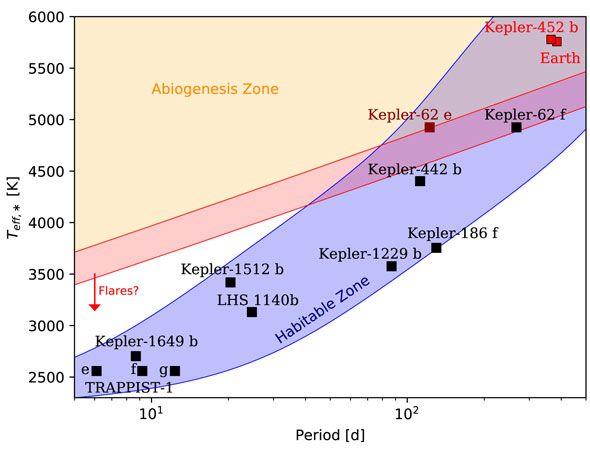
They found that stars around the same temperature as our sun emitted enough light for the building blocks of life to have formed on the surfaces of their planets. Cool stars, on the other hand, do not produce enough light for these building blocks to be formed, except if they have frequent powerful solar flares to jolt the chemistry forward step by step. Planets that both receive enough light to activate the chemistry and could have liquid water on their surfaces reside in what the researchers have called the abiogenesis zone.

Among the known exoplanets which reside in the abiogenesis zone are several planets detected by the Kepler telescope, including Kepler 452b, a planet that has been nicknamed Earth’s ‘cousin’, although it is too far away to probe with current technology. Next-generation telescopes, such as NASA’s TESS and James Webb Telescopes, will hopefully be able to identify and potentially characterise many more planets that lie within the abiogenesis zone.

Of course, it is also possible that if there is life on other planets, that it has or will develop in a totally different way than it did on Earth.

“I’m not sure how contingent life is, but given that we only have one example so far, it makes sense to look for places that are most like us,” said Rimmer. “There’s an important distinction between what is necessary and what is sufficient. The building blocks are necessary, but they may not be sufficient: it’s possible you could mix them for billions of years and nothing happens. But you want to at least look at the places where the necessary things exist.”

According to recent estimates, there are as many as 700 million trillion terrestrial planets in the observable universe. “Getting some idea of what fraction have been, or might be, primed for life fascinates me,” said Sutherland. “Of course, being primed for life is not everything and we still don’t know how likely the origin of life is, even given favourable circumstances – if it’s really unlikely then we might be alone, but if not, we may have company.”

The research was funded by the Kavli Foundation and the Simons Foundation.

Reference:
Paul B. Rimmer et al. ‘The Origin of RNA Precursors on Exoplanets.’ Science Advances (2018). DOI: 10.1126/sciadv.aar3302

Inset image: Diagram of confirmed exoplanets within the liquid water habitable zone (as well as Earth). Credit: Paul Rimmer


Creative Commons License
The text in this work is licensed under a Creative Commons Attribution 4.0 International License. Images, including our videos, are Copyright ©University of Cambridge and licensors/contributors as identified.  All rights reserved. We make our image and video content available in a number of ways – as here, on our main website under its Terms and conditions, and on a range of channels including social media that permit your use and sharing of our content under their respective Terms.

Cambridge Mathematician Awarded 2018 Fields Medal

Cambridge mathematician awarded 2018 Fields Medal

source: www.cam.ac.uk

University of Cambridge mathematician Caucher Birkar has been named one of four recipients of the 2018 Fields medals, the most prestigious awards in mathematics.

Kurdistan was an unlikely place for a kid to develop an interest in mathematics – I’m hoping that this news will put a smile on the faces of those 40 million people.

Caucher Birkar

Professor Birkar, who originally came to the UK as a Kurdish refugee, was given the award today at the International Congress of Mathematicians in Rio de Janeiro, Brazil.

The Fields medals, often called the Nobel Prize of mathematics, are awarded every four years. Medallists must be under the age of 40 by the start of the year they receive the award, with up to four mathematicians honoured at a time. Awarded for the first time in 1936, the medal is recognition for works of excellence and an incentive for new outstanding achievements.

Caucher Birkar from simonsfoundation.org on Vimeo.

Birkar, a member of Cambridge’s Department of Pure Mathematics and Mathematical Statistics, won the award for his work on categorising different kinds of polynomial equations. He proved that the infinite variety of such equations can be split into a finite number of classifications, a major breakthrough in the field of birational geometry. Born in a Kurdish village in pre-revolutionary Iran, Birkar sought and obtained political asylum in the UK while finishing his undergraduate degree in Iran.

“War-ridden Kurdistan was an unlikely place for a kid to develop an interest in mathematics,” Birkar told the ICM today. “I’m hoping that this news will put a smile on the faces of those 40 million people.”

Birkar, who just this year received recognition for his work as one of the London Mathematical Society Prize winners, was born in 1978 in Marivan, a Kurdish province in Iran bordering Iraq with about 200,000 inhabitants. His curiosity was awakened by algebraic geometry, the same interest that, in that same region, centuries earlier, had attracted the attention of Omar Khayyam (1048-1131) and Sharaf al-Din al-Tusi (1135-1213).

After graduating in Mathematics from Tehran University, Birkar went to live in the UK, where he became a British citizen. In 2004, he completed his PhD at the University of Nottingham with the thesis “Topics in modern algebraic geometry”. Throughout his career, birational geometry has stood out as his main area of interest. He has devoted himself to the fundamental aspects of key problems in modern mathematics – such as minimal models, Fano varieties, and singularities. His theories have solved long-standing conjectures.

In 2010, the year in which he was awarded by the Foundation Sciences Mathématiques de Paris, Birkar wrote, alongside Paolo Cascini (Imperial College London), Christopher Hacon (University of Utah) and James McKernan (University of California, San Diego), an article called “Existence of minimal models for varieties of general log type” that revolutionised the field. The article earned the quartet the AMS Moore Prize in 2016.

Founded by the Canadian mathematician John Charles Fields to celebrate outstanding achievements, the Fields Medal has already been awarded to 56 scholars of the most diverse nationalities, among them, Brazilian Fields laureate Artur Avila, an extraordinary researcher from IMPA, awarded in 2014 in South Korea. Due to its importance and prestige, the medal is often likened to a Nobel Prize of Mathematics.

“This is absolutely phenomenal, both for Caucher and for mathematics at Cambridge,” said Professor Gabriel Paternain, Head of the Department of Pure Mathematics and Mathematical Statistics. “Caucher was already an exceptional young researcher when he came to Cambridge, and he’s now one of the most remarkable people in this field. At Cambridge, we want to give all of our young researchers the opportunity to really explore their field early in their career: it can lead to some truly amazing things.”

The winners of the Fields medal are selected by a group of specialists nominated by the Executive Committee of the International Mathematical Union (IMU), which organize the ICMs. Every four years, between two and four researchers under the age of 40 are chosen. Since 2006, a cash prize of 15 thousand Canadian dollars accompanies the medal.

In an interview with Quanta Magazine, Birkar spoke of the math club at Tehran University, where pictures of Fields medallists lined the walls. “I looked at them and said to myself, ‘Will I ever meet one of these people?’ At that time in Iran, I couldn’t even know that I’d be able to go to the West.

“To go from the point that I didn’t imagine meeting these people to the point where someday I hold a medal myself — I just couldn’t imagine that this would come true.”

Professor Birkar is Cambridge’s 11th Fields medallist.

The other three winners of the 2018 Fields medals are Peter Scholze from the University of Bonn, Akshay Venkatesh from the Institute of Advanced Studies and Alessio Figalli from ETH Zurich.


Creative Commons License
The text in this work is licensed under a Creative Commons Attribution 4.0 International License. Images, including our videos, are Copyright ©University of Cambridge and licensors/contributors as identified.  All rights reserved. We make our image and video content available in a number of ways – as here, on our main website under its Terms and conditions, and on a range of channels including social media that permit your use and sharing of our content under their respective Terms.

Hewitsons LLP Sponsors 2018 Cambridge Innovation Summit

Hewitsons LLP is delighted to have sponsored the third annual Cambridge Innovation Summit which took place on 11 July.

The Cambridge Innovation Summit brought together over 100 leading thinkers about innovation processes from businesses and other organisations in the USA, Russia, Japan, Australia and across Europe. Delegates from all of the consortia run by the Cambridge-based Centre for Business Innovation (CfBI) and invited guests worked together on challenges and opportunities which they are experiencing in the innovation landscape.

There were sessions on ‘Global Innovation Processes’ (with discussion leaders from Apple, Facebook, 3M and Lloyds Bank), ‘Innovation for Health and Wellness’ (with discussion leaders from Amadeus Partners, the NHS, Astra Zeneca, Philips and Illumina) and ‘Innovation Made in Cambridge’ (with Professor Tim Minshall leading the discussion), and table-top demonstrations from a number of Cambridge-based innovators.

The world-class networking opportunity culminated with dinner in Trinity Hall addressed by Jane Osbourn of Medimmune on the theme of ‘Why Cambridge for Innovation?’

The following day CfBI consortia for ‘Open Innovation Meets Big Data’, ‘Medical Adherence/Digital Health’, ‘Nano-Carbon Enhanced Materials’ and ‘Corporate Venturing Leadership’ met in private sessions in the Cambridge region.

Andrew Priest, Head of Technology at Hewitsons, says “It was a privilege to once again sponsor and take part in the Cambridge Innovation Summit. The event offered a great insight into why Cambridge continues to attract so many technology businesses and entrepreneurial individuals, offering innovative solutions across many different technology sectors. On the evidence of what we have seen and heard today, Cambridge will continue to be a ‘hotbed’ for technology innovation for many years to come”.

Peter Hewkin CEO of the Centre for Business Innovation says “We are delighted to bring together the members of CfBI’s eight international consortia in Cambridge (UK) each year to inspire, inform and engage them in one of the world’s best innovation clusters”.

Planning has already started for Cambridge Innovation Summit 2019.

Editors notes:

About Hewitsons
Hewitsons is a leading law firm that delivers services with an absolute focus on the interests of each of its clients. It advises businesses, individuals and institutions including charities, educational bodies and the public sector. Hewitsons operates UK-wide and internationally, delivering a broad range of high-quality specialist legal services. Its ability to ensure its clients obtain top-quality advice in other jurisdictions is greatly enhanced by its international network, LawExchange International. The size and depth of its resources mean its clients know that Hewitsons will consistently add value and achieve the very best results for them.

Hewitsons has offices in Cambridge, London, Northampton and Milton Keynes. Our website can be found at www.hewitsons.com

About CfBI
CfBI is a new type of service organisation, headquartered in Cambridge, UK. It creates and facilitates communities whose participants work together in a trusting environment, towards common goals or under a brand which reflects their values and beliefs in order to  ‘do more with less’ in the spirit of open innovation. CfBI’s team has been refining the formula for over fifteen years to help members all over the world to get optimum benefit.

CfBI continues to expand its portfolio of consortia delivering “collaborative advantage” across Europe, the USA and beyond. Leading companies, government departments, research institutes and industry clusters, participate to derive benefit from accelerated learning, project cost sharing, influencing regulators, designing and promoting best practises, training as well as business development.

Read more at www.cfbi.com

The annual Cambridge Innovation Summit is where all of the CfBI’s consortium members come together with invited guests to discuss and help to shape the innovation landscape.

Military Spending Did Not “Crowd Out” Welfare in Middle East Prior to Arab Spring

Military spending did not “crowd out” welfare in Middle East prior to Arab Spring

source: www.cam.ac.uk

Findings dispute “guns versus butter” narrative as a major factor behind the Arab Spring. Researchers caution against uncritically applying lessons from Western nations to interpret public policy decisions in the Middle East.

Policy analysts should not single out military spending as a main culprit for the lack of investment in public goods

Adam Coutts

Research casts doubt on the widely-held view that spiralling military expenditure across the Middle East and North Africa (MENA) “crowded out” investment in healthcare and public services, leading to civil unrest that eventually exploded in the Arab Spring revolutions.

The so-called “guns versus butter” or “welfare versus warfare” hypotheses – that prioritised military spending resulted in neglect of health and education, thereby creating conditions that fomented public rebellion – is considered by many experts to be a root cause of the uprisings that gripped the region during 2011.

However, a team of researchers who analysed economic and security data from MENA nations in the 16 years leading up to the Arab Spring found no evidence of a trade-off between spending on the military and public services, specifically healthcare.

The researchers from Cambridge and the Lebanese American University argue that much of the evidence for the ‘guns versus butter’ causal link come from analyses of wealthy European nations, which has then been assumed to hold true for the Middle East.

They say the study’s findings, published today in the journal Defence and Peace Economics, provide a “cautionary note” against a reliance on simplistic correlations based on data from OECD nations to draw important policy conclusions about the causes of turmoil in the Middle East.

“Our research finds reports of this apparent spending trade-off prior to the Arab Spring to be somewhat spurious,” said Dr Adam Coutts, based at Cambridge University’s Department of Sociology.

“Academics and policy-makers should be careful in assuming that models and results from studies of other regions can be transplanted onto the Middle East and North Africa,” he said.

“Determining the cause of unrest is a rather more complex task than some experts may suggest. Historical experiences and political economy factors need to be considered.”

While only Saudi Arabia is in the top ten global nations for military spending in terms of hard cash, when calculated as a share of GDP six of the top ten military spenders are MENA nations.

Coutts and colleagues ran World Bank data through detailed statistical models to explore the trade-off between spending on military and on welfare – health, in this case – of 18 different MENA nations from 1995 up to the start of the Arab Spring in 2011.

The team also looked at casualties resulting from domestic terror attacks in an attempt to estimate security needs that might have helped drive military spending in a region plagued by terrorism.

They found no statistically significant evidence that increased military spending had an impact on health investment. “Contrary to existing evidence from many European nations, we found that levels of military expenditure do not induce or affect cuts to healthcare in the Middle East and North Africa,” said co-author Dr Adel Daoud from Cambridge’s Centre for Business Research.

The researchers also found no evidence for casualties from terrorism affecting either health or military spending – perhaps a result of the routine nature of such occurrences in the region.

“There may have been a policy adaptation in which regional conflicts and security threats are no longer the main influence on government security and military spending decisions,” said Daoud.

Adam Coutts added: “It has been argued that Arab populations accepted an ‘authoritarian bargain’ over the last forty years – one of societal militarisation in return for domestic security – and that this came at the expense of their welfare and social mobility.

“However, health and military spending cannot be predicted by each other in this troubled region. Policy analysts should not single out military spending as a main culprit for the lack of investment in public goods.

“Once again we find that straightforward explanations for unrest in the Middle East and North Africa are tenuous on close analysis.”


Creative Commons License
The text in this work is licensed under a Creative Commons Attribution 4.0 International License. Images, including our videos, are Copyright ©University of Cambridge and licensors/contributors as identified.  All rights reserved. We make our image and video content available in a number of ways – as here, on our main website under its Terms and conditions, and on a range of channels including social media that permit your use and sharing of our content under their respective Terms.

Cambridge to Appoint DeepMind Chair of Machine Learning

Cambridge to appoint DeepMind Chair of Machine Learning

Code
source: www.cam.ac.uk

The University of Cambridge will establish a DeepMind Chair of Machine Learning, thanks to a benefaction from the world-leading British AI company.

This gift will not only enhance Cambridge’s strengths in the field of AI research, but will benefit the UK more broadly, as AI has such transformative potential in so many aspects of our lives.

Stephen Toope, Vice-Chancellor

The new chair, which will be based at Cambridge’s Department of Computer Science and Technology, will build on the University’s strengths in computer science and engineering, and will be a focal point for the wide range of AI-related research taking place across the University. Cambridge researchers are designing systems that are cybersecure, model human reasoning, interact in affective ways with us, uniquely identify us by our face and give insights into our biological makeup.

The first DeepMind Chair is expected to take up their position in October 2019, following an international search by the department. The chair will have full academic freedom to pursue research in the field of machine learning.

Cambridge has a long tradition of excellence in computer science, and is home to the largest technology cluster in Europe. The DeepMind Chair will build on this tradition by enhancing Cambridge’s capacity in AI-related research, and will contribute to the UK’s standing as a global hub in this rapidly-growing area.

The gift is part of a wider DeepMind programme to encourage uptake of machine learning, to support the wider academic ecosystem. As part of these efforts, DeepMind will give a donation to support four Master’s students from underrepresented groups wishing to study machine learning and computer science at Cambridge. More information will be made available this coming autumn, for scholarships beginning in the 2019 academic year.

Demis Hassabis, DeepMind’s co-founder and CEO, completed his undergraduate degree in computer science at Queens’ College, Cambridge and received his PhD from UCL, while numerous other employees continue to give back to Cambridge through teaching and mentorship.

“I have many happy memories from my time as an undergraduate at Cambridge, so it’s now a real honour for DeepMind to be able to contribute back to the Department of Computer Science and Technology and support others through their studies,” said Hassabis. “My hope is that the DeepMind Chair in Machine Learning will help extend Cambridge’s already world-leading teaching and research capacities, and support further scientific breakthroughs towards the development of safe and ethical AI.”

“This gift will not only enhance Cambridge’s strengths in the field of AI research, but will benefit the UK more broadly, as AI has such transformative potential in so many aspects of our lives,” said Professor Stephen Toope, Vice-Chancellor of the University of Cambridge. “Our researchers are not only developing these new technologies, but are working to ensure that they benefit humanity. This new Professorship is an important piece of that puzzle.”

“This new Professorship will build on our existing strengths and become an important focus for research and teaching in applied AI,” said Professor Ann Copestake, Head of the Department of Computer Science and Technology. “The interdisciplinary environment in the University will help the development of ethical and sustainable AI-based solutions to complex social, economic and environmental challenges.”

Minister for Digital and the Creative Industries Margot James MP said: “The UK already has a global standing in AI and this new post at Cambridge is another string to our bow. Through our Industrial Strategy and £1bn AI sector deal, we are creating the right environment for the technology to be developed in the UK. I welcome any initiative which will help us achieve our aim of making sure it improves our economy and society.”


Creative Commons License
The text in this work is licensed under a Creative Commons Attribution 4.0 International License. Images, including our videos, are Copyright ©University of Cambridge and licensors/contributors as identified.  All rights reserved. We make our image and video content available in a number of ways – as here, on our main website under its Terms and conditions, and on a range of channels including social media that permit your use and sharing of our content under their respective Terms.


New Class of Materials Could Be Used To Make Batteries That Charge Faster

New class of materials could be used to make batteries that charge faster

source: www.cam.ac.uk

Researchers have identified a group of materials that could be used to make even higher power batteries. The researchers, from the University of Cambridge, used materials with a complex crystalline structure and found that lithium ions move through them at rates that far exceed those of typical electrode materials, which equates to a much faster-charging battery.

Fields stagnate if you don’t keep looking for new compounds.

Clare Grey

Although these materials, known as niobium tungsten oxides, do not result in higher energy densities when used under typical cycling rates, they come into their own for fast charging applications. Additionally, their physical structure and chemical behaviour give researchers a valuable insight into how a safe, super-fast charging battery could be constructed, and suggest that the solution to next-generation batteries may come from unconventional materials. The results are reported in the journal Nature.

Many of the technologies we use every day have been getting smaller, faster and cheaper each year – with the notable exception of batteries. Apart from the possibility of a smartphone which could be fully charged in minutes, the challenges associated with making a better battery are holding back the widespread adoption of two major clean technologies: electric cars and grid-scale storage for solar power.

“We’re always looking for materials with high-rate battery performance, which would result in a much faster charge and could also deliver high power output,” said Dr Kent Griffith, a postdoctoral researcher in Cambridge’s Department of Chemistry and the paper’s first author.

In their simplest form, batteries are made of three components: a positive electrode, a negative electrode and an electrolyte. When a battery is charging, lithium ions are extracted from the positive electrode and move through the crystal structure and electrolyte to the negative electrode, where they are stored. The faster this process occurs, the faster the battery can be charged.

In the search for new electrode materials, researchers normally try to make the particles smaller. “The idea is that if you make the distance the lithium ions have to travel shorter, it should give you higher rate performance,” said Griffith. “But it’s difficult to make a practical battery with nanoparticles: you get a lot more unwanted chemical reactions with the electrolyte, so the battery doesn’t last as long, plus it’s expensive to make.”

“Nanoparticles can be tricky to make, which is why we’re searching for materials that inherently have the properties we’re looking for even when they are used as comparatively large micron-sized particles. This means that you don’t have to go through a complicated process to make them, which keeps costs low,” said Professor Clare Grey, also from the Department of Chemistry and the paper’s senior author. “Nanoparticles are also challenging to work with on a practical level, as they tend to be quite ‘fluffy’, so it’s difficult to pack them tightly together, which is key for a battery’s volumetric energy density.”

The niobium tungsten oxides used in the current work have a rigid, open structure that does not trap the inserted lithium, and have larger particle sizes than many other electrode materials. Griffith speculates that the reason these materials have not received attention previously is related to their complex atomic arrangements. However, he suggests that the structural complexity and mixed-metal composition are the very reasons the materials exhibit unique transport properties.

“Many battery materials are based on the same two or three crystal structures, but these niobium tungsten oxides are fundamentally different,” said Griffith. The oxides are held open by ‘pillars’ of oxygen, which enables lithium ions to move through them in three dimensions. “The oxygen pillars, or shear planes, make these materials more rigid than other battery compounds, so that, plus their open structures means that more lithium ions can move through them, and far more quickly.”

Using a technique called pulsed field gradient (PFG) nuclear magnetic resonance (NMR) spectroscopy, which is not readily applied to battery electrode materials, the researchers measured the movement of lithium ions through the oxides, and found that they moved at rates several orders of magnitude higher than typical electrode materials.

Most negative electrodes in current lithium-ion batteries are made of graphite, which has a high energy density, but when charged at high rates, tends to form spindly lithium metal fibres known as dendrites, which can create a short-circuit and cause the batteries to catch fire and possibly explode.

“In high-rate applications, safety is a bigger concern than under any other operating circumstances,” said Grey. “These materials, and potentially others like them, would definitely be worth looking at for fast–charging applications where you need a safer alternative to graphite.”

In addition to their high lithium transport rates, the niobium tungsten oxides are also simple to make. “A lot of the nanoparticle structures take multiple steps to synthesise, and you only end up with a tiny amount of material, so scalability is a real issue,” said Griffith. “But these oxides are so easy to make, and don’t require additional chemicals or solvents.”

Although the oxides have excellent lithium transport rates, they do lead to a lower cell voltage than some electrode materials. However, the operating voltage is beneficial for safety and the high lithium transport rates mean that when cycling fast, the practical (usable) energy density of these materials remains high.

While the oxides may only be suited for certain applications, Grey says that the important thing is to keep looking for new chemistries and new materials. “Fields stagnate if you don’t keep looking for new compounds,” she says. “These interesting materials give us a good insight into how we might design higher rate electrode materials.”

The research was funded in part by the European Union, the Science and Technology Facilities Council, and the Engineering and Physical Sciences Research Council.

Reference: 
Kent J. Griffith et al. ‘Niobium tungsten oxides for high-rate lithium-ion energy storage.’ Nature (2018). DOI: 10.1038/s41586-018-0347-0


Creative Commons License
The text in this work is licensed under a Creative Commons Attribution 4.0 International License. Images, including our videos, are Copyright ©University of Cambridge and licensors/contributors as identified.  All rights reserved. We make our image and video content available in a number of ways – as here, on our main website under its Terms and conditions, and on a range of channels including social media that permit your use and sharing of our content under their respective Terms.

Cambridge Innovation Summit Attracts Global Leaders and Sponsorship From Silicon Valley Bank.

Cambridge Innovation Summit attracts global leaders and sponsorship from Silicon Valley Bank.

The third annual Cambridge Innovation Summit took place on 11 July and was sponsored by Silicon Valley Bank, the bank of the world’s most innovative businesses and their investors. The Cambridge Innovation Summit brought together over 100 leading thinkers about innovation processes from businesses and other organisations in the USA, Russia, Japan, Australia and from across Europe. Delegates from all of the consortia run by the Cambridge-based Centre for Business Innovation (CfBI) and invited guests worked together on challenges and opportunities which they are experiencing in the innovation landscape.

There were sessions on ‘Global Innovation Processes’ (with discussion leaders from Apple, Facebook, 3M and Lloyds Bank), ‘Innovation for Health and Wellness’ (with discussion leaders from Amadeus Partners, the NHS, Astra Zeneca, Philips and Illumina) and ‘Innovation Made in Cambridge’ (with Professor Tim Minshall leading the discussion), and table-top demonstrations from a number of Cambridge-based innovators introduced by Alex McCracken, a Managing Director at Silicon Valley Bank.

The world-class networking opportunity culminated with dinner in Trinity Hall addressed by Jane Osbourn of Medimmune on the theme of ‘Why Cambridge for Innovation?’

The following day CfBI consortia for ‘Open Innovation Meets Big Data’, ‘Medical Adherence/Digital Health’, ‘Nano-Carbon Enhanced Materials’ and ‘Corporate Venturing Leadership’ met in private sessions in the Cambridge region.
Alex McCracken of Silicon Valley Bank commented, “We are impressed with the healthcare and technology innovation that is being developed in Cambridge by startups and corporates. Coupled with an increasing supply of development capital, this bodes well for the Eastern region.We’re delighted to
support the tech ecosystem in Cambridge and across the UK.“

Peter Hewkin CEO of the Centre for Business Innovation says “We are delighted to bring together the members of CfBI’s eight international consortia in Cambridge (UK) each year to inspire, inform and engage them in one of the world’s best innovation clusters”.
Planning has already started for Cambridge Innovation Summit 2019. Editors notes:

About Silicon Valley Bank
For more than 35 years, Silicon Valley Bank has helped innovators, enterprises and their investors move bold ideas forward, fast. Today, we provide a wide range of banking and financing services to businesses of all sizes in innovation centres around the world. SVB Financial Group, the parent company of Silicon Valley Bank, has had a presence in the UK since 2004. The bank is committed to supporting disruptive technology and life science businesses within the UK’s vibrant innovation sector, including Made.com, IMImobile, The Hut Group and Trustpilot. svb.com/uk
Silicon Valley Bank is registered in England and Wales at Alphabeta, 14-18 Finsbury Square, London EC2A 1BR,
UK under No. FC029579. Silicon Valley Bank is authorised and regulated by the California Department of
Business Oversight and the United States Federal Reserve Bank; authorised by the Prudential Regulation
Authority with number 577295; and subject to regulation by the Financial Conduct Authority and limited regulation by the Prudential Regulation Authority. Details about the extent of our regulation by the Prudential Regulation
Authority are available from us on request.
About CfBI
The CfBI is a new type of service organisation, headquartered in Cambridge, UK. It creates and facilitates communities whose participants work together in a trusting environment, towards common goals or under a brand which reflects their values and beliefs in order to ‘do more with less’ in the spirit of open innovation. The CfBI’s team has been refining the formula for over fifteen years to help members all over the world to get optimum benefit.
The CfBI continues to expand its portfolio of consortia delivering “collaborative advantage” across Europe, the USA and beyond. Leading companies, government departments, research institutes and industry clusters, participate to derive benefit from accelerated learning, project cost sharing, influencing regulators, designing and promoting best practises, training as well as business development. All this is in the spirit of ‘open innovation’ with the goal of ‘doing more with less’.

The annual Cambridge Innovation Summit is where all of the CfBI’s consortium members come together with invited guests to discuss and help to shape the innovation landscape.

Scientists Generate Key Life Event In Artificial Mouse ‘Embryo’ Created From Stem Cells

Scientists generate key life event in artificial mouse ‘embryo’ created from stem cells

source: www.cam.ac.uk

The creation of artificial embryos has moved a step forward after an international team of researchers used mouse stem cells to produce artificial embryo-like structures capable of ‘gastrulation’, a key step in the life of any embryo.

Our artificial embryos underwent the most important event in life in the culture dish. They are now extremely close to real embryos

Magdalena Zernicka-Goetz

The team, led by Professor Magdalena Zernicka-Goetz at the University of Cambridge, previously created a much simpler structure resembling a mouse embryo in culture, using two types of stem cells – the body’s ‘master cells’ – and a 3D scaffold on which they can grow.

Now, in a study published today in Nature Cell Biology, Professor Zernicka-Goetz and colleagues have developed the embryo-like structures further, using not just two but three types of stem cells which let them reconstruct a process known as gastrulation, an essential step in which the embryonic cells being self-organising into the correct structure for an embryo to form.

Once a mammalian egg has been fertilised by a sperm, it divides multiple times to generate a small, free-floating ball comprising three types of stem cells. At the stage of development known as the ‘blastocyst’ stage, the particular stem cells that will eventually make the future body – the embryonic stem cells (ESCs) – cluster together inside the embryo towards one end. The other two types of stem cell in the blastocyst are the extra-embryonic trophoblast stem cells (TSCs), which will form the placenta, and primitive endoderm stem cells (PESCs) that will form the yolk sac, ensuring that the foetus’s organs develop properly and providing essential nutrients.

In March 2017, Professor Zernicka-Goetz and colleagues published a study that described how, using a combination of genetically-modified mouse ESCs and TSCs, together with a 3D ‘jelly’ scaffold known as an extracellular matrix, they were able to grow a structure capable of assembling itself and whose development and architecture very closely resembled the natural embryo. There was a remarkable degree of communication between the two types of stem cell: in a sense, the cells were telling each other where in the embryo to place themselves.

However, a key step in the life of the embryo – gastrulation, described by the eminent biologist Lewis Wolpert as “truly the most important time in your life” – was missing. Gastrulation is the point at which the embryo transforms from being a single layer to three layers: an inner layer (endoderm), middle layer (mesoderm) and outer layer (endoderm), determining which tissues or organs the cells will then develop into.

“Proper gastrulation in normal development is only possible if you have all three types of stem cell. In order to reconstruct this complex dance, we had to add the missing third stem cell,” says Professor Zernicka-Goetz. “By replacing the jelly that we used in earlier experiments with this third type of stem cell, we were able to generate structures whose development was astonishingly successful.”

By adding the PESCs, the team was able to see their ‘embryo’ undergo gastrulation, organising itself into the three body layers that all animals have. The timing, architecture and patterns of gene activity reflected that of natural embryo development.

Image: Synthetic embryo like structure with embryonic part generated from the embryonic stem cells (pink) and and extra-embryonic tissues in blue. (Credit: Zernicka-Goetz lab, University of Cambridge)

“Our artificial embryos underwent the most important event in life in the culture dish,” adds Professor Zernicka-Goetz. “They are now extremely close to real embryos. To develop further, they would have to implant into the body of the mother or an artificial placenta.”

The researchers say they should now be in a position to better understand how the three stem cell types interact to enable the embryo to develop, by experimentally altering biological pathways in one cell type and seeing how this affects the behaviour of one, or both, of the other cell types.

“We can also now try to apply this to the equivalent human stem cell types and so study the very earliest events in human embryo development without actually having to use natural human embryos,” says Professor Zernicka-Goetz.

By applying these studies side-by-side, it should be possible to learn a great deal about the fundamental aspects of the first stages of mammalian development. In fact, such comparisons should enable scientists to study events that happen beyond day 14 in human pregnancies, but without using 14-day-old human embryos; UK law permits embryos to be studied in the laboratory only up to this period.

“The early stages of embryo development are when a large proportion of pregnancies are lost and yet it is a stage that we know very little about,” says Professor Zernicka-Goetz. “Now we have a way of simulating embryonic development in the culture dish, so it should be possible to understand exactly what is going on during this remarkable period in an embryo’s life, and why sometimes this process fails.”

The research was funded by the European Research Council and Wellcome.

Reference
Sozen, B et al. Self-assembly of embryonic and two extra-embryonic stem cell types into gastrulating embryo structures. Nature Cell Biology; 23 Jul 2018; DOI: 10.1038/s41556-018-0147-7


Researcher Profile: Dr Berna Sozen

Dr Berna Sozen is living the dream.

Originally from Turkey, she came to Cambridge to join Professor Magdalena Zernicka-Goetz’s team. “During my MSc, as a young passionate researcher-to-be, I was fascinated by her research, which resolves the puzzles in early mammalian life,” she says. “My dream has come true and I have spent several years at Cambridge now.”

Understanding the very early stages of embryo development is important because it may help explain why a significant number of human pregnancies fail at around the time the embryo implants into the wall of the uterus. Key events after implantation stage of embryo development are largely inaccessible to science because they occur in the ‘black box’ of the human uterus even before most women know that they are pregnant.

The research is not always easy, of course – her work with Professor Zernicka-Goetz, growing embryo-like structures from mouse stem cells, really is at the cutting-edge of research – but it can be hugely satisfying.

“Observing these self-developing embryo-like structures under the microscope is so exciting that I do not care even if there is a need to be in lab in the middle of night!” she says. “I still clearly remember the moment that I and my co-author saw these structures for the first time. It was a breath-taking moment. Those moments are what we live for in science.”

Berna is helping contribute to the immense legacy that Cambridge has to offer in embryology and stem cell research.

“I work in the same building where Nobel Laureate Bob Edwards succeeded in fertilising a human egg in vitro. Another Nobel Laureate Sir Martin Evans was the first to culture mouse embryonic stem cells and cultivate them in a laboratory at University of Cambridge,” she says. “These works revolutionised treatments for fertility and laid the foundations for human stem cell research. These great scientists paved the way for Magdalena’s pioneering research in embryology. I feel I couldn’t have been in any better place for my research than this.”

The beautiful images of early embryos produced by Professor Zernicka-Goetz’s team no doubt help inspire Berna’s other passion in life, photography. “Colours and patterns become glamorous behind the lens and I always find the beauty in everything,” she says. “I think this makes me a better biologist!”


Creative Commons License
The text in this work is licensed under a Creative Commons Attribution 4.0 International License. Images, including our videos, are Copyright ©University of Cambridge and licensors/contributors as identified.  All rights reserved. We make our image and video content available in a number of ways – as here, on our main website under its Terms and conditions, and on a range of channels including social media that permit your use and sharing of our content under their respective Terms.

Why We Just Can’t Stop Eating: The Complex Truth Behind Obesity

Why we just can’t stop eating: the complex truth behind obesity

source: www.cam.ac.uk

Obesity is often characterised as nothing more than greed and lack of willpower. The truth is far more complex.

Britain has seen a dramatic transformation in recent years in its attitude towards food. We have gone from being a country ridiculed for its bland, carb-heavy cuisine, for whom the chicken tikka masala was the height of exoticness, to becoming a nation obsessed with food.

But alongside this obsession with food has come a growing understanding of the impact that our diet has on our bodies – not only on our waistlines, but also on conditions such as diabetes, heart disease, cancer, and even dementia.

This relationship between our diet and our weight is simple: you eat too much, you get fat. Hence, some would argue, the solution should be equally simple: you eat less, you lose weight.

If only it were this easy. Anyone who has tried to shed a few pounds – and, crucially, to keep them off – knows that the answer is rarely so straightforward. In fact, even the food – and volume – that we ‘choose’ to eat is influenced by a surprising number of factors.

Read more


Creative Commons License
The text in this work is licensed under a Creative Commons Attribution 4.0 International License. Images, including our videos, are Copyright ©University of Cambridge and licensors/contributors as identified.  All rights reserved. We make our image and video content available in a number of ways – as here, on our main website under its Terms and conditions, and on a range of channels including social media that permit your use and sharing of our content under their respective Terms.

Thatcher Papers for 1988 Reveal Her ‘Deep Enthusiasm’ For the Single Market

Thatcher papers for 1988 reveal her ‘deep enthusiasm’ for the single market

source: www.cam.ac.uk

Margaret Thatcher’s infamous Bruges speech – which helped to coin the phrase ‘Euroscepticism’ – was never intended to be an anti-European diatribe, according to newly-released archive material by the Churchill Archives Centre and the Margaret Thatcher Foundation.

When you read her papers for 1988, you see her sheer level of enthusiasm for the single market.

Chris Collins

Her speechwriting files for Bruges, including drafts and contributions from outsiders, are among more than 40,000 pages of Lady Thatcher’s papers for the year 1988 being opened to the public at Churchill College from Monday.

They show that rather than acting as a call-to-arms for Eurosceptics and attacking the principles behind the single market – of which Thatcher was something of a devotee – her speech was more concerned with the perceived power grab by European Commission chief Jacques Delors, and a possible move to a more ‘federal’ European ‘super-state’.

Historian Chris Collins of the Margaret Thatcher Foundation, the only person to date to have read all 40,000 pages of material being released, said: “She wanted her speech to be about direction, rather than point scoring – and she edges back from attacking the Commission, approaching it in a more intellectual style.

“I know she was uncomfortable about the venue, but we are very lucky in that few of her speeches remain in such a complete form as this.

“When you read her papers for 1988, you see her sheer level of enthusiasm for the single market. She goes up hill and down dale with deep enthusiasm because this is practical Europe, this is how it works together. The role of speechwriter Hugh Thomas – a committed Europhile – is also crucial to consider when looking at this speech from a historical perspective.”

The 1988 papers are the latest of Margaret Thatcher’s reign as Prime Minister from 1979-90 to be made available to scholars, researchers and the general public – alongside the papers of Sir Winston Churchill and hundreds of other leading figures at the Churchill Archives Centre.

As well as Lady Thatcher’s papers surrounding the Bruges speech in September 1988, her personal papers also reveal the emergence of plans for a possible fourth term in office, with no obvious end to Thatcherism in sight at that point.

However, 1988 was not without its problems as the government experienced a large number of backbench rebellions on controversial measures, including many with manifesto authority. When Thatcher met with the Executive of the 1922 Committee in January, she was warned that one of the things they wanted to raise with her was the ‘problem of a large majority in the House of Commons and an inadequate Opposition, leading the government being perceived as dictatorial and insensitive to criticism’.

“Unsurprisingly, when this point was indeed made to her face, Thatcher made an indignant response,” said Collins. “There followed a series of rebellions over benefits and the poll tax which she took very personally as relationships with the Conservative parliamentary party frayed.”

Away from frontline politics, the archives for 1988 also reveal that her husband Denis went through a showbiz reception guest list with a fine tooth-comb, querying whether certain celebrities such as Paul McCartney and David Attenborough should be invited to Number 10 for a gathering of those who would be easily recognised by the public and do Mrs Thatcher much good on TV.

The original list of 45 personalities was too low on numbers thought Lady Thatcher and a much longer list of more than 200 names was drawn up by former culture secretary, John Whittingdale – then political secretary to the Prime Minister.

“He (Whittingdale) was not the grizzled elder statesman of the present day,” said Collins. “This was the young man whose evening was spent watching Meatloaf at the Hammersmith Odeon and whose idea of a good party was to invite Paul McCartney, Freddie Mercury and the Jaggers.

Whittingdale, perhaps, did not count on the scrutinous eye of Denis Thatcher – who attacked the proposed guest list with no small amount of red ink, marking ticks against those he ‘would personally like to see included’ and question marks beside ‘those who, I believe, do not help’.

He went on to say: “Whilst I accept of course that not everyone who comes to our receptions are necessarily on ‘our’ side I find it both unpleasant and embarrassing to entertain those who publicly insult the PM. This list needs some careful checking in this regard.”

His favourite name of those listed was comedian Eric Sykes who gained an expansive four ticks. Others to receive enthusiastic backing from Denis included Andrew Lloyd-Webber, Dame Judi Dench, Nick Faldo and Rolf Harris.

McCartney and Attenborough were not alone in having question marks placed next to their name. Sebastian Coe, Shirley Bassey and magician Paul Daniels all fell foul of Denis’ red pen.

In the end, the longer guest list was dropped in favour of the original 45 and the British Winter Olympic Squad – minus Eddie ‘The Eagle’ Edwards, who was double booked and unable to attend.


Creative Commons License
The text in this work is licensed under a Creative Commons Attribution 4.0 International License. Images, including our videos, are Copyright ©University of Cambridge and licensors/contributors as identified.  All rights reserved. We make our image and video content available in a number of ways – as here, on our main website under its Terms and conditions, and on a range of channels including social media that permit your use and sharing of our content under their respective Terms.

Six Cambridge academics elected To Prestigious British Academy Fellowship

Six Cambridge academics elected to prestigious British Academy fellowship

source: www.cam.ac.uk

Six academics from the University of Cambridge have been made Fellows of the prestigious British Academy for the humanities and social sciences.

As having something of a renegade academic status, I am only delighted and honoured to be elected to the Academy.

Christopher Evans

They are among 76 distinguished scholars to be elected to the fellowship in recognition of their work in the fields of archaeology, history, law, politics and prison reform.

The Cambridge academics made Fellows of the Academy this year are:

  • Christopher Evans (Department of Archaeology) is to be elected to the fellowship in recognition of his work on some of the most important archaeological field projects undertaken in this country since the growth of development-led archaeology
  • Professor Martin Jones (Department of Archaeology) is to be elected to the fellowship in recognition of his work in the field of in the field of archaeobotany
  • Professor Joya Chatterji (Faculty of History) is to be elected to the fellowship in recognition of her work on South Asian history, specifically the history of the India/Pakistan Partition of 1947
  • Professor Brian Cheffins (Faculty of Law) is to be elected to the fellowship in recognition of his work on the application of economic analysis to the area of company law
  • Professor David Runciman (Department of Politics and International Studies) is to be elected to the fellowship in recognition of his work on the history of political thought (from Hobbes through to late nineteenth and twentieth century political thought); theories of the state and political representation; and contemporary politics and political theory
  • Professor Alison Liebling (Director of the Prisons Research Centre) is to be elected to the fellowship in recognition of her work on studying prisons, specifically the internal social order of prisons.

They join the British Academy, a community of over 1400 of the leading minds that make up the UK’s national academy for the humanities and social sciences. Current Fellows include the classicist Dame Mary Beard, the historian Sir Simon Schama and philosopher Baroness Onora O’Neill, while previous Fellows include Sir Winston Churchill, C.S Lewis, Seamus Heaney and Beatrice Webb.

Christopher Evans said: “As having something of a renegade academic status, I am only delighted and honoured to be elected to the Academy.”

Professor Martin Jones said: “It is a real privilege to join the Academy at a time when the humanities and social sciences have more to offer society than ever before.”

This year marks the largest ever cohort of new Fellows elected to the British Academy for their distinction in the humanities and social sciences.

As well as a fellowship, the British Academy is a funding body for research, nationally and internationally, and a forum for debate and engagement.

Professor Sir David Cannadine, President of the British Academy, said: “I am delighted to welcome this year’s exceptionally talented new Fellows to the Academy. Including historians and economists, neuroscientists and legal theorists, they bring a vast range of expertise, insights and experience to our most distinguished fellowship.

“The election of the largest cohort of Fellows in our history means the British Academy is better placed than ever to help tackle the challenges we all face today. Whether it’s social integration or the ageing society, the future of democracy or climate change, Brexit or the rise of artificial intelligence, the insights of the humanities and social sciences are essential as we navigate our way through an uncertain present into what we hope will be an exciting future.

“I extend to all of our new Fellows my heartiest congratulations and I look forward to working closely with them to build on the Academy’s reputation and achievements.”


Creative Commons License
The text in this work is licensed under a Creative Commons Attribution 4.0 International License. Images, including our videos, are Copyright ©University of Cambridge and licensors/contributors as identified.  All rights reserved. We make our image and video content available in a number of ways – as here, on our main website under its Terms and conditions, and on a range of channels including social media that permit your use and sharing of our content under their respective Terms.

Underdogs, Curses and ‘Neymaresque’ Histrionics: Cambridge University Press Reveals What’s Been Getting Us Talking This World Cup

Underdogs, curses and ‘Neymaresque’ histrionics: Cambridge University Press reveals what’s been getting us talking this World Cup

source: www.cam.ac.uk

Cambridge University Press has revealed the results of its global study into the language used around the 2018 FIFA World Cup in Russia.

The huge amount of language data we’ve collected and analysed gives us fascinating insight into the mood surrounding the World Cup.

Laura Grimes

There has been no shortage of surprises during this year’s competition, and this shines through in the language data. Expressions such as premature exit reflect that several of the predicted favourites haven’t fared as well as expected, with the odd unforgivable blunder making an appearance, too.

Building on similar research conducted during the 2014 World Cup, the Press has mined over 12 million words of media coverage, to analyse the language used when discussing the various teams over the course of this year’s tournament.

Comparison with the language collected in 2014 shows that, whilst traditionally successful teams such as Brazil have gone from stylish to nervous and Argentina from having flair to struggling, World Cup 2018 underdogs such as England have gone from being inexperienced to confident.

The data reflects that several teams have defied expectations – the word underdogsfeatures frequently in media reports, along with related language like plucky, determined, and punch above their weight also making an appearance.

As fans root for their home teams, the verb overcome is commonly found alongside words such as obstacles, hurdles and adversity. Even England’s long-standing penalty curse has been overcome, whereas previous champions Germany fell victim to the curse of the holders.

The introduction of Video Assisted Referee (VAR) technology has seemingly been met with mixed feelings, as it is commonly associated with words such as controversy, overturnand incident.

Despite the introduction of VAR, however, bad behaviour still abounds; the word histrionics is prominent in the data – often found alongside adjectives such as ridiculous, headline-grabbing, and amateurish. A new term has even been coined this year: neymaresque.

As well as analysing the language used by journalists and media commentators, The Press has also been asking fans to submit the words they would use to describe their national teams.

Laura Grimes, senior ELT research manager at Cambridge University Press, said: “It’s been great to see the correlation between the language used by the media and the descriptive words submitted by football fans. We’ve combined these two datasets to select the three words most strongly associated with each team.

“The huge amount of language data we’ve collected and analysed gives us fascinating insight into the mood surrounding the World Cup. It’s been a dramatic and surprising tournament and this is certainly reflected by the language used in the media, as well as by football fans.”

The Press is still inviting submissions for the public’s top three words to describe each national team. To contribute, simply visit www.cambridge.org/word-cup, click on any country and enter the three words you feel best describes this team.

Once submitted, you’ll be taken to a page that is updated in real time and shows the most popular words that have been submitted in a word cloud.


Creative Commons License
The text in this work is licensed under a Creative Commons Attribution 4.0 International License. Images, including our videos, are Copyright ©University of Cambridge and licensors/contributors as identified.  All rights reserved. We make our image and video content available in a number of ways – as here, on our main website under its Terms and conditions, and on a range of channels including social media that permit your use and sharing of our content under their respective Terms.

Bridging The Divide: Philosophy Meets Science

Bridging the divide: philosophy meets science

source: www.cam.ac.uk

A unique three-year project to bridge the divide between science and philosophy – which embedded early-career philosophers into some of Cambridge’s ground-breaking scientific research clusters – is the subject of a new film released today.

Academics in the humanities as well as the sciences are beginning to appreciate some of the difficulties arising from the extreme degrees of specialisation – where we are losing the ability to talk to each other.

Daniel De Haan

The Templeton World Charity Foundation Project, spearheaded by Professor Sarah Coakley, the Norris-Hulse Professor of Divinity at Cambridge, saw three postdoctoral researchers placed into science labs around the University with the aim of addressing the ever-widening gap between those working in the fields of science and those working in fields of philosophy and theology.

For three years, Daniel De Haan, Natalja Deng and Peter Woodford worked side-by-side with colleagues from the Department of Experimental Psychology, the Department of Applied Mathematics and Theoretical Physics (DAMTP) and the Department of Zoology respectively – taking part in cutting-edge research, and being mentored by world-leading thinkers in their subject fields.

It is hoped that the huge success of this project – which saw unusually deep philosophical engagement with working scientists – will be a catalyst for similar experiments both in Cambridge and beyond.

Professor Coakley said: “Top level, path-breaking science can often go on in universities without any connections to the history and philosophy of science which is coming at the same material from a different direction. The philosophical questions are enormously pressing so we were delighted that some truly leading scientists at Cambridge were open to the possibility of having our three young researchers embedded with them.”

Dr Peter Woodford, who worked both in Cambridge’s Zoology labs and in the field in Africa to look at cooperation among meerkats, what makes them behaves the way they do, and how we as humans understand the value of selflessness, altruism and the care of others.

He said: “It was obviously a unique experience for any philosopher to have, seeing what animals are doing in their natural environment and asking why animals do what they do – that’s a central question of philosophy as well as science. The value of pursuing these big questions is to understand what we believe and why we believe it in a better way.”

Dr Natalja Deng, who worked on the cosmology strand of the project, alongside colleagues in DAMPT, said: “What does it mean to ask if God exists? And what does it mean to say that the universe had a beginning? If you ask yourself questions like this, you are doing philosophy.

“In order to do that, you need to talk to both theologians and physicists. They may not be used to talking to one another, but that’s all the more reason to bring them together in conversation. We were an experiment for this.”

Dr De Haan looked at the connections between cognitive neuroscience, psychology and philosophy for his strand of the project. As with his other Templeton colleagues, Daniel received formal training in his chosen subject areas to ensure they were up to date with the latest research and scientific developments in that particular field.

He said: “It was enormously helpful to spend time seeing what the day-to-day routines are, working in a lab and attending lectures. The people in my lab were open to the idea of having someone around from a different background and a different perspective.

“Academics in the humanities as well as the sciences are beginning to appreciate some of the difficulties arising from the extreme degrees of specialisation – where we are losing the ability to talk to each other.”

Added Coakley: “I’m more happy than I could have hoped. This was a unique experiment in how to create a new generation of scholars to learn this agility early in their careers and we have shown that if it’s possible in one of the top universities in the world for scientific and mathematical endeavour, it should be possible in other places, too.”


Creative Commons License
The text in this work is licensed under a Creative Commons Attribution 4.0 International License. Images, including our videos, are Copyright ©University of Cambridge and licensors/contributors as identified.  All rights reserved. We make our image and video content available in a number of ways – as here, on our main website under its Terms and conditions, and on a range of channels including social media that permit your use and sharing of our content under their respective Terms.

Baby’s Sex Affects Mother’s Metabolism and May Influence Risk of Pregnancy-Related Complications

Baby’s sex affects mother’s metabolism and may influence risk of pregnancy-related complications

source: www.cam.ac.uk

The sex of a baby controls the level of small molecules known as metabolites in the pregnant mother’s blood, which may explain why risks of some diseases in pregnancy vary depending whether the mother is carrying a boy or a girl, according to new research from the University of Cambridge.

In pregnancy and childbirth, the sex of the baby is at the forefront of many parents’ minds, but we do not even think of the placenta as having a sex

Gordon Smith

The findings, published today in JCI Insight, help to explain, for example, why male babies in the womb may be more vulnerable to the effects of poor growth, and why being pregnant with a girl may lead to an increased risk of severe pre-eclampsia for the mother.

A team led by researchers at the Department of Obstetrics and Gynaecology, NIHR Cambridge Biomedical Research Centre, performed detailed scientific studies of more than 4,000 first time mothers and analysed samples of placenta and maternal blood.

They found that the genetic profile of the placentas of male and female babies were very different in relation to the baby’s sex. Many of the genes that differed according to the sex of the baby in the placenta had not previously been seen to differ by sex in other tissues of the body.

The team found that one of these uniquely sex-related placental genes controlled the level of a small molecule called spermine. Spermine is a metabolite – a substance involved in metabolism – that plays an important role in all cells and is even essential for the growth of some bacteria.

Female placentas had much higher levels of the enzyme that makes spermine, and mothers pregnant with baby girls had higher levels of a form of spermine in their blood compared to mothers pregnant with baby boys.

Placental cells from boys were also found to be more susceptible to the toxic effects of a drug that blocked spermine production. This provided direct experimental evidence for sex-related differences in the placental metabolism of spermine.

The researchers also found that the form of spermine which was higher in mothers pregnant with a girl was also predictive of the risk of pregnancy complications: high levels were associated with an increased risk of pre-eclampsia (where the mother develops high blood pressure and kidney disease), whereas low levels were associated with an increased risk of poor fetal growth.

The patterns observed were all consistent with previous work which has shown that boys may be more vulnerable to the effects of fetal growth restriction and that being pregnant with a girl may lead to an increased risk of severe preeclampsia.

“In pregnancy and childbirth, the sex of the baby is at the forefront of many parents’ minds, but we do not even think of the placenta as having a sex. This work shows that the placenta differs profoundly according to sex,” says Professor Gordon Smith from the University of Cambridge, who led the study.

“These differences alter elements of the composition of the mother’s blood and may even modify her risk of pregnancy complications. Better understanding of these differences could lead to new predictive tests and possibly even new approaches to reducing the risk of poor pregnancy outcome.”

The work was supported by NIHR Cambridge Biomedical Research Centre and the Medical Research Council.

Reference
Gong, S et al. Placental polyamine metabolism differs by fetal sex, fetal growth restriction, and preeclampsia. JCI Insight; 12 July 2018; DOI: 10.1172/jci.insight.120723


Creative Commons License
The text in this work is licensed under a Creative Commons Attribution 4.0 International License. Images, including our videos, are Copyright ©University of Cambridge and licensors/contributors as identified.  All rights reserved. We make our image and video content available in a number of ways – as here, on our main website under its Terms and conditions, and on a range of channels including social media that permit your use and sharing of our content under their respective Terms.

Legislating labour in the long run – how worker rights help economies

Legislating labour in the long run – how worker rights help economies

source: www.cam.ac.uk

Researchers have built the single largest dataset of employment laws – spanning more than 100 countries across much of post-war history – to look at how worker rights affect economies over decades.

Complex data of this nature may well prove helpful when exploring crucial issues for the future of society, such as how to combine social justice with economic growth

Simon Deakin

There’s a familiar story that goes something like this: the post-war consensus was one of heavy regulation, dominant trade unions and the same job for life; then, in the 1980s, free market forces were unleashed, and regulation came to be viewed as a ‘market distortion’ that stifled productivity.

By the start of the 1990s, deregulation was a cornerstone of the emergent ‘Washington Consensus’, and worker protection and unions were in steep decline. Legal reforms to ‘free up’ the labour market were declared a route to prosperity by international bodies such as the OECD and World Bank.

Now, a decade on from a global economic crash, and the mood music may again be changing. Issues of inequality and migrant labour are destabilising politics, while all-conquering technology companies are driving new and more flexible – as well as precarious – ways of working.

Last year, for the first time in a generation, both major UK parties went into an election with manifestos that argued free market forces alone were not sufficient to achieve the desired levels of productivity and social cohesion.

From time limits on working to minimum wages, from dismissal rights for workers to legal support for strikes, the extent to which labour regulations engender flourishing or sclerotic economies is a major policy question that is now firmly back on the table.

Helpfully, a research project compiling the largest ever dataset of employment regulationsfrom countries representing over 95% of world GDP (117 nations) tracked across a 44-year period (from 1970 to 2013) is now beginning to publish findings. The team has made the data open access for other researchers to use.

Ten years (with various intermissions) in the making, the project involved around 20 legal, economic and statistical researchers – from senior academics to PhD students and postdocs – pulling together numerous data sources before refining the analysis with sophisticated regression models based on equations created by Cambridge economists in the 1990s.

One constant, however, has been Simon Deakin, Director of the Centre for Business Research, Professor of Law at the Faculty of Law and Co-Chair of the University’s Public Policy Strategic Research Initiative.

“What we’ve ended up with is a vast dynamic dataset – a concrete product with implications for big policy debates, not least whether legislating to strengthen worker rights helps or hinders different types of economies,” says Deakin.

“Complex data of this nature may well prove helpful when exploring crucial issues for the future of society, such as how to combine social justice with economic growth. It’s really a question of the kind of global society we want.”

The datasets tell a story that contrasts to some extent with the familiar political story that most of us recognise.

It goes something like this: despite the massive deregulation that accompanied economic liberalisation in the 1980s – spreading through former Soviet territories as well as into the global South during the 1990s – employment protection laws became gradually stronger over time pretty much everywhere.

“Even during the Thatcher years – while trade union laws were certainly dismantled – we don’t see significant weakening in individual protection laws governing areas such as termination of employment, for example,” says Deakin.

Moreover, after controlling for all other effects, the data suggest that this increase in employment protection that most countries and regions experienced during much of post-war history appeared to have no negative impact on their economies.

In fact, the team found small but positive correlations between stronger protective legislation and beneficial social and economic outcomes. This was seen in overall levels of employment, in increased labour productivity and in the amount of national income going to workforce wages rather than to capital profit.

Some of these positives may be the result of a “virtuous circle” in the long run, argues Deakin. Employment regulations can create short-term shocks: labour costs go up, leading to recruitment freezes or even lay-offs.

In the medium term, however, firms invest in new technologies and in training workers to use them. This improves morale, job security and productivity, while workers and their employers co-invest in learning and sharing knowledge – it’s called a “capital deepening” effect. “Innovation is connected to the way we regulate the labour market,” Deakin suggests.

He offers some important caveats. The positive coefficients seen in the data are small, conclusions can’t be drawn about any single nation and empirically it’s not straightforward to infer causation from correlation. “This is the first time anyone’s done this for so many countries over such a long period; much more work is needed to extend the analysis, including studies of individual countries.”

In addition, the bigger picture remains one of widening inequality and shrinking labour share – as illustrated by another time-series dataset the researchers have been working on: the shifting legal protections of shareholders.

“Labour rights are fighting a constant headwind across the decades,” says Deakin. “Worker protections gradually get a bit stronger over time, while shareholder rights start to rocket from the early 1990s – across the West but also in China and Russia.

“When you put these datasets together you can see labour weakening significantly compared with capital. However, we can say that the labour share would have gone down even further were it not for the strengthening in employment protection law.”

The only dip of real note in the otherwise steady uptick of global employment regulation is found in Europe following the 2008 crash. The data show that labour protection laws became entangled in the Eurozone’s austerity drive, particularly in “debtor nations” such as Greece and Portugal.

“A reactionary resurgence of Washington-Consensus-style thinking post-crash resulted in minor rolling back of employment protections in Europe, but this approach is short-termist and I doubt there’s any real economic evidence for its effectiveness,” he says.

While liberalising legislation is often combined with new worker protections, as seen in Italy’s Jobs Act of 2014 or Germany’s controversial Hartz IV in the mid-2000s, reforms such as these loosened rules around ‘nonstandard’ employment: fixed-term and temporary work.

The rise of this type of work – along with new notions of self-employment through digital platforms – make up the so-called gig economy of often-piecemeal and insecure employment.

How labour relations in this economy are regulated may prove to be a crucible for policymaking in many countries in the future. Deakin sees potential similarities within the dataset and beyond.

“The gig economy is an issue that’s exploded in recent years, but our data show similar debates around labour law when part-time and agency work dramatically expanded 30 years ago and people needed better protection.

“You could even argue similarities to the late 18th century with factory expansion. At various points in history, labour law comes under pressure from technological innovation, an oversupply of labour or a loss of collective power. Traditional forms of regulation start to look worn.

“But the law evolves. We’re starting to see this with the designation of Uber drivers as ‘limb b’ workers: dependent to some extent on an employer, with accompanying rights.” There are parallels between ‘limb b’ and the introduction of part-time and temporary work in the 1980s, argues Deakin – “but the law caught up then and will do so again”.

“The law, society and technology often evolve out of sync. Sometimes the law actually triggers advancement, such as the commercialisation of intellectual property rights contributing to innovation in IT and pharmaceuticals. You need to take a broad historical perspective to gauge these interactions, which is exactly what our research allows.”

Inset image: read more about our research on the topic of work in the University’s research magazine; download a pdf; view on Issuu.


Creative Commons License
The text in this work is licensed under a Creative Commons Attribution 4.0 International License. Images, including our videos, are Copyright ©University of Cambridge and licensors/contributors as identified.  All rights reserved. We make our image and video content available in a number of ways – as here, on our main website under its Terms and conditions, and on a range of channels including social media that permit your use and sharing of our content under their respective Terms.

Cambridge Partners With Industry Leaders To Fund Research on Global Sustainability Challenges

Cambridge partners with industry leaders to fund research on global sustainability challenges

source: www.cam.ac.uk
The Prince of Wales Global Sustainability Fellowship Programme represents a multi-million-pound commitment from the private sector to accelerate progress on UN Sustainable Development Goals.

The Prince of Wales Global Sustainability Fellowship Programme will create a rich intellectual space for collaboration between researchers and industry as we seek breakthrough ideas and leadership actions towards meeting the UN Sustainable Development Goals.

Polly Courtice

The Cambridge Institute for Sustainability Leadership (CISL) is launching The Prince of Wales Global Sustainability Fellowship Programme today (11 July), with the support of some of the UK’s leading companies. The programme will attract researchers from around the world to identify solutions to meet the UN Sustainable Development Goals (SDGs).

In a unique model for the University, up to 15 Prince of Wales Global Sustainability Fellows will be appointed to undertake three-year studies to mobilise global evidence on the world’s most pressing challenges, enabling companies and policymakers to build a more sustainable economy.

Founding sponsors of the Fellowship Programme include Anglian Water, Asda, AstraZeneca, The Equal Opportunities Foundation, Heathrow Airport Holdings, Paul and Michelle Gilding, Sainsbury’s, Sappi and Unilever.

As a tribute to his 70th birthday year, and in recognition of his lifetime’s dedication to environmental issues, the Fellowship Programme is named in honour of CISL’s Patron The Prince of Wales.

This effort is even more urgent given the UN’s announcement last week that progress on the SDGs has been slow and not on track to reach its 2030 targets.

“Universities contribute to society through the creation of new knowledge and the development of new skills,” said Professor Stephen Toope, Vice-Chancellor of the University of Cambridge. “It is our aspiration to do this in ways that are relevant and purposeful. The Prince of Wales Global Sustainability Fellowship Programme, hosted by the University of Cambridge Institute for Sustainability Leadership, will help us to do just that by allowing academics to engage productively with business, government and financial institutions for society’s benefit – both in the UK and globally.”

The SDGs were launched in 2015 to provide a global framework for development with 17 Goals to be achieved by 2030, such as ending poverty, tackling inequality and climate change. Governments have cited the critical role of the private sector in delivering the Goals.

“The Prince of Wales Global Sustainability Fellowship Programme will create a rich intellectual space for collaboration between researchers and industry as we seek breakthrough ideas and leadership actions towards meeting the UN Sustainable Development Goals,” said Polly Courtice, Director of CISL.

“Sainsbury’s are proud to be founding supporters of this Fellowship Programme and to have the opportunity to assess the evidence and potential for our business to play a more active and positive role in the communities we serve and source from,” said Mike Coupe, Group Chief Executive, Sainsbury’s.

“AstraZeneca is proud to be part of the Prince of Wales Global Sustainability Fellowship Programme, supporting research to positively impact SDG 3; Good health and wellbeing,” said Katarina Ageborg, Executive Vice-President, Sustainability and Chief Compliance Officer, AstraZeneca. “By supporting a research Fellow to review the academic evidence for non-communicable disease prevention, we look forward to understanding and sharing more about the policies, practices and innovations necessary to deliver the economic and human benefits of sustainable health.”

“Meeting the UN SDGs will require the biggest transformation the world has ever faced and it will take all stakeholders to pull it off: governments, the private sector, civil society and academia,” said Lise Kingo, CEO & Executive Director, United Nations Global Compact. “The Prince of Wales Global Sustainability Fellowship Programme will provide a critical meeting point for the exchange of ideas in the development of solutions, and the evidence base for the urgent action that is required.”


Creative Commons License
The text in this work is licensed under a Creative Commons Attribution 4.0 International License. Images, including our videos, are Copyright ©University of Cambridge and licensors/contributors as identified.  All rights reserved. We make our image and video content available in a number of ways – as here, on our main website under its Terms and conditions, and on a range of channels including social media that permit your use and sharing of our content under their respective Terms.

Making Sense of Cancer’s ‘Big Data’ Problem To Revolutionise Patient Care

Making sense of cancer’s ‘big data’ problem to revolutionise patient care

source: www.cam.ac.uk
A new institute at the University of Cambridge aims to revolutionise cancer care by using cutting edge analytics to maximize the use of big data sets collected from patients.

Integrated cancer medicine offers the promise of turning the tsunami of data generated in medical practice into an extraordinarily powerful but practical tool for patient benefit

Richard Gilbertson

The Mark Foundation Institute for Integrated Cancer Medicine, announced today, will be funded by an £8.6 million award to the University of Cambridge from The Mark Foundation for Cancer Research – the first time that the New York-based philanthropic organisation has made an award to a UK institution.

The virtual institute aims to exploit recent advances in big data processing and machine learning to capture and integrate clinical, genomic, and image data collated from hundreds of cancer patients in real-time. Laboratory and clinic-based researchers and data experts will work together to determine whether sophisticated computational integration of all these diverse data types into a single platform can inform and predict the best treatment decisions for each individual patient.

Blood tests, biopsies, medical imaging, and genetic tests are a routine part of current cancer care; however, it is not always clear which of these increasingly large datasets are most important in guiding treatment at specific points in the patient journey.

“Doctors have long dreamed of an objective system that can integrate all the results generated from their cancer patients, guiding comprehensive treatment decisions both for current treatment and to predict how a particular disease will behave in the future,” explains Professor Richard Gilbertson, Director of the Cancer Research UK Cambridge Centre where the new institute will be based.

“This is essentially an enormous mathematical problem that requires state-of-the art computational and machine learning approaches to solve. It is this problem that our new institute, funded by a visionary award from The Mark Foundation for Cancer Research, will seek to address.”

With the help of artificial intelligence and machine learning approaches, the new institute will build and interrogate common data platforms and translate insights gained into principles for guiding timely clinical decision making.

“Integrated cancer medicine offers the promise of turning the tsunami of data generated in medical practice into an extraordinarily powerful but practical tool for patient benefit. This should enable us to deliver conventional and novel cancer treatments more effectively, and learn constantly from each patient through iterative analysis, as we refine and improve care for the future,” adds Professor Gilbertson.

The researchers involved in these studies plan to use existing breast cancer clinical trials to test the concept of synthesising different types of data to produce results that improve clinical decisions for patients during the course of their treatment. If successful, this approach will be extended to other disease types.

Dr Michele Cleary, CEO of The Mark Foundation for Cancer Research said: “We are delighted to support this bold and innovative research at the University of Cambridge.  The maximal use of patient data holds tremendous promise to offer better outcomes to patients and their families.  Cambridge scientists are at the forefront of the field in this regard and are well positioned to accelerate optimal approaches for personalised cancer medicine.”


Creative Commons License
The text in this work is licensed under a Creative Commons Attribution 4.0 International License. Images, including our videos, are Copyright ©University of Cambridge and licensors/contributors as identified.  All rights reserved. We make our image and video content available in a number of ways – as here, on our main website under its Terms and conditions, and on a range of channels including social media that permit your use and sharing of our content under their respective Terms.

The Gaia Sausage: The Major Collision That Changed the Milky Way

The Gaia Sausage: the major collision that changed the Milky Way

source: www.cam.ac.uk

An international team of astronomers has discovered an ancient and dramatic head-on collision between the Milky Way and a smaller object, dubbed ‘the Sausage galaxy’. The cosmic crash was a defining event in the early history of the Milky Way and reshaped the structure of our galaxy, fashioning both the galaxy’s inner bulge and its outer halo, the astronomers report in a series of new papers.

These Sausage stars are what’s left of the last major merger of the Milky Way.

Wyn Evans

The astronomers propose that around eight to 10 billion years ago, an unknown dwarf galaxy smashed into our own Milky Way. The dwarf did not survive the impact. It quickly fell apart, and the wreckage is now all around us.

“The collision ripped the dwarf to shreds, leaving its stars moving on very radial orbits, like needles,” said Vasily Belokurov of the University of Cambridge and the Center for Computational Astrophysics at the Flatiron Institute in New York City. “These stars’ paths take them very close to the centre of our galaxy. This is a tell-tale sign that the dwarf galaxy came in on a really eccentric orbit and its fate was sealed.”

The salient features of this extraordinary event are outlined in several new papers, some of which were led by Cambridge graduate student GyuChul Myeong. He and colleagues used data from the European Space Agency’s Gaia satellite. This spacecraft has been mapping the stellar content of our galaxy, recording the journeys of stars as they travel through the Milky Way. Thanks to Gaia, astronomers now know the positions and trajectories of our celestial neighbours with unprecedented accuracy.

“The paths of the stars from the galactic merger earned the moniker ‘Gaia Sausage’,” said Wyn Evans of Cambridge’s Institute of Astronomy. “We plotted the velocities of the stars, and the sausage shape just jumped out at us. As the smaller galaxy broke up, its stars were thrown out on very radial orbits. These Sausage stars are what’s left of the last major merger of the Milky Way.”

There are ongoing mergers taking place right now, such as between the puny Sagittarius dwarf galaxy and the Milky Way. However, the Sausage galaxy was much more massive. Its total mass in gas, stars and dark matter was more than 10 billion times the mass of our sun. When it crashed into the young Milky Way, it caused a lot of mayhem. The Sausage’s piercing trajectory meant that the Milky Way’s disk was probably puffed up or even fractured following the impact, and the Milky Way had to re-grow a new disk. At the same time, the Sausage debris was scattered all around the inner parts of the Milky Way, creating the ‘bulge’ at the galaxy’s centre and the surrounding ‘stellar halo’.

“Numerical simulations of the galactic smash-up can reproduce these features,” said Denis Erkal of the University of Surrey. In simulations ran by Erkal and colleagues, stars from the Sausage galaxy enter stretched out orbits. The orbits are further elongated by the growing Milky Way disk, which swells and becomes thicker following the collision.

“Evidence of this galactic remodelling is seen in the paths of stars inherited from the dwarf galaxy,” said Alis Deason of Durham University. “The Sausage stars are all turning around at about the same distance from the centre of the Galaxy. These U-turns cause the density in the Milky Way’s stellar halo to drop dramatically where the stars flip directions.” This discovery was especially pleasing for Deason, who predicted this orbital apocentric pile-up almost five years ago.

The new research also identified at least eight large, spherical clumps of stars called globular clusters that were brought into the Milky Way by the Sausage galaxy. Small galaxies do not normally have globular clusters of their own, so the Sausage galaxy was big enough to host its own entourage of clusters.

“While there have been many dwarf satellites falling onto the Milky Way over its life, this was the largest of them all,” said Sergey Koposov of Carnegie-Mellon University, who has been studying the kinematics of the Sausage stars and globular cluster in detail.

The head-on collision of the Sausage galaxy was a defining event in the early history of the Milky Way. It created the thick disk and the inner stellar halo. Even though the merger took place at a very remote epoch, the stars in the Sausage galaxy can be picked out today. Memory of this event persists in the kinematics and chemistry of its stars. Thanks to the Gaia satellite, astronomers have miraculous data with which we can peer back into the very distant past and recreate the pre-history of our galactic home.

Reference: 
Paper 1Paper 2Paper 3Paper 4Paper 5


Creative Commons License
The text in this work is licensed under a Creative Commons Attribution 4.0 International License. Images, including our videos, are Copyright ©University of Cambridge and licensors/contributors as identified.  All rights reserved. We make our image and video content available in a number of ways – as here, on our main website under its Terms and conditions, and on a range of channels including social media that permit your use and sharing of our content under their respective Terms.

Ancient American Dogs Almost Completely Wiped Out By Arrival of European Breeds

Ancient American dogs almost completely wiped out by arrival of European breeds

source: www.cam.ac.uk

The arrival of Europeans to the Americas, beginning in the 15th century, all but wiped out the dogs that had lived alongside native people on the continent for thousands of years, according to new research published today in Science.

It’s quite incredible to think that possibly the only survivor of a lost dog lineage is a tumour that can spread between dogs as an infection

Maire Ní Leathlobhair

But one close relative of these native dogs lives on in an unexpected place – as a transmissible cancer whose genome is that of the original dog in which it appeared, but which has since spread throughout the world.

Using genetic information from 71 archaeological dog remains from North America and Siberia, an international team led by researchers at the University of Oxford, University of Cambridge, Queen Mary University of London, and Durham University showed that ‘native’ (or ‘pre-contact’) American dogs, which arrived alongside people over 10,000 years ago and dispersed throughout North and South America, possessed genetic signatures unlike dogs found anywhere else in the world.

Comparison of ancient and modern American dog genomes, however, demonstrated that these pre-contact American dogs rapidly disappeared following the arrival of Europeans and left little to no trace in modern American dogs.

Senior lead author Dr Laurent Frantz from Queen Mary University and the Palaeogenomics & Bio-Archaeology Research Network (Palaeo-BARN) at Oxford said: “It is fascinating that a population of dogs that inhabited many parts of the Americas for thousands of years, and that was an integral part of so many Native American cultures, could have disappeared so rapidly. Their near-total disappearance is likely due to the combined effects of disease, cultural persecution and biological changes starting with the arrival of Europeans.”

Professor Greger Larson, Director of the Palaeo-BARN at Oxford and senior author of the study, said: “This study demonstrates that the history of humans is mirrored in our domestic animals. People in Europe and the Americas were genetically distinct, and so were their dogs. And just as indigenous people in the Americas were displaced by European colonists, the same is true of their dogs.”

By comparing the ancient and modern genomes, the researchers confirmed that the earliest American dogs were not descended from North American wolves, but likely originated in Siberia, crossing into the Americas during early human migrations.

Lead archaeologist Dr Angela Perri from Durham University, co-first author on the study, added: “Archaeological evidence has long suggested that ancient dogs had a dynamic history in the Americas, but the fate of these pre-contact dogs and their relationship to modern American dog populations was largely unknown. Our study confirms that they likely originated in Siberia, crossing the Bering Strait during initial human migrations.”

“In fact, we now know that the modern American dogs beloved worldwide, such as Labradors and Chihuahuas, are largely descended from Eurasian breeds, introduced to the Americas between the 15th and 20th centuries.”

Intriguingly, the study revealed a close link between the genomes of the pre-contact dogs, as the researchers refer to them, and those derived from canine transmissible venereal tumours (CTVT). CTVT is a contagious genital cancer that is spread between dogs by the transfer of living cancer cells during mating. CTVT originated from the cells of a single dog, known as the ‘CTVT founder dog’, that lived several thousand years ago. Remarkably, the research revealed that the dog that first spawned CTVT was closely related to American pre-contact dogs. Overall the results indicate that this cancer, now found worldwide, possesses a genome that is the last remaining vestige of the dog population that was once found all across the Americas.

“It’s quite incredible to think that possibly the only survivor of a lost dog lineage is a tumour that can spread between dogs as an infection,” added Maire Ní Leathlobhair, co-first author, from the Department of Veterinary Medicine at the University of Cambridge. “Although this cancer’s DNA has mutated over the years, it is still essentially the DNA of that original founder dog from many thousands of years ago.”

Co-author and zooarchaeologist Professor Keith Dobney from the University of Liverpool, who co-directs the dog domestication project with Professor Larson added “This is yet another new and exciting finding from our combined genetic and archaeological research, which continues to challenge and illuminate our understanding of the history of the first and most iconic domestic animal.”

The research was largely funded by Wellcome, the Natural Environment Research Council, and the European Research Council.

Reference
Ní Leathlobhair, M, Perri, AR, Irving-Pease, EK, Witt, KE, Linderholm, A, et al. The Evolutionary History of Dogs in the Americas. Science; 6 July 2018; DOI: 10.1126/science.aao4776


Creative Commons License
The text in this work is licensed under a Creative Commons Attribution 4.0 International License. Images, including our videos, are Copyright ©University of Cambridge and licensors/contributors as identified.  All rights reserved. We make our image and video content available in a number of ways – as here, on our main website under its Terms and conditions, and on a range of channels including social media that permit your use and sharing of our content under their respective Terms.

Mend The Gap: Solving The UK’s Productivity Puzzle

Mend the gap: solving the UK’s productivity puzzle

source: www.cam.ac.uk

When it comes to the output, education and wellbeing of the Great British workforce, our towns, cities and regions exist on a dramatically unequal footing. A new, wide-ranging research network hopes to find answers to a decades-old problem – the UK’s productivity gap.

There’s a narrative that the UK is a very rich country, but many regions of the UK outside the capital are poor.

Maria Abreu

The UK is the world’s sixth largest economy. But would it surprise you to learn that outside of London, the South East and a handful of major cities, many areas of the UK are just as poor as swathes of Eastern Europe?

The disparity between different regions of the UK is stark, and not only in terms of living standards and educational attainment – but, crucially, also in the productivity of its workforce.

The productivity gap is one of the most serious and vexing economic problems facing the government of the day, and Brexit is adding uncertainty to the mix.

Close the productivity gap between the most and least successful regions of the UK, and the GDP of UK PLC will invariably rise. Allow it to remain at current, stagnant levels – or, even worse, let the gap widen – and it’s not only our place in the world rankings that suffers, but also the UK’s economy, infrastructure, educational standards and health, as well as other indicators of social cohesion, such as child poverty and rising crime rates.

Put simply, productivity fires the engine of our economy – and we all need to mind the gap.

The UK’s ‘productivity puzzle’ is what concerns Dr Maria Abreu from the Department of Land Economy. She’s working with colleagues from universities around the UK as part of the Productivity Insights Network funded by the Economic and Social Research Council (ESRC) and led by the University of Sheffield. The group of economists, geographers, management experts and other scientists are taking a place-based approach to a problem HM government is desperate to solve.

Last year, the government published a 256-page Industrial Strategy that placed the productivity gap at its centre and is looking to the Network to provide policy recommendations, explains Abreu.

“There’s a narrative that the UK is a very rich country, but many regions of the UK outside the capital are poor,” she says. “We have a few of the richest regions in Europe and some of the poorest. It’s a delusion to say we’re rich.

“All the growth in the economy is centred on London, the South East and a few other cities. But growth is low or negative in the rest of the UK, and overall that means there is nearly no growth whatsoever. We are standing still.”

Compared with other OECD countries, the UK has had low productivity performance since the 1970s.

The gap with other countries closed significantly during the Labour governments of the late 1990s and 2000s: GDP per hour worked grew at an average rate of 2.1% until 2007 when the global financial crisis began.

Since then, however, productivity growth has been negative (-1.1% per year for 2007–9) or very low (0.4% per year from 2009–13), and the gap with other OECD countries has increased again despite employment rates remaining relatively strong, leading to the so-called productivity puzzle.

The three-year ESRC project is divided into distinct themes, and Abreu is leading on researching how the skills of the UK labour force, developed from preschool to life-long adult learning, go hand in hand with the rise (or fall) of productivity – and how place is a crucial, determining factor in all of this.

Figures from the Office for National Statistics showed that labour productivity in 2016 was significantly above the UK average in London (+33%) and the South East (+6%), but below average in all other regions and nations, and particularly low in the North East (-11%), the West Midlands (-13%), Yorkshire (-15%), and Wales and Northern Ireland (-17%).

“My group is looking at education and teaching standards, and what might be causing the regional disparities,” says Abreu. “We are also looking at graduate migration because we have some excellent northern universities, but those regions lose a lot of people after graduation.

“London and its surrounding areas are very successful in attracting graduates and highly skilled workers from around the UK, as well as migrant workers from abroad.

“The capital’s productivity is enormous, but this means it is decoupling from the rest of the economy. We can link this directly to globalisation in the 1980s and the offshoring of certain industries. Most of the new jobs have been in hi-tech industries concentrated in only a few places.”

Abreu suggests the dismantling of the Regional Development Agencies and the move to LEPs (Learning Enterprise Zones) from 2010 has come at a huge cost to large areas of the UK that are no longer covered by a consistent development strategy.

She passionately believes that increasing education standards across the country is vital if the UK is ever to close its productivity gap. She also argues for proper development strategies for all regions of the UK – as well as investment in education.

The extent to which parents are engaged with their children’s schooling also displays strong regional variations. Areas that are better off attract better teachers. The benefits and drawbacks of this regionalism become self-perpetuating and that affects everyone.

“These disparities in productivity, education and living standards affect us all,” says Abreu. “It matters if you have one region that far outpaces everywhere else. Regions get left behind, become very socially and politically unstable, and low productivity translates into low wages and deprivation. Families do badly at school and this entrenches poverty and poor social mobility, which impacts the rest of the country.”


Migrant workers and domestic labour

A study by the Department for Business, Innovation and Skills in 2015 found that migrant workers brought benefits to UK employers that led to productivity boosts. What happens after Brexit?

Professor Catherine Barnard from the Faculty of Law believes that too much of the Brexit debate has been taken up with the discussion of trade – manufacturing amounts to only 15% of the economy – rather than the impact of the migrant workforce.

“We know there are sectors that are highly dependent on EU labour such as agriculture, which is often low-paid, seasonal work where the incentive to UK workers is not that great,” says Barnard. “We also know that 10% of
the NHS, especially in London, is made up of migrant workers. At Cambridge University, it’s 27% at postdoctoral level.”

Barnard, working with Dr Amy Ludlow and Sarah Fraser-Butlin, has been looking at the issue of immigration and the labour force, funded by the ESRC. They have focused on the East of England, visiting schools in Spalding as well as attending town hall meetings in Holt and Sheringham. Barnard says: “You get a very different view of the world. When I have given evidence to parliament, I can talk about these towns and their experiences of Eastern European migration – which are very different to the experiences of a town like Cambridge.

“The reason people can’t get a hospital appointment or a school place is partly to do with migration, but it’s also because of the underfunding of public services. Local councils have lost 40% of their funding from central government since 2010.”


Read more about our research on the topic of work in the University’s research magazine; download a pdf; view on Issuu.


Creative Commons License
The text in this work is licensed under a Creative Commons Attribution 4.0 International License. Images, including our videos, are Copyright ©University of Cambridge and licensors/contributors as identified.  All rights reserved. We make our image and video content available in a number of ways – as here, on our main website under its Terms and conditions, and on a range of channels including social media that permit your use and sharing of our content under their respective Terms.

Why Life On Earth First Got Big

Why life on Earth first got big

source: www.cam.ac.uk

Some of the earliest complex organisms on Earth – possibly some of the earliest animals to exist – got big not to compete for food, but to spread their offspring as far as possible.

Reproduction appears to have been the main reason that life on Earth got big when it did.

Emily Mitchell

The research, led by the University of Cambridge, found that the most successful organisms living in the oceans more than half a billion years ago were the ones that were able to ‘throw’ their offspring the farthest, thereby colonising their surroundings. The results are reported in the journal Nature Ecology and Evolution.

Prior to the Ediacaran period, between 635 and 541 million years ago, life forms were microscopic in size, but during the Ediacaran, large, complex organisms first appeared, some of which – such as a type of organism known as rangeomorphs – grew as tall as two metres. These organisms were some of the first complex organisms on Earth, and although they look like ferns, they may have been some of the first animals to exist – although it’s difficult for scientists to be entirely sure. Ediacaran organisms do not appear to have mouths, organs or means of moving, so they are thought to have absorbed nutrients from the water around them.

As Ediacaran organisms got taller, their body shapes diversified, and some developed stem-like structures to support their height.

In modern environments, such as forests, there is intense competition between organisms for resources such as light, so taller trees and plants have an obvious advantage over their shorter neighbours. “We wanted to know whether there were similar drivers for organisms during the Ediacaran period,” said Dr Emily Mitchell of Cambridge’s Department of Earth Sciences, the paper’s lead author. “Did life on Earth get big as a result of competition?”

Mitchell and her co-author Dr Charlotte Kenchington from Memorial University of Newfoundland in Canada examined fossils from Mistaken Point in south-eastern Newfoundland, one of the richest sites of Ediacaran fossils in the world.

Earlier research hypothesised that increased size was driven by the competition for nutrients at different water depths. However, the current work shows that the Ediacaran oceans were more like an all-you-can-eat buffet.

“The oceans at the time were very rich in nutrients, so there wasn’t much competition for resources, and predators did not yet exist,” said Mitchell, who is a Henslow Research Fellow at Murray Edwards College. “So there must have been another reason why life forms got so big during this period.”

Since Ediacaran organisms were not mobile and were preserved where they lived, it’s possible to analyse whole populations from the fossil record. Using spatial analysis techniques, Mitchell and Kenchington found that there was no correlation between height and competition for food. Different types of organisms did not occupy different parts of the water column to avoid competing for resources – a process known as tiering.

“If they were competing for food, then we would expect to find that the organisms with stems were highly tiered,” said Kenchington. “But we found the opposite: the organisms without stems were actually more tiered than those with stems, so the stems probably served another function.”

According to the researchers, one likely function of stems would be to enable the greater dispersion of offspring, which rangeomorphs produced by expelling small propagules. The tallest organisms were surrounded by the largest clusters of offspring, suggesting that the benefit of height was not more food, but a greater chance of colonising an area.

“While taller organisms would have been in faster-flowing water, the lack of tiering within these communities shows that their height didn’t give them any distinct advantages in terms of nutrient uptake,” said Mitchell. “Instead, reproduction appears to have been the main reason that life on Earth got big when it did.”

Despite their success, rangeomorphs and other Ediacaran organisms disappeared at the beginning of the Cambrian period about 540 million years ago, a period of rapid evolutionary development when most major animal groups first appear in the fossil record.

The research was funded by the Natural Environment Research Council, the Cambridge Philosophical Society, Murray Edwards College and Newnham College, Cambridge.

Reference
Emily G. Mitchell and Charlotte G. Kenchington. ‘The utility of height for the Ediacaran organisms of Mistaken Point.’ Nature Ecology and Evolution (2018). DOI: 10.1038/s41559-018-0591-6

Inset image: 
A close-up view of the Mistaken Point ‘E’ surface community. Credit: Emily Mitchell. 


Creative Commons License
The text in this work is licensed under a Creative Commons Attribution 4.0 International License. Images, including our videos, are Copyright ©University of Cambridge and licensors/contributors as identified.  All rights reserved. We make our image and video content available in a number of ways – as here, on our main website under its Terms and conditions, and on a range of channels including social media that permit your use and sharing of our content under their respective Terms.