All posts by Admin

Minecraft Tree “Probably” The Tallest Tree In The Tropics

Minecraft tree “probably” the tallest tree in the Tropics

source: www.cam.ac.uk

A tree the height of 20 London double-decker buses has been discovered in Malaysia by conservation scientists monitoring the impact of human activity on the biodiversity of a pristine rainforest. The tree, a Yellow  Meranti, is one of the species that can be grown in the computer game Minecraft.

I don’t have time to take photos using a good camera because there’s an eagle around that keeps trying to attack me

Unding Jami

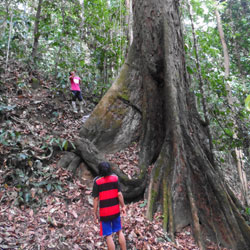
The Yellow Meranti stands 89.5m tall in an area of forest known as ‘Sabah’s Lost World’ – the Maliau Basin Conservation Area, one of Malaysia’s last few untouched wildernesses. Its height places it ahead of the previous record-holder, an 88.3m Yellow Meranti in the Tawau Hills National Park.

The giant tree was discovered during reconnaissance flights by conservation scientists from the University of Cambridge working with the Sabah Forestry Department to help protect the area’s biodiversity. It comes at a crucial time, as the Sabah government takes measures to protect and restore heavily logged areas in the region.

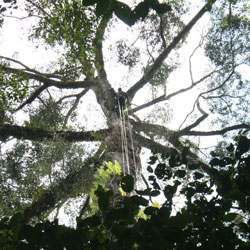
Measuring a tree’s exact height is tricky when the tree is quite possibly the tallest tree in the Tropics. The only way is to climb it, and to take a tape measure with you. This is precisely what Unding Jami, an expert tree-climber from Sabah, did recently. When he reached the top, he confirmed the tree’s height and texted “I don’t have time to take photos using a good camera because there’s an eagle around that keeps trying to attack me and also lots of bees flying around.”

The tree actually stands on a slope: downhill it’s 91m tall, and uphill it’s around 88m tall. “We’d put it at 89.5m on average,” explains lead researcher Dr David Coomes, from Cambridge’s Department of Plant Sciences. “It’s a smidgen taller than the record, which makes it quite probably the tallest tree recorded in the Tropics!”

At this height, the tree is roughly equivalent to the height of 65 people standing on each other’s shoulders, or 20 double-decker London buses. It’s just a few metres short of London’s Big Ben.

“Trees in temperate regions, like the giant redwoods, can grow up to 30m taller; yet around 90m seems to be the limit in the Tropics. No-one knows why this should be the case,” adds Coomes.

The tree was spotted using a LiDAR scanner – a machine that’s capable of producing exquisitely detailed three-dimensional images of rainforest canopies over hundreds of square kilometres. Its laser range finder hangs from the undercarriage of the research plane, peppering the forest with 200,000 laser pulses every second, and calculating distances in 3D from each reflected pulse. The researchers then ‘stitch’ the images together, enabling them to map the forest tree by tree.

Threatened by habitat loss, the Yellow Meranti (Shorea faguetiana) is classified as endangered on the International Union for Conservation of Nature ‘Red list’, the world’s most comprehensive inventory of the global conservation status of biological species.

“Interestingly, there may be more of this tree in cyberspace than in the world. It’s one of the trees that players can grow in the computer game Minecraft,” adds Coomes.

“Conserving these giants is really important. Some, like the California redwoods, are among the largest and longest-living organisms on earth. Huge trees are crucial for maintaining the health of the forest and its ecology. But they are difficult to find, and monitor regularly, which is where planes carrying LiDAR can help.”

Globally, around one billion hectares of degraded forest might be restorable, enabling then to continue to contribute to the planet’s biodiversity and its carbon and water cycles. However, a major problem faced by conservation managers is how to survey extensive areas in which conditions can vary in just a few hundred square metres and are continually changing through natural regeneration. “LiDAR scanning together with digital photography and hyperspectral scanners now provide us with unprecedented information on the state of the forest,” explains Coomes.

With funding from the Natural Environment Research Council (NERC), the Cambridge scientists worked with the Sabah Forestry Department, the South-East Asia Rainforest Research Partnership and the NERC Airborne Remote Sensing Facility.

“The Sabah government is extremely proud of this discovery, which lays credence to the fact that our biodiversity is of global importance,” says Sam Mannan, Director of the Sabah Forestry Department. “Our international collaboration, as in this case, has brought great scientific dividends to the state and we shall continue to pursue such endeavours.”

Adds Coomes: “The discovery of this particular tree comes at a critical moment because, set against a backdrop of decades of forest loss, the Sabah government has decided to protect and restore a huge tract of heavily logged forest just to the east of the Maliau Basin. It’s exciting to know that these iconic giants of the forest are alive and well so close to this major restoration project.”

Inset images: Stephanie Law.


Creative Commons License
The text in this work is licensed under a Creative Commons Attribution 4.0 International License. For image use please see separate credits above.

Genetic Approach Could Help Identify Side-Effects At Early Stages of Drug Development

Genetic approach could help identify side-effects at early stages of drug development

source: www.cam.ac.uk

An approach that could reduce the chances of drugs failing during the later stages of clinical trials has been demonstrated by a collaboration between the University of Cambridge and pharmaceutical company GlaxoSmithKline (GSK).

This further suggests that human genetics can support the development of new therapies, and can offer insights into their safety profile early in the development process

Robert Scott

The technique involves identifying genetic variants that mimic the action of a drug on its intended target and then checking in large patient cohorts whether these variants are associated with risk of other conditions, such as cardiovascular disease.

When developing a new drug for market, pharmaceutical companies must not only demonstrate that it is effective at treating a particular condition, but also that the drug does not have any adverse side-effects in patients. For example, the Food and Drug Administration, which approves all new medicines for use in the USA, has defined that any new anti-diabetic medicines need to demonstrate cardiovascular safety. However, in many cases adverse safety profiles do not become apparent until late in the drug development process, by which point millions – possibly even billions – of pounds will have been invested.

In a study published today in the journal Science Translational Medicine, scientists have provided a proof of concept that it is possible to use genetic analyses to demonstrate systematically at a very early stage whether a drug will alter the risk of developing other conditions.

A major class of anti-diabetic therapies are those known as glucose-lowering glucagon-like peptide-1 receptor (GLP1R)-agonists.  These drugs bind to the GLP-1 receptor (which is encoded by the GLP1R gene) to increase insulin production, helping reduce levels of blood sugar. However, the cardiovascular safety, of this class of agents, including the risk of heart disease for example, remains unknown.

By analysing genetic variations in DNA encoding drug targets for type 2 diabetes and obesity in almost 12,000 individuals, the researchers identified a variant in the GLP1Rgene that was associated with lower fasting glucose and a lower risk of type 2 diabetes – in other words, the variant appeared to mimic the action of the diabetes drugs. They confirmed this result in a further 40,000 individuals.

The researchers then used genetic data available through an international data-sharing consortium to study the association of that same variant with coronary heart disease in almost 62,000 individuals with coronary heart disease and over 160,000 controls. In fact, they found that the variant actually reduced the risk of heart disease. Long-term large-scale randomised controlled clinical trials to evaluate the cardiovascular safety of GLP1R-agonists are underway and results from a large trial are scheduled to be released later this month.

“This further suggests that human genetics can support the development of new therapies, and can offer insights into their safety profile early in the development process,” says Dr Robert Scott from the Medical Research Council (MRC) Epidemiology Unit at the University of Cambridge, the study’s first author.

Professor Nick Wareham, Director of the MRC Epidemiology Unit, added: “These findings suggest that beyond their effectiveness in treating diabetes, these drugs may have the added benefit of lowering risk of heart disease.”

“Researching and developing new medicines is a lengthy, expensive and risky journey, and any insights we can gain in to the processes of the body related to disease could help improve our ability to succeed,” says Dr Dawn Waterworth, joint senior author from GSK. “By pooling our resources and expertise in collaborations like this one with Cambridge University, we believe there’s an opportunity to expand our knowledge of disease biology, which in turn could help reduce the risk of late-stage failures and accelerate the development of innovative new treatments for patients.”

The study was primarily funded by GSK and the Medical Research Council.

Reference
Scott, R et al. A genomic approach to therapeutic target validation identifies a glucose-lowering GLP1R variant protective for coronary heart disease. Sci Trans Med; 2 June 2016; DOI: 10.1126/scitranslmed.aad3744


Creative Commons License
The text in this work is licensed under a Creative Commons Attribution 4.0 International License. For image use please see separate credits above.

– See more at: http://www.cam.ac.uk/research/news/genetic-approach-could-help-identify-side-effects-at-early-stages-of-drug-development#sthash.AyZjCVOP.dpuf

What Birds’ Attitudes To Litter Tell Us About Their Ability to Adapt

What birds’ attitudes to litter tell us about their ability to adapt

source: www.cam.ac.uk

Urban birds are less afraid of litter than their country cousins, according to a new study, which suggests they may learn that litter in cities is not dangerous. The research could help birds to adapt to urban settings better, helping them to survive increasing human encroachment on their habitats.

[The birds] may actually be learning which specific parts of urban habitats are safe and which are dangerous

Alison Greggor

The study led by Gates Cambridge Scholar Alison Greggor and published in the journal Animal Behaviour, shows that corvids – the family of birds which includes crows, ravens and magpies – are more likely to show fear in relation to unfamiliar objects than other birds. However, if they and other bird species have previously encountered similar objects they are able to overcome some of their fear.

The researchers measured levels of fear of new objects in birds across urban and rural habitats, comparing corvids, a family known for being behaviourally flexible and innovative, with other bird species found in urban areas. The birds’ hesitancy to approach food when different types of objects were nearby was compared to their behaviour when food was presented alone.

The researchers found corvids were more afraid of objects than other birds. However, birds were less fearful if the objects involved were similar to something they may have encountered before, for instance, urban birds were less hesitant in approaching litter.

Alison Greggor, who is doing a PhD in Psychology at the University of Cambridge, said: “From a broad perspective this work aims to help us understand how animals adapt to human-dominated landscapes. We found that although species differ in their overall levels of fear towards new things, populations of all species in urban areas showed lesser fear towards objects that looked like rubbish, but did not show reductions in fear towards all types of novelty. Therefore,  they may actually be learning which specific parts of urban habitats are safe and which are dangerous. In future, others might be able to use this information to predict what types of things animals need to learn to be able to survive in urban areas. Such predictions may help us understand why some species are unable to adjust to urban areas.”

Reference
Greggor, AL et al. Street smart: faster approach towards litter in urban areas by highly neophobic corvids and less fearful birds. Animal Behaviour; 30 May 2016; DOI: 10.1016/j.anbehav.2016.03.029


Creative Commons License
The text in this work is licensed under a Creative Commons Attribution 4.0 International License. For image use please see separate credits above.

– See more at: http://www.cam.ac.uk/research/news/what-birds-attitudes-to-litter-tell-us-about-their-ability-to-adapt#sthash.23qtQAsF.dpuf

The Myth of Quitting In Anger

The myth of quitting in anger

source: www.cam.ac.uk

Anger often decreases – rather than boosts – a person’s intention to quit a job when they identify strongly with their company, says a new study.

Company policies that are designed to promote positive emotions or minimise negative emotions may in fact not have the intended effect.

Jochen Menges

Anger at the workplace is commonly associated with employees storming out of the office and quitting their jobs, but a new study from the Cambridge Judge Business School suggests that the picture is far more complex.

More broadly, positive emotions are usually thought to lead to constructive outcomes and negative emotions to damaging outcomes for business and other organisations.

A new academic study finds, however, that these generalisations are often a myth: when identification with a company is high, anger over job situations often decreases (rather than boosts) a person’s intention to leave because such employees want to stick it out and improve the organisation rather than walk out in a huff.

Conversely, when a person’s identity with their organisation is low, anger increases their intention to quit, says the study published in the Academy of Management Journal.

Researchers at the Cambridge Judge Business School found that for an individual highly-identified with the organisation, anger directed toward the organisation is similar to self-blame because the organisation is part of their self-definition, and hence such people are less likely to respond to negative feelings by disengaging.

The practical implication of the research, the authors say, is that it is unwise for companies to broadly characterise specific emotions as beneficial or detrimental to the organisation.

“The study suggests that company policies that are designed to promote positive emotions or minimise negative emotions may in fact not have the intended effect,” says Jochen Menges, University Lecturer in Organisational Behaviour at Cambridge Judge Business School and Professor of Leadership at WHU – Otto Beisheim School of Management in Germany. “So rather than seeking to suppress certain workplace emotions, companies should instead adopt practices that seek to encourage greater organisational identification.”

The research focused on a large company in the pilot training and certification business, with a final dataset of 135 people employed in the United States and Europe who were evaluated over a one-year period.  They were asked about their intentions to leave the company or remain, and about both general organisation issues (such as schedule and pay) and specific matters related to the job – such as events that “made you feel good at your job,” “made you feel disrespected as a pilot” or “made you feel close to other pilot instructors.”

As a follow-up, the study looked at actual staff turnover at the flight training company six months after the last survey of employees and found a significant correlation between the number of employees intending to leave the company and the actual staff turnover.

The study examined guilt and pride, in addition to anger – and found here, too, a dark side of positive emotion and a bright side of negative emotion. For example, while pride is generally associated with a likelihood to remain at a company, for employees lacking in work-related identifications, a feeling of pride made them more likely to consider moving on.

The research looked at a people’s identity with their occupation as well as organisation, and found that while occupational identity is not as powerful as organisational identity in staff turnover, it does play a complementary role.

Reference:
Samantha Conroy, William Becker and Jochen Menges. ‘The Meaning of My Feelings Depends on Who I Am: Work-related Identifications Shape Emotion Effects in Organizations.’ Academy of Management Journal (2016). DOI: 10.5465/amj.2014.1040

Originally published on the Cambridge Judge Business School website


Creative Commons License
The text in this work is licensed under a Creative Commons Attribution 4.0 International License. For image use please see separate credits above.

– See more at: http://www.cam.ac.uk/research/news/the-myth-of-quitting-in-anger#sthash.JFboN388.dpuf

Cambridge App Maps Decline in Regional Diversity of English Dialects

Cambridge App maps decline in regional diversity of English dialects

source: www.cam.ac.uk

Regional diversity in dialect words and pronunciations could be diminishing as much of England falls more in line with how English is spoken in London and the south-east, according to the first results from a free app developed by Cambridge researchers.

More and more people are using and pronouncing words in the way that people from London and the south-east do.

Adrian Leemann

The English Dialects App (free for Android and iOS) was launched in January 2016 and has been downloaded more than 70,000 times. To date, more than 30,000 people from over 4,000 locations around the UK have provided results on how certain words and colloquialisms are pronounced. A new, updated version of the app – which attempts to guess where you’re from at the end of the quiz – is available for download from this week.

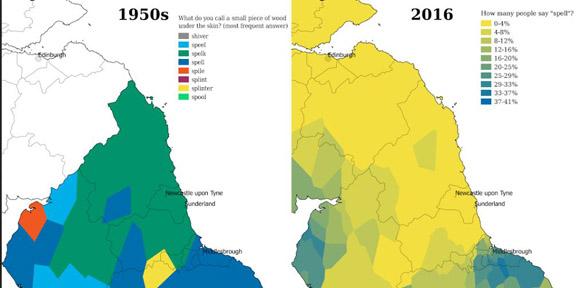
Based on the huge new dataset of results, researchers at Cambridge, along with colleagues at the universities of Bern and Zurich, have been able to map the spread, evolution or decline of certain words and colloquialisms compared to results from the original survey of dialect speakers in 313 localities carried out in the 1950s.

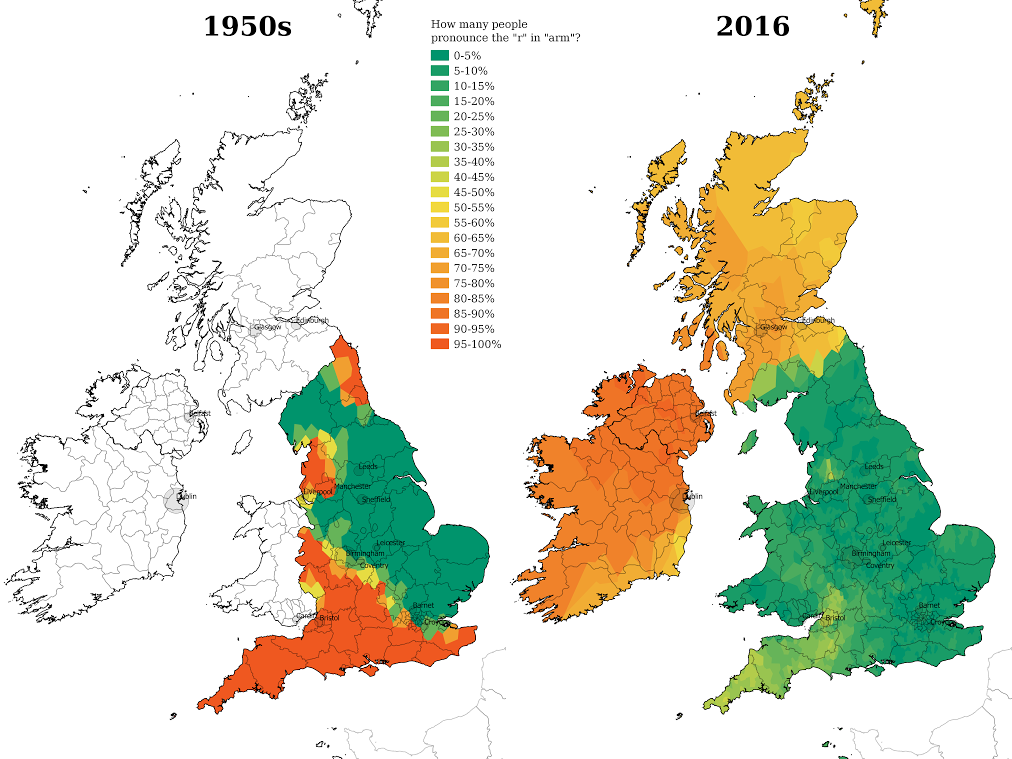
One of the major findings is that some features of regional accents, such as pronouncing the ‘r’ in words like ‘arm’ – a very noticeable pronunciation feature which was once normal throughout the West Country and along much of the south coast – are disappearing in favour of the pronunciations found in London and the South-East (see map slideshow).

Lead researcher Dr Adrian Leemann, from Cambridge’s Department of Theoretical and Applied Linguistics, said: “When it comes to language change in England, our results confirm that there is a clear pattern of levelling towards the English of the south-east; more and more people are using and pronouncing words in the way that people from London and the south-east do.

Professor David Britain from the University of Bern added: “People in Bristol speak much more similarly to those in Colchester now than they did fifty years ago. Regional differences are disappearing, some quite quickly. However, while many pockets of resistance to this levelling are shrinking, there is still a stark north-south divide in the pronunciation of certain key words.”

Dialect words are even more likely to have disappeared than regional accents, according to this research. Once, the word ‘backend’ instead of ‘autumn’ was common in much of England, but today very few people report using this word (see map slideshow).

However, the research has shown some areas of resistance to the patterns of overall levelling in dialect. Newcastle and Sunderland stood out from the rest of England with the majority of people from those areas continuing to use local words and pronunciations which are declining elsewhere. For example, many people in the North-East still use a traditional dialect word for ‘a small piece of wood stuck under the skin’, ‘spelk’ instead of Standard English ‘splinter’.

Other dialect words, like ‘shiver’ for ‘splinter’, are still reported in exactly the same area they were found historically—although they are far less common than they once were (see map slideshow).

The data collected to date shows that one northern pronunciation has proved especially robust: saying words like ‘last’ with a short vowel instead of a long one. In this case, the northern form actually appears to have spread southwards in the Midlands and the West Country compared with the historical survey.

In other cases, new pronunciations were found to be spreading. Pronouncing words like ‘three’ with an ‘f’ was only found in a tiny region in the south east in the 1950s, but the data from today show this pronunciation is much more widespread – 15% of respondents reported saying ‘free’ for ‘three’, up from just 2% in the old Atlas.

Cambridge PhD student Tam Blaxter, who worked alongside Dr Leemann to map the 30,000 responses supplied by the public, suggests that greater geographical mobility is behind the changes when compared to the first systematic nationwide investigation of regional speech, the Survey of English Dialects from the 1950s.

“There has been much greater geographical mobility in the last half century,” said Blaxter. “Many people move around much more for education, work and lifestyle and there has been a significant shift of population out of the cities and into the countryside.

“Many of the results have confirmed what language experts might predict – but until now we just didn’t have the geographical breadth of data to back up our predictions. If we were to do the survey in another 60-70 years we might well see this dialect levelling expanding further, although some places like the north-east seem to have been especially good at preserving certain colloquialisms and pronunciations.”

When the app was originally launched in January, users were quizzed about the way they spoke 26 different words or phrases. The academics behind the app wanted to see how English dialects have changed, spread or levelled out since the Survey of English Dialects. The 1950s project took eleven years to complete and captured the accents and dialects of mainly farm labourers.

Perhaps one of the most surprising results of the data provided so far is how the use of ‘scone’ (to rhyme with ‘gone’ rather than ‘cone’) is much more common in the north of England that many might imagine (see map slideshow).

Adrian Leemann said: “Everyone has strong views about how this word is pronounced but until we launched the app in January, we knew rather little about who uses which pronunciation and where. Our data shows that for the North and Scotland, ‘scone’ rhymes with ‘gone’, for Cornwall and the area around Sheffield it rhymes with ‘cone’ – while for the rest of England, there seems to be a lot of community-internal variation. In the future we will further unpick how this distribution is conditioned socially.”

The launch of the English Dialects App in January has also allowed language use in Wales, Scotland and Northern Ireland to be compared with language use in England (the original 1950s survey was limited to England and similar surveys of the other parts of the UK were not undertaken at the same time or using the same methods).

The huge levels of feedback have also meant the team have improved the prediction of where users might be from. The app now correctly places 25 per cent of respondents within 20 miles, compared with 37 miles for the old method.


Creative Commons License
The text in this work is licensed under a Creative Commons Attribution 4.0 International License. For image use please see separate credits above.

– See more at: http://www.cam.ac.uk/research/news/cambridge-app-maps-decline-in-regional-diversity-of-english-dialects#sthash.QhGEJGPc.dpuf

A 100 Million-Year Partnership On the Brink of Extinction

A 100 million-year partnership on the brink of extinction

source: www.cam.ac.uk

A symbiotic relationship that has existed since the time of the dinosaurs is at risk of ending, as habitat loss and environmental change mean that a species of Australian crayfish and the tiny worms that depend on them are both at serious risk of extinction.

We’ve now got a picture of how these two species have evolved together through time, and it looks like this ancient partnership could end with the extinction of both species.

Jennifer Hoyal Cuthill

A relationship that has lasted for 100 million years is at serious risk of ending, due to the effects of environmental and climate change. A species of spiny crayfish native to Australia and the tiny flatworms that depend on them are both at risk of extinction, according to researchers from the UK and Australia.

Look closely into one of the cool, freshwater streams of eastern Australia and you might find a colourful mountain spiny crayfish, from the genus Euastacus. Look even closer and you could see small tentacled flatworms, called temnocephalans, each only a few millimetres long. Temnocephalans live as specialised symbionts on the surface of the crayfish, where they catch tiny food items, or inside the crayfish’s gill chamber where they can remove parasites. This is an ancient partnership, but the temnocephalans are now at risk of coextinction with their endangered hosts. Coextinction is the loss of one species, when another that it depends upon goes extinct.

In a new study, researchers from the UK and Australia reconstructed the evolutionary and ecological history of the mountain spiny crayfish and their temnocephalan symbionts to assess their coextinction risk. This study was based on DNA sequences from crayfish and temnocephalans across eastern Australia, sampled by researchers at James Cook University, sequenced at the Natural History Museum, London and Queensland Museum, and analysed at the University of Sydney and the University of Cambridge. The resultsare published in the Proceedings of the Royal Society B.

“We’ve now got a picture of how these two species have evolved together through time,” said Dr Jennifer Hoyal Cuthill from Cambridge’s Department of Earth Sciences, the paper’s lead author. “The extinction risk to the crayfish has been measured, but this is the first time we’ve quantified the risk to the temnocephalans as well – and it looks like this ancient partnership could end with the extinction of both species.”

Mountain spiny crayfish species diversified across eastern Australia over at least 80 million years, with 37 living species included in this study. Reconstructing the ages of the temnocephalans using a ‘molecular clock’ analysis showed that the tiny worms are as ancient as their crayfish hosts and have evolved alongside them since the Cretaceous Period.

Today, many species of mountain spiny crayfish have small geographic ranges. This is especially true in Queensland, where mountain spiny crayfish are restricted to cool, high-altitude streams in small pockets of rainforest. This habitat was reduced and fragmented by long-term climate warming and drying, as the continent of Australia drifted northwards over the last 165 million years. As a consequence, mountain spiny crayfish are severely threatened by ongoing climate change and the International Union for the Conservation of Nature (IUCN) has assessed 75% of these species as endangered or critically endangered.

“In Australia, freshwater crayfish are large, diverse and active ‘managers’, recycling all sorts of organic material and working the sediments,” said Professor David Blair of James Cook University in Australia, the paper’s senior author. “The temnocephalan worms associated only with these crayfish are also diverse, reflecting a long, shared history and offering a unique window on ancient symbioses. We now risk extinction of many of these partnerships, which will lead to degradation of their previous habitats and leave science the poorer.”

The crayfish tend to have the smallest ranges in the north of Australia, where the climate is the hottest and all of the northern species are endangered or critically endangered. By studying the phylogenies (evolutionary trees) of the species, the researchers found that northern crayfish also tended to be the most evolutionarily distinctive. This also applies to the temnocephalans of genus Temnosewellia, which are symbionts of spiny mountain crayfish across their geographic range. “This means that the most evolutionarily distinctive lineages are also those most at risk of extinction,” said Hoyal Cuthill.

The researchers then used computer simulations to predict the extent of coextinction. This showed that if all the mountain spiny crayfish that are currently endangered were to go extinct, 60% of their temnocephalan symbionts would also be lost to coextinction. The temnocephalan lineages that were predicted to be at the greatest risk of coextinction also tended to be the most evolutionarily distinctive. These lineages represent a long history of symbiosis and coevolution of up to 100 million years. However they are the most likely to suffer coextinction if these species and their habitats are not protected from ongoing environmental and climate change.

“The intimate relationship between hosts and their symbionts and parasites is often unique and long lived, not just during the lifespan of the individual organisms themselves but during the evolutionary history of the species involved in the association,” said study co-author Dr Tim Littlewood of the Natural History Museum. “This study exemplifies how understanding and untangling such an intimate relationship across space and time can yield deep insights into past climates and environments, as well as highlighting current threats to biodiversity.”

Reference:
Jennifer F. Hoyal Cuthill et al. ‘Australian spiny mountain crayfish and their temnocephalan ectosymbionts: an ancient association on the edge of coextinction?’ Proceedings of the Royal Society B (2016). DOI: 10.1098/rspb.2016.0585


Creative Commons License
The text in this work is licensed under a Creative Commons Attribution 4.0 International License. For image use please see separate credits above.

– See more at: http://www.cam.ac.uk/research/news/a-100-million-year-partnership-on-the-brink-of-extinction#sthash.m5sBnBe9.dpuf

Urgent Action Needed To Close UK Languages Gap

Urgent action needed to close UK languages gap

source: www.cam.ac.uk

The UK Government needs to urgently adopt a new, comprehensive languages strategy if it is to keep pace with its international competitors and reduce a skills deficit that has wide-reaching economic, political, and military effects.

It is vital that we communicate clearly and simply the value of languages for the health of the nation. English is necessary, but not sufficient.

Wendy Ayres-Bennett

The findings are included in a new report, The Value of Languages, published by the University of Cambridge this week, after wide-ranging consultation with government bodies and agencies including the MoD, Foreign and Commonwealth Office, GCHQ, and the Department for Education.

The report argues for the full contribution of languages to the UK economy and society to be realised across government, rather than falling solely under the remit of the Department for Education, thereby allowing a centralised approach in how language impacts the UK in almost every sphere of 21st-century life.

Recent independent research, highlighted within the report, indicates the language deficit could be costing the UK economy billions of pounds per year.

The Value of Languages draws on discussions at a workshop held in Cambridge, co-chaired by Professor Wendy Ayres-Bennett of the Department of Theoretical and Applied Linguistics, and Baroness Coussins, Co-Chair of the All-Party Parliamentary Group on Languages. The workshop was attended by representatives from across government and is likely to inform future policy decisions in this area.

Professor Ayres-Bennett said: “It is vital that we communicate clearly and simply the value of languages for the health of the nation. English is necessary, but not sufficient. We cannot leave language policy to the Department for Education alone.

“We need a more coordinated cross-government approach which recognises the value of languages to key issues of our time including security and defence, diplomacy and international relations, and social cohesion and peace-building. Our report aims to raise awareness of the current deficiencies in UK language policy, put forward proposals to address them, and illustrate the strategic value of languages to the UK.”

The report also suggests:

  • Education policy for languages must be grounded in national priorities and promote a cultural shift in the attitude towards languages.
  • Language policy must be underpinned by organisational cultural change. The report highlights how cultural change is being achieved, for example, in the military with language skills being valued and rewarded financially. Military personnel are encouraged to take examinations to record their language skills, regardless of whether they are language learners or speakers of community or heritage languages.
  • Champions for languages both within and outside government are vital.

“Whereas the STEM subjects are specifically highlighted under the responsibilities for the Minister of State for Universities and Science, and there is a Chief Government Scientist, languages lack high-level champions within parliament and Whitehall,” added Ayres-Bennett.  “Modern languages also need media champions. Figures such as Simon Schama for history or Brian Cox for physics and astronomy have helped bring the importance of these subjects to the public’s attention.”

Imminent or immediate problems for government to address include the decline of languages and language learning in the UK from schools through to higher education, where language departments and degree courses are closing; business lost to UK companies through lack of language skills; and an erosion of the UK’s ‘soft power’ in conflict and matters of national security, which are currently limited by a shortage of speakers of strategically important languages

The report finds that the UK is also under-represented internationally, for instance in the EU civil service or in the translating and interpreting departments of the UN – and that the community and heritage languages spoken in the UK are often undervalued.

“A UK strategy for languages would mean that UK businesses can participate fully in the global market place using the language and communication skills of their workforce,” said Professor Ayres-Bennett.

“It would also mean that the UK is able to maximise its role and authority in foreign policy through language and diplomacy. Educational attainment in a wide range of languages brings with it personal cognitive benefits as well as the ‘cultural agility’ vital to international relations and development, as well as enhancing the cultural capital and social cohesion of the different communities of the UK.”

The report cites a number of case studies illustrating the value of languages. For example, a Spanish linguist recruited to GCHQ was from her first day able to use her ‘street language’ acquired during her year abroad and her knowledge of certain Latin American countries to translate communications related to an international drugs cartel looking to transport cocaine into the UK.  Comparing her analysis with those developed by two of her language community colleagues in Russian and Urdu, she was able to create a clear intelligence picture of the likely methods and dates of the imminent drugs importation. Meetings with Law Enforcement agents eventually led to the seizure of large quantities of cocaine and lengthy jail terms for the key players.

Policy workshops and briefings will be a key element of a new £4m research project on multilingualism led by Professor Ayres-Bennett at the University of Cambridge, and funded under the AHRC’s Open World Research Initiative.

The full report can be seen here: http://www.publicpolicy.cam.ac.uk/research-impact/value-of-languages


Creative Commons License
The text in this work is licensed under a Creative Commons Attribution 4.0 International License. For image use please see separate credits above.

– See more at: http://www.cam.ac.uk/research/news/urgent-action-needed-to-close-uk-languages-gap#sthash.9Mrj9MV9.dpuf

The Man We Love To Hate: It’s Time To Reappraise Thomas Robert Malthus

The man we love to hate: it’s time to reappraise Thomas Robert Malthus

source: www.cam.ac.uk

Thomas Robert Malthus, who was born 250 years ago, became notorious for his ‘principle of population’.  He argued that, because poverty was inevitable, some people would not find a seat at ‘nature’s table’ and would perish. In a new book, historians at Cambridge and Harvard set the life and work of this contentious thinker within a wider context – and look in particular at his engagement with the world beyond Europe.

As early as 1803, Malthus anticipated and deplored the fate he foresaw awaiting the inhabitants of the new world as settler populations increasingly claimed lands that seemed to offer almost limitless resources.

The controversial theorist Thomas Robert Malthus did not much enjoy travelling. Invited by his friend and fellow political economist, David Ricardo, to stay at the country house of Gatcombe Park in Gloucestershire, he declared that “that part of the world” was simply too far from his home near London, and wrote that he’d resolved “not to make distant excursions more than once a year”.

Now new research confirms that Malthus travelled vicariously all over the world, immersed in the accounts of voyages to the new lands being explored and colonised by Europeans. Malthus’s journeying through the medium of print to far-flung shores in the Americas and Pacific informed the theories on human development, population, and land use (and the precarious balance among them) for which he quickly became famous.

Professors Alison Bashford (Cambridge) and Joyce E Chaplin (Harvard) explore this under-researched aspect of Malthus’s life and works. The New Worlds of Thomas Robert Malthus reveals that the contentious theorist raised profound and prescient questions about the nature of people worldwide – and, in particular, about the collision of interests that resulted when white settlers claimed territories inhabited by indigenous communities.

The New Worlds of Thomas Robert Malthus radically re-casts the famous economist’s ideas from a British and European context, to a world and imperial one. The book is already hailed, by scholars on both sides of the Atlantic, as a stunningly distinctive contribution to interpretations of Malthus. One scholar calls it “the most important new reading of the life and work of Malthus in a generation”.

The seventh child in a well-off family, Malthus was born 250 years ago on 13 February 1766. His father’s social circle included some of the best-known philosophers of the time, including David Hume and Jean Jacques Rousseau.  Like many younger sons of the gentry, Malthus took orders in the Church of England and, after an education at Jesus College, Cambridge, became a curate who corresponded widely. He began to publish pamphlets on topical issues in the stormy last decade of the 18th century.

Though cast as ‘parson Malthus’, for most of his life he was in fact a professor of political economy at the East India Company College in Haileybury. Bashford explains: “This put him at the centre of the imperial world, for several generations educating young men for service as Company clerks in India.”

Malthus is best known for his Essay on the Principle of Population, which first appeared in 1798. In the thesis, both respected and vilified for the past 200 years, he argued that while population multiplies exponentially, food supplies increase only arithmetically. The oscillating mismatch between the two would spell disaster when ‘checked’ by nature through famine or disease, or by humans through war or infanticide.

The most troubling aspect of Malthus’s essay is his interpretation of poverty. While a generation of utopians was imagining a brighter and better future for all, Malthus proposed a much bleaker picture. Some poverty, he argued, was inevitable. As population increased when times were good, so the poorest would perish when times were bad. Disease and famine served as natural checks to over-population. These uncompromising views led Malthus to be much disliked or even hated.

Yet Malthus also thought the number of people on that poverty line could and should be reduced. “Despite assertions that Malthus blamed only the poor for producing too many children, for being the problem, he was in fact at least equally critical of the behaviour of the privileged,” Chaplin points out. “He argued that when the rich had large families, the poor disproportionately suffered any material shortages, therefore wealthier people were morally obliged to produce fewer children.”

Historians have consistently set Malthus within a European context. But Bashford and Chaplin show that his Essay was about the Atlantic and Pacific new worlds as well. It was written within the tradition of ‘stadial’ theories of economic development; these ‘universal histories’ sought to understand all cultures in all places and times. Using Jesuit travel accounts, 18th-century journals of Pacific voyagers, and the writings of new world settlers, Malthus wrote a world history.

Bashford and Chaplin initially approached Malthus from different chronological perspectives. Chaplin had written extensively about English interpretations of colonisation and population, also on Benjamin Franklin’s influential population thesis, which was a key inspiration for Malthus. Meanwhile, Bashford had examined modern theories of population and of 20th-century Malthusianism. They began to talk about population, and Malthus, while Bashford was a visiting professor at Harvard University.

“Several years ago, I opened the 1803 edition of Malthus’s Essay and was entirely surprised to see the name Bennelong,” explains Bashford. “Well known to Australian historians, Bennelong was an Aboriginal leader in the earliest years of British colony of New South Wales, a cultural interlocutor who spent several years in London in the 1790s. But what was he doing in Malthus’s famous Essay?” The need to re-interpret Malthus’s work in the light of colonial and imperial history was clear.

Chaplin then discovered that Franklin’s and Malthus’s works on population had been produced by the same London publisher. “That seemed more than coincidental,” Chaplin says. “Together, the two authors — American and British — and their two books show that new world colonies and the imperial centre were neither topically distant or theoretically distinct.”

Many of the books Malthus used to research and write his world history are in the Old Library at Jesus College. The Malthus Collection includes volumes that belonged to his father, his brother, his learned cousin, Jane Dalton, and Malthus himself. Among them are copies of Benjamin Franklin’s essays, Cook’s journals from the South Sea, and Jesuit accounts of New France and New Spain – all owned by Malthus.

Bashford and Chaplin’s research reveals that, as white settlers began to claim new territories, Malthus occasionally questioned the morality of colonisation, very unusual for his time, and almost unique among his political economy contemporaries. As early as 1803, he anticipated and deplored the fate he foresaw awaiting the inhabitants of the new world as settler populations increasingly claimed lands that seemed to offer almost limitless resources.

Anticipating formal policies for the removal of indigenous people in North America and Van Diemen’s Land (Tasmania), he wrote: “The right of exterminating, or driving into a corner where they must starve, even the inhabitants of these thinly populated regions, will be questioned in a moral view.”

The New Worlds of Thomas Robert Malthus also explains Malthus’s views on the slave trade. His Essay, written and rewritten between 1798 and 1830, coincided with the height of the abolitionist campaigns, first against the slave trade and then against slavery. He asked William Wilberforce to inform the House of Commons that he was against the slave trade, in large part because quite a few slave traders were using his Principle of Population in their own defence.

“Yet Malthus spoke out against the slave trade somewhat reluctantly,” argue Bashford and Chaplin, “and he never spoke out against slavery itself.” This diffidence is evident in his famous books, analysed in terms of slavery and abolition, for the first time. While it was common at the time to consider slavery in terms of reproduction and population, The New Worlds of Thomas Robert Malthus explains why and how Malthus sidestepped the issue.

The New Worlds of Thomas Robert Malthus analyses, for the first time, the reception history of the work in the very places Malthus examined. He was read and discussed in new world sites that ran from Lexington in Kentucky to Hobart in Tasmania. So eager were new world people to read him that his text appeared in a pirated edition produced in the United States. His ideas entered public discourse:  settler populations, for example, debated his key statement that they should neither exterminate nor drive into ‘a corner’ indigenous populations.

Malthus was bolder than many of his European and American contemporaries and, in terms of continuing arguments over the rights of different global populations, his text remains deeply resonant today.

The New Worlds of Thomas Robert Malthus is published by Princeton University Press.


Creative Commons License
The text in this work is licensed under a Creative Commons Attribution 4.0 International License. For image use please see separate credits above.

– See more at: http://www.cam.ac.uk/research/news/the-man-we-love-to-hate-its-time-to-reappraise-thomas-robert-malthus#sthash.Es7EGHsw.dpuf

First Evidence of Icy Comets Orbiting a Sun-Like Star

First evidence of icy comets orbiting a sun-like star

source: www.cam.ac.uk

Astronomers have found the first evidence of comets around a star similar to the sun, providing an opportunity to study what our solar system was like as a ‘baby’.

The system has a similar ice composition to our own, so it’s a good one to study in order to learn what our solar system looked like early in its existence.

Sebastián Marino

An international team of astronomers have found evidence of ice and comets orbiting a nearby sun-like star, which could give a glimpse into how our own solar system developed.

Using data from the Atacama Large Millimeter Array (ALMA), the researchers, led by the University of Cambridge, detected very low levels of carbon monoxide gas around the star, in amounts that are consistent with the comets in our own solar system.

The results, which will be presented today at the ‘Resolving Planet Formation in the era of ALMA and extreme AO’ conference in Santiago, Chile, are a first step in establishing the properties of comet clouds around sun-like stars just after the time of their birth.

Comets are essentially ‘dirty snowballs’ of ice and rock, sometimes with a tail of dust and evaporating ice trailing behind them, and are formed early in the development of stellar systems. They are typically found in the outer reaches of our solar system, but become most clearly visible when they visit the inner regions. For example, Halley’s Comet visits the inner solar system every 75 years, some take as long as 100,000 years between visits, and others only visit once before being thrown out into interstellar space.

It’s believed that when our solar system was first formed, the Earth was a rocky wasteland, similar to how Mars is today, and that as comets collided with the young planet, they brought many elements and compounds, including water, along with them.

The star in this study, HD 181327, has a mass about 30% greater than the sun and is located 160 light years away in the Painter constellation. The system is about 23 million years old, whereas our solar system is 4.6 billion years old.

“Young systems such as this one are very active, with comets and asteroids slamming into each other and into planets,” said Sebastián Marino, a PhD student from Cambridge’s Institute of Astronomy and the paper’s lead author. “The system has a similar ice composition to our own, so it’s a good one to study in order to learn what our solar system looked like early in its existence.”

Using ALMA, the astronomers observed the star, which is surrounded by a ring of dust caused by the collisions of comets, asteroids and other bodies. It’s likely that this star has planets in orbit around it, but they are impossible to detect using current telescopes.

“Assuming there are planets orbiting this star, they would likely have already formed, but the only way to see them would be through direct imaging, which at the moment can only be used for very large planets like Jupiter,” said co-author Luca Matrà, also a PhD student at Cambridge’s Institute of Astronomy.

In order to detect the possible presence of comets, the researchers used ALMA to search for signatures of gas, since the same collisions which caused the dust ring to form should also cause the release of gas. Until now, such gas has only been detected around a few stars, all substantially more massive than the sun. Using simulations to model the composition of the system, they were able to increase the signal to noise ratio in the ALMA data, and detect very low levels of carbon monoxide gas.

“This is the lowest gas concentration ever detected in a belt of asteroids and comets – we’re really pushing ALMA to its limits,” said Marino.

“The amount of gas we detected is analogous to a 200 kilometre diameter ice ball, which is impressive considering how far away the star is,” said Matrà. “It’s amazing that we can do this with exoplanetary systems now.”

The results have been accepted for publication in the Monthly Notices of the Royal Astronomical Society.

Reference:
S. Marino et al. ‘Exocometary gas in the HD 181327 debris ring.’ Paper presented to the Resolving Planet Formation in the era of ALMA and extreme AO conference, Santiago, May 16-20, 2016. http://www.eso.org/sci/meetings/2016/Planet-Formation2016/program.html

Inset image: ALMA image of the ring of comets around HD 181327 (colours have been changed). The white contours represent the size of the Kuiper Belt in the Solar System. Credit: Amanda Smith, University of Cambridge.


Creative Commons License
The text in this work is licensed under a Creative Commons Attribution 4.0 International License. For image use please see separate credits above.

– See more at: http://www.cam.ac.uk/research/news/first-evidence-of-icy-comets-orbiting-a-sun-like-star#sthash.T2Lp5Koq.dpuf

Body-Worn Cameras Associated With Increased Assaults Against Police, and Increase In Use-Of-Force If Officers Choose When To Activate Cameras

Body-worn cameras associated with increased assaults against police, and increase in use-of-force if officers choose when to activate cameras

source: www.cam.ac.uk

Preliminary results from eight UK and US police forces reveal rates of assault against officers are 15% higher when they use body-worn cameras. The latest findings, from one of the largest randomised-controlled trials in criminal justice research, highlight the need for cameras to be kept on and recording at all stages of police-public interaction – not just when an individual officer deems it necessary – if police use-of-force and assaults against police are to be reduced.

It may be that in some places it’s a bad idea to use body-worn cameras, and the only way you can find that out is to keep doing these tests in different kinds of places

Barak Ariel

New evidence from the largest-yet series of experiments on use of body-worn cameras by police has revealed that rates of assault against police by members of the public actually increased when officers wore the cameras.

The research also found that on average across all officer-hours studied, and contrary to current thinking, the rate of use-of-force by police on citizens was unchanged by the presence of body-worn cameras, but a deeper analysis of the data showed that this finding varied depending on whether or not officers chose when to turn cameras on.

If officers turned cameras on and off during their shift then use-of-force increased, whereas if they kept the cameras rolling for their whole shift, use-of-force decreased.

The findings are released today across two articles published in the European Journal of Criminology and the Journal of Experimental Criminology.

While researchers describe these findings as unexpected, they also urge caution as the work is ongoing, and say these early results demand further scrutiny. However, gathering evidence for what works in policing is vital, they say.

“At present, there is a worldwide uncontrolled social experiment taking place – underpinned by feverish public debate and billions of dollars of government expenditure. Robust evidence is only just keeping pace with the adoption of new technology,” write criminologists from the University of Cambridge and RAND Europe, who conducted the study.

For the latest findings, researchers worked with eight police forces across the UK and US – including West Midlands, Cambridgeshire and Northern Ireland’s PSNI, as well as Ventura, California and Rialto, California PDs in the United States – to conduct ten randomised-controlled trials.

Over the ten trials, the research team found that rates of assault against officers wearing cameras on their shift were an average of 15% higher, compared to shifts without cameras.

The researchers say this could be due to officers feeling more able to report assaults once they are captured on camera – providing them the impetus and/or confidence to do so.

The monitoring by camera also may make officers less assertive and more vulnerable to assault. However, they point out these are just possible explanations, and much more work is needed to unpick the reasons behind these surprising findings.

In the experimental design, the shift patterns of 2,122 participating officers across the forces were split at random between those allocated a camera and those without a camera. A total of 2.2 million officer-hours policing a total population of more than 2 million citizens were covered in the study.

The researchers set out a protocol for officers allocated cameras during the trials: record all stages of every police-public interaction, and issue a warning of filming at the outset. However, many officers preferred to use their discretion, activating cameras depending on the situation.

Researchers found that during shifts with cameras in which officers stuck closer to the protocol, police use-of-force fell by 37% over camera-free shifts. During shifts in which officers tended to use their discretion, police use-of-force actually rose 71% over camera-free shifts.

“The combination of the camera plus the early warning creates awareness that the encounter is being filmed, modifying the behaviour of all involved,” said principle investigator Barak Ariel from the University of Cambridge’s Institute of Criminology.

“If an officer decides to announce mid-interaction they are beginning to film, for example, that could provoke a reaction that results in use-of-force,” Ariel said. “Our data suggests this could be what is driving the results.”

The new results are the latest to come from the research team since their ground-breaking work reporting the first experimental evidence on body-worn cameras with Rialto PD in California – a study widely-cited as part of the rationale for huge investment in this policing technology.

“With so much at stake, these findings must continue to be scrutinised through further research and more studies. In the meantime, it’s clear that more training and engagement with police officers are required to ensure they are confident in the decisions they make while wearing cameras, and are safe in their job,” said co-author and RAND Europe researcher Alex Sutherland.

Ariel added, “It may be that in some places it’s a bad idea to use body-worn cameras, and the only way you can find that out is to keep doing these tests in different kinds of places. After all, what might work for a sheriff’s department in Iowa may not necessarily apply to the Tokyo PD.”


Creative Commons License
The text in this work is licensed under a Creative Commons Attribution 4.0 International License. For image use please see separate credits above.

– See more at: http://www.cam.ac.uk/research/news/body-worn-cameras-associated-with-increased-assaults-against-police-and-increase-in-use-of-force-if#sthash.8k0E6T2S.dpuf

A Shaggy Dog Story: The Contagious Cancer That Conquered The World

A shaggy dog story: The contagious cancer that conquered the world


source: www.cam.ac.uk

A contagious form of cancer that can spread between dogs during mating has highlighted the extent to which dogs accompanied human travellers throughout our seafaring history. But the tumours also provide surprising insights into how cancers evolve by ‘stealing’ DNA from their host.

It is remarkable that this unusual and long-lived cancer can teach us so much about the history of dogs, and also about the genetic and evolutionary processes that underlie cancer more generally

Elizabeth Murchison

‘Canine transmissible venereal tumour’ (CTVT) is a cancer that spreads between dogs through the transfer of living cancer cells, primarily during mating. The disease usually manifests as genital tumours in both male and female domestic dogs. The cancer first arose approximately 11,000 years ago from the cells of one individual dog; remarkably, it survived beyond the death of this original dog by spreading to new dogs. The cancer is now found in dog populations worldwide, and is the oldest and most prolific cancer lineage known in nature.

In a study published today in the journal eLife, an international team led by researchers at the University of Cambridge studied the DNA of mitochondria – the ‘batteries’ that provide cells with their energy – in 449 CTVT tumours from dogs in 39 countries across six continents. Previous research has shown that at occasional points in history, mitochondrial DNA has transferred from infected dogs to their tumours – and hence to tumour cells in subsequently-infected dogs.

In the new study, the researchers show that this process of swapping mitochondrial DNA has occurred at least five times since the original cancer arose. This discovery has allowed them to create an evolutionary ‘family tree’, showing how the tumours are related to each other. In addition, the unusual juxtaposition of different types of mitochondrial DNA within the same cell unexpectedly revealed that cancer cells can shuffle or ‘recombine’ DNA from different mitochondria.

“At five distinct time-points in its history, the cancer has ‘stolen’ mitochondrial DNA from its host, perhaps to help the tumour survive,” explains Andrea Strakova, from the Department of Veterinary Medicine at the University of Cambridge, co-first author of the study. “This provides us with a set of unique genetic tags to trace how dogs have travelled the globe over the last few hundred years.”

In the evolutionary ‘family tree’, the five main branches are known as ‘clades’, each representing a point in history when mitochondria transferred between dog and tumour. By mapping tumours within these clades to the geographical location where they were found, the researchers were able to see how the cancers have spread across the globe. The distance and speed with which the clades have spread suggests that the dogs commonly travelled with human companions, often by sea.

One branch of the CTVT evolutionary tree appears to have spread from Russia or China around 1,000 years ago, but probably only came to the Americas within the last 500 years, suggesting that it was taken there by European colonialists. Conquistadors are known to have travelled with dogs – contemporary artworks have portrayed them both as attack dogs and as a source of food.

Image: 1598 fictional engraving by Theodor de Bry supposedly depicting a Spaniard feeding Indian children to his dogs. Wikipedia

The disease probably arrived in Australia around the turn of the twentieth century, most likely imported inadvertently by dogs accompanying European settlers.

One of the most surprising findings from the study related to how mitochondrial DNA transfers – and mixes – between the tumour and the host. The researchers found that mitochondrial DNA molecules from host cells that have migrated into tumour cells occasionally fuse with the tumour’s own  mitochondrial DNA, sharing host and tumour DNA in a process known as ‘recombination’. This is the first time this process has been observed in cancers.

Máire Ní Leathlobhair, the study’s co-first author, explains: “Mitochondrial DNA recombination could be happening on a much wider scale, including in human cancers, but it may usually be very difficult to detect. When recombination occurs in transmissible cancers, two potentially very different mitochondrial DNAs – one from the tumour, one from the host – are merging and so the result is more obvious. In human cancer, the tumour’s mitochondrial DNA is likely to be very similar to the mitochondrial DNA in the patient’s normal cells, so the result of recombination would be almost impossible to recognise.”

Although the significance of mitochondrial DNA recombination in cancer is not yet known, its discovery is now leading scientists to explore how this process may help cancer cells to survive – and if blocking it may stop cancer cells from growing.

Dr Elizabeth Murchison, senior author of the study, said: “The genetic changes in CTVT have allowed us to reconstruct the global journeys taken by this cancer over two thousand years. It is remarkable that this unusual and long-lived cancer can teach us so much about the history of dogs, and also about the genetic and evolutionary processes that underlie cancer more generally.”

The research was funded by the Wellcome Trust, the Leverhulme Trust and the Royal Society.

Reference
Strakova, A et al. Mitochondrial genetic diversity, selection and recombination in a canine transmissible cancer. eLife; 17 May 2016; DOI: 10.7554/eLife.14552


Creative Commons License
The text in this work is licensed under a Creative Commons Attribution 4.0 International License. For image use please see separate credits above.

– See more at: http://www.cam.ac.uk/research/news/a-shaggy-dog-story-the-contagious-cancer-that-conquered-the-world#sthash.FZx2L1xg.dpuf

Cambridge Oncometrix News

Cambridge Oncometrix is developing a non-invasive, accurate, sensitive and affordable diagnostic test for the early detection of prostate cancer – the CAMONX test.

This highly accurate diagnostic test can be performed by men in the comfort of their homes to check the health of their prostate or by their GP or urologist. The test can be used either on a sample of seminal fluid or prostatic secretion.

People’s Choice Award at Pitch@Palace business competition shows, how such a test is needed.

Photo from St.James’s Palace March 9, 2016. From right to Left: D.Soloviev & M.Rossmann from Cambridge Oncometrix, other award winners and HRH The Duke Of York announcing the awards.

The results of the test will show whether the prostate is in a healthy condition or not. Importantly, the test will specifically distinguish between Prostate Cancer and  Benign Prostatic Hyperplasia. Benign Prostatic Hyperplasia is the most common prostatic condition in men over 45 and it mimics the symptoms of prostate cancer. The test will be significantly more precise, convenient and accurate than the PSA blood test, which is currently the gold standard screening test that is used before biopsies are taken.

Our vision:

– The CAMONX-Home test will be a simple colour based dip stick test that will be as simple to use as a pregnancy test. It will provide peace of mind for men and their families who have concerns about the condition of their prostate. When used at home, the CAMONX test will provide men with a very accurate indication of whether they need to visit their doctor for further diagnosis.

– The CAMONX-Pro test will be an important, non-invasive and accurate tool for doctors managing prostate cancer patients who have been offered an active surveillance programme. The instrument is very easy to use and the GP or urologist will receive the results of the test immediately.

– Our test will become a very important non-invasive diagnostic tool to determine whether a patient is at a high-risk for prostate cancer and will prevent unnecessary repeat biopsies.

– Being easy-to-use and affordable we hope that our test will become available to men all over the world, even in the most remote of locations.

– Our test has the potential to become a life-saving prostate cancer screening test.

Current status of development:

– We have discovered a set of novel biomarkers for the diagnosis of prostate cancer.

– We have developed an accurate and robust assay for an instrumental version of the CAMONX test, which will be performed at the point of care.

– We have set up an international collaboration with urologists and specialised clinics.

– We have started a proof of concept clinical investigation to complete the characterisation of cancer biomarkers and refine the corresponding assays.

– We have set up collaboration with an academic partner.

University of Central Lancashire, March 2016.  Dr.Carole Rolph, Dr.Maxim Rossmann and Joe Mather, B.Sc. 

What are the Funds needed for?

To make our test available to every man on the planet we need £4.5 Million. This crowdfunding campaign will speed up the completion of stage 1 and kickstart the project towards stage 2 and beyond.

  1. £150,000 is needed to complete the on going proof of concept clinical investigation of CAMONX biomarkers.
  2. £350,000 is needed to complete the development of measurement methods and data processing algorithms.
  3. £1 M is needed to develop test device prototypes.
  4. £3 M is needed to conduct clinical trials and obtain regulatory approvals for the test device.

Rewards:

We can’t offer much in the way of material rewards but as a group of scientists fighting the most prevalent cancer among men we can offer the following:

Gratitude: A personal thank you letter from the test developers to the pledger for supporting those hoping to help millions of people.

Inspiration: A download of “My Life” single composed by inspirational prostate cancer fighter and campaigner Kevin Vardy.

Readiness: A download of Cambridge Oncometrix’s guide to prostate health and longevity.

Awareness: A specially commissioned  CitrusFriends’ T-shirt.

Peace of mind: The opportunity to be among the first men to receive the test.

Hope: An original painting by Mr. Shaun George, a double cancer survivor.

We realize, that most of you want to help us selflessly. You can also choose to pledge anonimously not asking for any material rewards. Just choose £1 pledge and add any amount to your pledge. Your support is very important to us!

To our backers:

Huge thank you to everybody who has supported us!

We have already raised enough funds to support MSc fellowship at University of Central Lancashire for a very gifted student Joe Mather featured at the photo below 4th left.

From left to right: Mr. Kevin Vardy, prostate cancer fighter and campaignerDmitry Soloviev, PhD, Cambridge Oncometrix Chief Scientist, Cambridge Oncometrix CEO Maxim Rossmann, PhD,  UCLan biomedical master’s student Joe Mather and Dr. Carole Rolph, Senior Lecturer in Clinical Biochemistry at the University of Central Lancashire.

About our Citrus Friends supporters on the T-shirt:

Did you know, that healthy prostate is the size of a wallnut and produces loads of citiric acid? This is the same acid, that makes the taste of lemon. If you range the concentrations of citric acid in the increasing order you will obtain the following row:

Orange (5mM)< Healthy Prostate (75mM)< Lemon (300mM).

When the cancer resides inside the prostate, this picture changes dramatically – as you can see it on the banner above. Our Citrus Friends are campaiging against the Porstate cancer.

The bad grey guy represents the canerous prostate. If detected early it could be treated!

By the way, the bad grey guy on the banner was designed by our main supporter, prostate cancer fighter and Prostate cancer test campaigner Mr.Kevin Vardy. Please visit his page and say hello to him! 

Our supporters on the world map:

People watch our campaign video all over the world: French Polinesia, Caribbean , South Africa, New Zealand and the whole of Europe, of course!

With your help we already start making difference – prostate cancer awareness! Please share this project with you friends. To win big we need to keep momentum!

Natural Selection Sculpts Genetic Information To Limit Diversity

Natural selection sculpts genetic information to limit diversity

source: www.cam.ac.uk

A study of butterflies suggests that when a species adapts, other parts of its genetic make-up  can be linked to that adaptation, limiting diversity in the population.

While we cannot forecast the future, an emerging idea is that mutations that have no effect on survival today may be a source of beneficial variation in the future

Simon Martin

A study of tropical butterflies has added to growing evidence that natural selection reduces species’ diversity by moulding parts of their genetic structure, including elements that have no immediate impact on their survival.

The research, by a University of Cambridge-led team of academics, focused on genetic data from South American Heliconius butterflies. It showed that when these butterflies develop a beneficial adaptation through a mutation in their DNA, other parts of the same chromosome – the long strings of DNA that make up the butterfly’s genome – may end up being defined by the fact that they are “linked” to the point where the mutation took place. Natural selection ends up influencing the fate of these linked sites, even though they have no impact on the species’ fitness and long-term survival prospects.

As the adaptation is passed down through the generations as a result of natural selection, this collection of linked genetic sites can be passed on intact, removing genetic variation that previously existed in the population at these sites. This effectively limits the overall amount of variation in the butterfly population.

The study complements similar findings in other species, including humans and fruit flies, which together offer one possible solution to a long-standing paradox in population genetics. This is the fact that while species with bigger populations should be more genetically diverse – because there is more potential for new mutations to occur – in practice they often only exhibit as much diversity as smaller populations.

For example, in the Cambridge-led study, the researchers found that the genetic diversity of Heliconius butterflies is very similar to that of fruit flies, even though fruit flies are far more numerous. They also estimated that the amount of adaptation within Heliconius butterflies caused by natural selection is probably about half that of fruit flies. In other words, because natural selection affects the fruit flies more, reducing variation, they end up exhibiting roughly the same amount of genetic diversity, even though there are more of them.

The researchers stress that this explanation for variable levels of genetic diversity between different species is still, at the moment, a theory. Not all scientists are convinced that natural selection has this effect and argue that the variable diversity of species relative to population size may well have other causes.

Understanding more about what these causes are will, however, help to answer even more fundamental scientific questions – such as how and why species vary in the first place, and when they can really be said to have become distinct enough from their ancestors to represent a species in their own right.

Dr Simon Martin, a Research Fellow at St John’s College, Cambridge, who led the study, said: “We will only be able to understand this fully if we can compare results from across different species. Extending our knowledge to butterflies is a step towards explaining these much broader patterns in nature; it’s only by doing this kind of research that we will know whether these ideas are right or not.”

Martin and his colleagues examined a very large data set of 79 whole genome sequences representing 12 related species of Heliconius butterfly. This large-scale data has only become available in recent years, as a result of advances in genome sequencing which have made the process both easier and more affordable.

The study involved scouring the sequences for an apparent pattern of association between particular sites within the genome and low variation. “That acts as a kind of signature,” Martin said. “If you can see that in a genome, then as far as we can tell it is an indication of selection.”

In addition, the researchers compared the number of variations in the parts of the genome where proteins are coded – and therefore may be responsible for adaptations – with the number of variations in other parts of the genome. It is possible to predict what this ratio would be if variations only occurred by chance. The difference between that prediction, and the actual statistics, suggests the extent to which natural selection has shaped species differences.

The study estimated that around 30% of the protein differences between species of Heliconius are adaptations caused by natural selection. In keeping with theories about diversity in the population of other species, this turned out to be about half the number of protein variations in fruit flies – a larger population with less genetic diversity overall.

Intriguingly, the study effectively suggests that natural selection could limit a species’ ability to adapt to future environmental change by removing linked variations that, despite having no immediate beneficial impact on the species, could become relevant to its survival and capacity to cope with its environment in the future.

“Variation is a kind of raw material and you don’t necessarily use it all at any one time,” Martin explained. “It’s something that could be used to adapt and change in the future.”

“Something that has turned up during the last few years in research of this kind is a phenomenon where we see that a species has adapted, and we discover, when we look for the origin of that adaptation, that the mutation was not actually new. Instead, it was a variation that previously existed in the population. So while we cannot forecast the future, an emerging idea is that mutations that have no effect on survival today may be a source of beneficial variation in the future.”

The study appears in the May 2016 issue of Genetics.


Creative Commons License
The text in this work is licensed under a Creative Commons Attribution 4.0 International License. For image use please see separate credits above.

– See more at: http://www.cam.ac.uk/research/news/natural-selection-sculpts-genetic-information-to-limit-diversity#sthash.M9Bo6PPU.dpuf

Ageing Affects Test-Taking, Not Language, Study Shows

Ageing affects test-taking, not language, study shows

source: www.cam.ac.uk

The ability to understand language could be much better preserved into old age than previously thought, according to researchers from the University of Cambridge, who found older adults struggle more with test conditions than language processing.

Scientists claim that they are studying language, when really they are studying language plus your motivation to do well, plus your understanding of the instructions, plus your ability to focus, and so on

Karen Campbell

Scientists from the Cambridge Centre for Ageing and Neuroscience (Cam-CAN) scanned participants during testing and found that the areas of the brain responsible for language performed just as well in older adults as in younger ones.

The research, published in the Journal of Neuroscience, suggests that increased neural activation in the frontal brain regions of older adults reflects differences in the way they respond to the demands of the task compared with younger adults, rather than any difference in language processing itself.

“These findings suggest our ability to understand language is remarkably preserved well into old age, and it’s not through some trick of the mind, or reorganisation of the brain,” says co-author Professor Lorraine Tyler, who leads Cam-CAN. “Instead, it’s through the continued functioning of a well-used language processing machine common to all humans.”

Professor Tyler says cognitive neuroscientists attempting to explain how the mind and brain work typically approach the question with tasks designed to measure particular cognitive abilities, such as memory or language. However, it’s rarely as simple as that, she says, and tasks never end up measuring only one thing.

“Scientists claim that they are studying language, when really they are studying language plus your motivation to do well, plus your understanding of the instructions, plus your ability to focus, and so on,” says lead author Dr Karen Campbell, now based at Harvard University. “These poorly defined tasks become even more problematic when it comes to studying the older brain, because older adults sometimes show increased neural activation in frontal brain regions, which is thought to reflect a change in how older brains carry out a given cognitive function. However, this extra activation may simply reflect differences in how young and older adults respond to the demands of the task.”

Campbell and her Cam-CAN colleagues tried to isolate the effect of the testing by scanning 111 participants aged 22-87 using functional magnetic resonance imaging (fMRI) while they either passively listened to sentences or decided if the sentences were grammatical or not.

The researchers found that simply listening to and comprehending language, as we do in everyday life, “lights up” brain networks responsible for hearing and language, whereas performing a cognitive task with the same sentences leads to the additional activation of several task-related networks.

Age had no effect on the language network itself, but it did affect this network’s ability to “talk with” other task-related networks.

The Cambridge Centre for Ageing and Neuroscience is funded by the Biotechnology and Biological Sciences Research Council and is jointly based at the University of Cambridge and the Medical Research Council Cognition and Brain Sciences Unit.

Reference
Campbell, KL et al. Robust Resilience of the Frontotemporal Syntax System to Aging.Journal of Neuroscience; 11 May 2016; DOI: 10.1523/JNEUROSCI.4561-15.2016


Creative Commons License
The text in this work is licensed under a Creative Commons Attribution 4.0 International License. For image use please see separate credits above.

– See more at: http://www.cam.ac.uk/research/news/ageing-affects-test-taking-not-language-study-shows#sthash.FiBo2yD9.dpuf

Reading The Face Of A Leader

Reading the face of a leader

source: www.cam.ac.uk

Women (but not men) with both high and low facial masculinity are perceived as competitive leaders, finds new study co-authored by a Cambridge Judge Business School academic.

This study challenges gender theory that says women with feminine facial characteristics are associated with communal behaviour and nurturing

Jochen Menges

Past studies have shown that, in competitive settings, people prefer both male and female leaders to have masculine facial characteristics – because these are perceived as signalling competitive personality traits.

A new academic study finds, however, thatlow facial masculinity in women is also linked in people’s minds with competitiveness, and not only to cooperation – suggesting that traits of facial masculinity in men and women are interpreted differently.

“Whereas men in competitive settings benefit from high levels of facial masculinity, women fare well when they either look particularly masculine or when they do not look masculine at all,” concludes the study published in the journal Academy of Management Discoveries.

The practical implications of these findings, says study co-author Jochen Menges, work both ways for women: while there may be less of a disadvantage to some women than previously assumed based on traditional facial-characteristic leadership theories, recruitment in competitive settings “may be biased” against women whose faces simply fit in the middle between masculine-looking and not masculine looking at all.

“This study challenges gender theory that says women with feminine facial characteristics are associated with communal behaviour and nurturing, while men with masculine features are associated with being driven and competitive,” says Menges. “The study finds that it’s much more nuanced – that when women look very feminine people associate competitiveness with them as well.”

More masculine facial characteristics, as shown in digitally altered photos of a man and a woman in the study, include thicker and flatter eyebrows, a squarer jaw and more pronounced cheekbones.

The study – entitled “Reading the face of a leader: Women with low facial masculinity are perceived as competitive” – was co-authored by Cambridge Judge PhD alumnus Raphael Silberzahn of IESE Business School at the University of Navarra in Barcelona, and Jochen Menges, University Lecturer in Organisational Behaviour at University of Cambridge Judge Business School and Professor of Leadership at WHU – Otto Beisheim School of Management in Germany.

The study cites Yahoo’s Marissa Mayer, Hewlett Packard’s Meg Whitman and Facebook’s Sheryl Sandberg – three high-profile women executives – as having three particular things in common: “They are all top-level leaders in highly competitive companies, they are all women, and none of them look particular masculine.” In fact, the study finds, that in S&P 500 companies, “a greater range of facial masculinity is present among women CEOs compared to men CEOs.”

The researchers based their findings on a series of studies involving hundreds of American adult participants, a mixture of men and women.

In one study, participants selected a suitable leader of a company that “has many rivals and competes heavily” from a series of images showing faces of women or men with digitally altered degrees of masculinity, while in another study participants were asked to assign certain competition-themed statements (such as “She wants it her way or you’re out” and “He treats others with respect to a degree, but mostly believes he is right”) to such modified images.

Among the results: For women leaders, more than 50 per cent of study participants associated such statements as “She was feared by those around her” or “There is only one boss, and that is her” with both a low-masculinity and high-masculinity image of the same woman. For men leaders, the statement “Coworkers consider him very driven” was associated by 64 per cent of participants with high-masculinity images compared to 33 per cent for low-masculinity images, while “Doesn’t tolerate people trying to act like they are smarter or wiser than he is” had a 63 percent link to a high-masculinity image compared to 27 per cent for a low-masculinity image.

“Our findings suggest that there has been a misalignment between past research and the reality,” says Menges, emphasizing that feminine-looking women have a better chance of being seen as leaders than previously thought.

Reference: 

“Reading the face of a leader: Women with low facial masculinity are perceived as competitive” Academy of Management Discoveries, Raphael Silberzahn and Jochen Menges

DOI:10.5465/amd.2014.0070


Creative Commons License
The text in this work is licensed under a Creative Commons Attribution 4.0 International License. For image use please see separate credits above.

– See more at: http://www.cam.ac.uk/research/news/reading-the-face-of-a-leader#sthash.0RIj10FK.dpuf

First Global Map of Flow Within The Earth’s Mantle Finds The Surface Is Moving Up and Down “like a yo-yo”

First global map of flow within the Earth’s mantle finds the surface is moving up and down “like a yo-yo”

source: www.cam.ac.uk

Researchers have compiled the first global set of observations of flow within the Earth’s mantle – the layer between the crust and the core – and found that it is moving much faster than has been predicted.

Although we’re talking about timescales that seem incredibly long to you or me, in geological terms, the Earth’s surface bobs up and down like a yo-yo.

Mark Hoggard


Researchers have compiled the first global set of observations of the movement of the Earth’s mantle, the 3000-kilometre-thick layer of hot silicate rocks between the crust and the core, and have found that it looks very different to predictions made by geologists over the past 30 years.

The team, from the University of Cambridge, used more than 2000 measurements taken from the world’s oceans in order to peer beneath the Earth’s crust and observe the chaotic nature of mantle flow, which forces the surface above it up and down. These movements have a huge influence on the way that the Earth looks today – the circulation causes the formation of mountains, volcanism and other seismic activity in locations that lie in the middle of tectonic plates, such as at Hawaii and in parts of the United States.

They found that the wave-like movements of the mantle are occurring at a rate that is an order of magnitude faster than had been previously predicted. The results, reported in the journal Nature Geoscience, have ramifications across many disciplines including the study of oceanic circulation and past climate change.

“Although we’re talking about timescales that seem incredibly long to you or me, in geological terms, the Earth’s surface bobs up and down like a yo-yo,” said Dr Mark Hoggard of Cambridge’s Department of Earth Sciences, the paper’s lead author. “Over a period of a million years, which is our standard unit of measurement, the movement of the mantle can cause the surface to move up and down by hundreds of metres.”

Besides geologists, the movement of the Earth’s mantle is of interest to the oil and gas sector, since these motions also affect the rate at which sediment is shifted around and hydrocarbons are generated.

Most of us are familiar with the concept of plate tectonics, where the movement of the rigid plates on which the continents sit creates earthquakes and volcanoes near their boundaries. The flow of the mantle acts in addition to these plate motions, as convection currents inside the mantle – similar to those at work in a pan of boiling water – push the surface up or down. For example, although the Hawaiian Islands lie in the middle of a tectonic plate, their volcanic activity is due not to the movement of the plates, but instead to the upward flow of the mantle beneath.

“We’ve never been able to accurately measure these movements before – geologists have essentially had to guess what they look like,” said Hoggard. “Over the past three decades, scientists had predicted that the movements caused continental-scale features which moved very slowly, but that’s not the case.”

The inventory of more than 2000 spot observations was determined by analysing seismic surveys of the world’s oceans. By examining variations in the depth of the ocean floor, the researchers were able to construct a global database of the mantle’s movements.

They found that the mantle convects in a chaotic fashion, but with length scales on the order of 1000 kilometres, instead of the 10,000 kilometres that had been predicted.

“These results will have wider reaching implications, such as how we map the circulation of the world’s oceans in the past, which are affected by how quickly the sea floor is moving up and down and blocking the path of water currents,” said Hoggard. “Considering that the surface is moving much faster than we had previously thought, it could also affect things like the stability of the ice caps and help us to understand past climate change.”

Reference:
M.J. Hoggard et al. ‘Global dynamic topography observations reveal limited influence of large-scale mantle flow.’ Nature Geoscience (2016). DOI: 10.1038/ngeo2709


Creative Commons License
The text in this work is licensed under a Creative Commons Attribution 4.0 International License. For image use please see separate credits above.

– See more at: http://www.cam.ac.uk/research/news/first-global-map-of-flow-within-the-earths-mantle-finds-the-surface-is-moving-up-and-down-like-a-yo#sthash.3vBs4wrG.dpuf

Walking and Cycling Good For Health Even In Cities With Higher Levels of Air Pollution

Walking and cycling good for health even in cities with higher levels of air pollution

source: www.cam.ac.uk

The health benefits of walking and cycling outweigh the negative effects on health of air pollution, even in cities with high levels of air pollution, according to a study led by researchers from the Centre for Diet and Activity Research (CEDAR) and Medical Research Council Epidemiology Unit at the University of Cambridge. This new evidence strengthens the case for supporting cycling even in polluted cities – an effort that in turn can help reduce vehicle emissions.

Our model indicates that in London health benefits of active travel always outweigh the risk from pollution

Marko Tainio

Regular physical activity reduces the risk of diseases such as diabetes, heart disease, and several cancers. One way for people to increase their levels of physical activity is through ‘active travel’ – for example walking and cycling; however, concern has been raised about the potential risk due to air pollution while walking and cycling in urban environments.

Air pollution is one of the leading environmental risk factors for people’s health. A recent report from the Royal Colleges of Physicians and of Paediatrics and Child Health suggested that it contributes to around 40,000 early deaths a year in the UK. One of the main sources of air pollution in cities is transport and a shift from cars, motorbikes and buses to active travel would help to reduce emissions. However, people who walk or cycle in such environments will inhale more pollution, which could be detrimental to their health.

Previous studies conducted in Europe, the USA and several other developed countries found that the health benefits of active travel are greater than the risks, but these were undertaken in areas of relatively low air pollution, and the applicability of their results to more polluted cities in emerging economies has been uncertain.

Researchers from CEDAR, a partnership between the Universities of Cambridge and East Anglia, and the Medical Research Council, used computer simulations to compare the risks and benefits for different levels of intensity and duration of active travel and of air pollution in different locations around the world, using information from international epidemiological studies and meta-analyses. The study, published in Preventive Medicine, is the first to model the risks and benefits of walking and cycling across a range of air pollution concentrations around the world.

Using this data, the researchers calculated that in practical terms, air pollution risks will not negate the health benefits of active travel in the vast majority of urban areas worldwide. Only 1% of cities in the World Health Organization’s Ambient Air Pollution Database had pollution levels high enough that the risks of air pollution could start to overcome the benefits of physical activity after half an hour of cycling every day.

Dr Marko Tainio from the MRC Epidemiology Unit at the University of Cambridge, who led the study, says: “Our model indicates that in London health benefits of active travel always outweigh the risk from pollution. Even in Delhi, one of the most polluted cities in the world – with pollution levels ten times those in London – people would need to cycle over five hours per week before the pollution risks outweigh the health benefits.

“We should remember, though, that a small minority of workers in the most polluted cities, such as bike messengers, may be exposed to levels of air pollution high enough to cancel out the health benefits of physical activity.”

Senior author Dr James Woodcock, also from CEDAR, says: “Whilst this research demonstrates the benefits of physical activity in spite of air quality, it is not an argument for inaction in combatting pollution. It provides further support for investment in infrastructure to get people out of their cars and onto their feet or their bikes – which can itself reduce pollution levels at the same time as supporting physical activity.”

The authors caution that their model does not take into account detailed information on conditions within different localities in individual cities, the impact of short-term episodes of increased air pollution, or information on the background physical activity or disease history of individuals. For individuals who are highly active in non-transport settings, for example recreational sports, the marginal health benefits from active travel will be smaller, and vice versa for those who are less active than average in other settings.

The research was undertaken by the Centre for Diet and Activity Research, a UKCRC Public Health Research Centre of Excellence. The work was also supported by the project Physical Activity through Sustainable Transportation Approaches, funded by the European Union.

Reference
Tainio et al. Can air pollution negate the health benefits of cycling and walking?Preventive Medicine; 5 May 2016; DOI: 10.1016/j.ypmed.2016.02.002


Creative Commons License
The text in this work is licensed under a Creative Commons Attribution 4.0 International License. For image use please see separate credits above.

– See more at: http://www.cam.ac.uk/research/news/walking-and-cycling-good-for-health-even-in-cities-with-higher-levels-of-air-pollution#sthash.EEYp25Fb.dpuf

Genetic Variant May Help Explain Why Labradors Are Prone To Obesity

Genetic variant may help explain why Labradors are prone to obesity

source: www.cam.ac.uk

A genetic variation associated with obesity and appetite in Labrador retrievers – the UK and US’s favourite dog breed – has been identified by scientists at the University of Cambridge. The finding may explain why Labrador retrievers are more likely to become obese than dogs of other breeds.

People who live with Labradors often say they are obsessed by food, and that would fit with what we know about this genetic change

Eleanor Raffan

In developed countries, between one and two in three dogs (34-59%) is  overweight, a condition associated with reduced lifespan, mobility problems, diabetes, cancer and heart disease, as it is in humans. In fact, the increase in levels of obesity in dogs mirrors that in humans, implicating factors such as reduced exercise and ready access to high calorie food factors. However, despite the fact that dog owners control their pets’ diet and exercise, some breeds of dog are more susceptible to obesity than others, suggesting the influence of genetic factors. Labradors are the most common breed of dog in the UK, USA and many other countries worldwide and the breed is known as being particularly obesity-prone.

In a study published today in the journal Cell Metabolism, an international team led by researchers at the Wellcome Trust-Medical Research Council Institute of Metabolic Science, University of Cambridge, report a study of 310 pet and assistance dog Labradors. Independent veterinary professionals weighed the dogs and assessed their body condition score, and the scientists searched for variants of three candidate obesity-related genes. The team also assessed ‘food motivation’ using a questionnaire in which owners reported their dog’s behavior related to food.

The researchers found that a variant of one gene in particular, known as POMC, was strongly associated with weight, obesity and appetite in Labradors and flat coat retrievers. Around one in four (23%) Labradors is thought to carry at least one copy of the variant. In both breeds, for each copy of the gene carried, the dog was on average 1.9kg heavier, an effect size particularly notable given the extent to which owners, rather than the dogs themselves, control the amount of food and exercise their dogs receive.

“This is a common genetic variant in Labradors and has a  significant effect on those dogs that carry it, so it is likely that this helps explain why Labradors are more prone to being overweight in comparison to other breeds,” explains first author Dr Eleanor Raffan from the University of Cambridge. “However, it’s not a straightforward picture as the variant is even more common among flat coat retrievers, a breed not previously flagged as being prone to obesity.”

The gene affected is known to be important in regulating how the brain recognises hunger and the feeling of being full after a meal.  “People who live with Labradors often say they are obsessed by food, and that would fit with what we know about this genetic change,” says Dr Raffan.

Senior co-author Dr Giles Yeo adds: “Labradors make particularly successful working and pet dogs because they are loyal, intelligent and eager to please, but importantly, they are also relatively easy to train. Food is often used as a reward during training, and carrying this variant may make dogs more motivated to work for a titbit.

“But it’s a double-edged sword – carrying the variant may make them more trainable, but it also makes them susceptible to obesity. This is something owners will need to be aware of so they can actively manage their dog’s weight.”

The researchers believe that a better understanding of the mechanisms behind the POMC gene, which is also found in humans, might have implications for the health of both Labradors and human.

Professor Stephen O’Rahilly, Co-Director of the Wellcome Trust-Medical Research Council Institute of Metabolic Science, says: “Common genetic variants affecting the POMC gene are associated with human body weight and there are even some rare obese people who lack a very similar part of the POMC gene to the one that is missing in the dogs. So further research in these obese Labradors may not only help the wellbeing of companion animals but also have important lessons for human health.”

The research was funded by the Wellcome Trust, the Medical Research Council and the Dogs Trust.

Reference
Raffan, E et al. A deletion in the canine POMC gene is associated with weight and appetite in obesity prone Labrador retriever dogs. Cell Metabolism; 3 May 2016; DOI: 10.1016/j.cmet.2016.04.012


Creative Commons License
The text in this work is licensed under a Creative Commons Attribution 4.0 International License. For image use please see separate credits above.

– See more at: http://www.cam.ac.uk/research/news/genetic-variant-may-help-explain-why-labradors-are-prone-to-obesity#sthash.Al2vIEiD.dpuf

Algae Use Their ‘Tails’ To Gallop and Trot Like Quadrupeds

Algae use their ‘tails’ to gallop and trot like quadrupeds

source: www.cam.ac.uk

Species of single-celled algae use whip-like appendages called flagella to coordinate their movements and achieve a remarkable diversity of swimming gaits.

As physicists our instinct is to seek out generalisations and universal principles, but the world of biology often presents us with many fascinating counterexamples.

Raymond Goldstein

Long before there were fish swimming in the oceans, tiny microorganisms were using long slender appendages called cilia and flagella to navigate their watery habitats. Now, new research reveals that species of single-celled algae coordinate their flagella to achieve a remarkable diversity of swimming gaits.

When it comes to four-legged animals such as cats, horses and deer, or even humans, the concept of a gait is familiar, but what about unicellular green algae with multiple limb-like flagella? The latest discovery, published in the journal Proceedings of the National Academy of Sciences, shows that despite their simplicity, microalgae can coordinate their flagella into leaping, trotting or galloping gaits just as well.

Many gaits are periodic: whether it is the stylish walk of a cat, the graceful gallop of a horse, or the playful leap of a springbok, the key is the order or sequence in which these limbs are activated. When springboks arch their backs and leap, or ‘pronk’, they do so by lifting all four legs simultaneously high into the air, yet when horses trot it is the diagonally opposite legs that move together in time.

In vertebrates, gaits are controlled by central pattern generators, which can be thought of as networks of neural oscillators that coordinate output. Depending on the interaction between these oscillators, specific rhythms are produced, which, mathematically speaking, exhibit certain spatiotemporal symmetries. In other words, the gait doesn’t change when one leg is swapped with another – perhaps at a different point in time, say a quarter-cycle or half-cycle later.

It turns out the same symmetries also characterise the swimming gaits of microalgae, which are far too simple to have neurons. For instance, microalgae with four flagella in various possible configurations can trot, pronk or gallop, depending on the species.

“When I peered through the microscope and saw that the alga was performing two sets of perfectly synchronous breaststrokes, one directly after the other, I was amazed,” said the paper’s first author Dr Kirsty Wan of the Department of Applied Mathematics and Theoretical Physics (DAMTP) at the University of Cambridge. “I realised immediately that this behaviour could only be due to something inside the cell rather than passive hydrodynamics. Then of course to prove this I had to expand my species collection.”

The researchers determined that it is in fact the networks of elastic fibres which connect the flagella deep within the cell that coordinate these diverse gaits. In the simplest case of Chlamydomonas, which swims a breaststroke with two flagella, absence of a particular fibre between the flagella leads to uncoordinated beating. Furthermore, deliberately preventing the beating of one flagellum in an alga with four flagella has zero effect on the sequence of beating in the remainder.

However, this does not mean that hydrodynamics play no role. In recent work from the same group, it was shown that nearby flagella can be synchronised solely by their mutual interaction through the fluid. There is a distinction between unicellular organisms for which good coordination of a few flagella is essential, and multicellular species or tissues that possess a range of cilia and flagella. In the latter case, hydrodynamic interactions are much more important.

“As physicists our instinct is to seek out generalisations and universal principles, but the world of biology often presents us with many fascinating counterexamples,” said Professor Ray Goldstein, Schlumberger Professor of Complex Physical Systems at DAMTP, and senior author of the paper. “Until now there have been many competing theories regarding flagellar synchronisation, but I think we are finally making sense of how these different organisms make best use of what they have.”

The findings also raise intriguing questions about the evolution of the control of peripheral appendages, which must have arisen in the first instance in these primitive microorganisms.

This research was supported by a Neville Research Fellowship from Magdalene College, and a Senior Investigator Award from the Wellcome Trust.

Reference:
Kirsty Y. Wan and Raymond E. Goldstein. ‘Coordinated beating of algal flagella is mediated by basal coupling.’ PNAS (2016). DOI: 10.1073/pnas.1518527113


Creative Commons License
The text in this work is licensed under a Creative Commons Attribution 4.0 International License. For image use please see separate credits above.

– See more at: http://www.cam.ac.uk/research/news/algae-use-their-tails-to-gallop-and-trot-like-quadrupeds#sthash.QiQAlxeQ.dpuf

Scientists Double Number of Known Genetic Risk Factors For Endometrial Cancer

Scientists double number of known genetic risk factors for endometrial cancer

source: www.cam.ac.uk

An international collaboration of researchers has identified five new gene regions that increase a woman’s risk of developing endometrial cancer, one of the most common cancers to affect women, taking the number of known gene regions associated with the disease to nine.

Interestingly, several of the gene regions we identified in the study were already known to contribute to the risk of other common cancers

Deborah Thompson

Endometrial cancer affects the lining of the uterus. It is the fourth most commonly diagnosed cancer in UK women, with around 9,000 new cases being diagnosed each year.

Researchers at the University of Cambridge, Oxford University and QIMR Berghofer Medical Research Institute in Brisbane studied the DNA of over 7,000 women with endometrial cancer and 37,000 women without cancer to identify genetic variants that affected a woman’s risk of developing the disease. The results are published today in the journal Nature Genetics.

Dr Deborah Thompson from the Department of Public Health and Primary Care at the University of Cambridge said: “Our findings help us to paint a clearer picture of the genetic causes of endometrial cancer in women, particularly where there no strong family history of cancer. Prior to this study, we only knew of four regions of the genome in which a common genetic variant increases a woman’s risk of endometrial cancer.

“In this study we have identified another five regions, bringing the total to nine. This finding doubles the number of known risk regions, and therefore makes an important contribution to our knowledge of the genetic drivers of endometrial cancer.

“Interestingly, several of the gene regions we identified in the study were already known to contribute to the risk of other common cancers such as ovarian and prostate.

“Although each individual variant only increases risk by around 10-15%, their real value will be in looking at the total number of such variants inherited by a woman, together with her other risk factors, in order to identify those women at higher risk of endometrial cancer so that they can be regularly checked and be alert to the early signs and symptoms of the disease.”

The study also looked at how the identified gene regions might be increasing the risk of cancer, and these findings have implications for the future treatment of endometrial cancer patients.

“As we develop a more comprehensive view of the genetic risk factors for endometrial cancer, we can start to work out which genes could potentially be targeted with new treatments down the track,” said Associate Professor Amanda Spurdle from QIMR Berghofer.

“In particular, we can start looking into whether there are drugs that are already approved and available for use that can be used to target those genes.”

The study was an international collaboration involving researchers from Australia, the United Kingdom, German, Belgium, Norway, Sweden, the United States and China. The UK part of the study received funding from Cancer Research UK.

Dr Emma Smith, Cancer Research UK’s science information manager, said: “The discovery of genetic changes that affect women’s risk of developing endometrial – or womb – cancer could help doctors identify women at higher risk, who could benefit from being more closely monitored for signs of the disease.

“It might also provide clues into the faulty molecules that play an important role in womb cancer, leading to potential new treatments. More than a third of womb cancer cases in the UK each year could be prevented, and staying a healthy weight and keeping active are both great ways for women to reduce the risk.”

Reference
Cheng, THT et al. Five endometrial cancer risk loci identified through genome-wide association analysis. Nature Genetics; 2 May 2016; DOI: 10.1038/ng.3562


Creative Commons License
The text in this work is licensed under a Creative Commons Attribution 4.0 International License. For image use please see separate credits above.

– See more at: http://www.cam.ac.uk/research/news/scientists-double-number-of-known-genetic-risk-factors-for-endometrial-cancer#sthash.JM28nixE.dpuf

Little ANTs: Researchers Build the World’s Tiniest Engine

Little ANTs: researchers build the world’s tiniest engine

source: www.cam.ac.uk

Researchers have built a nano-engine that could form the basis for future applications in nano-robotics, including robots small enough to enter living cells.

Like real ants, they produce large forces for their weight.

Jeremy Baumberg

Researchers have developed the world’s tiniest engine – just a few billionths of a metre in size – which uses light to power itself. The nanoscale engine, developed by researchers at the University of Cambridge, could form the basis of future nano-machines that can navigate in water, sense the environment around them, or even enter living cells to fight disease.

The prototype device is made of tiny charged particles of gold, bound together with temperature-responsive polymers in the form of a gel. When the ‘nano-engine’ is heated to a certain temperature with a laser, it stores large amounts of elastic energy in a fraction of a second, as the polymer coatings expel all the water from the gel and collapse. This has the effect of forcing the gold nanoparticles to bind together into tight clusters. But when the device is cooled, the polymers take on water and expand, and the gold nanoparticles are strongly and quickly pushed apart, like a spring. The results are reported in the journal PNAS.

“It’s like an explosion,” said Dr Tao Ding from Cambridge’s Cavendish Laboratory, and the paper’s first author. “We have hundreds of gold balls flying apart in a millionth of a second when water molecules inflate the polymers around them.”

“We know that light can heat up water to power steam engines,” said study co-author Dr Ventsislav Valev, now based at the University of Bath. “But now we can use light to power a piston engine at the nanoscale.”

Nano-machines have long been a dream of scientists and public alike, but since ways to actually make them move have yet to be developed, they have remained in the realm of science fiction. The new method developed by the Cambridge researchers is incredibly simple, but can be extremely fast and exert large forces.

The forces exerted by these tiny devices are several orders of magnitude larger than those for any other previously produced device, with a force per unit weight nearly a hundred times better than any motor or muscle. According to the researchers, the devices are also bio-compatible, cost-effective to manufacture, fast to respond, and energy efficient.

Professor Jeremy Baumberg from the Cavendish Laboratory, who led the research, has named the devices ‘ANTs’, or actuating nano-transducers. “Like real ants, they produce large forces for their weight. The challenge we now face is how to control that force for nano-machinery applications.”

The research suggests how to turn Van de Waals energy – the attraction between atoms and molecules – into elastic energy of polymers and release it very quickly. “The whole process is like a nano-spring,” said Baumberg. “The smart part here is we make use of Van de Waals attraction of heavy metal particles to set the springs (polymers) and water molecules to release them, which is very reversible and reproducible.”

The team is currently working with Cambridge Enterprise, the University’s commercialisation arm, and several other companies with the aim of commercialising this technology for microfluidics bio-applications.

The research is funded as part of a UK Engineering and Physical Sciences Research Council (EPSRC) investment in the Cambridge NanoPhotonics Centre, as well as the European Research Council (ERC).

Reference:
Tao Ding et al. ‘Light-induced actuating nanotransducers.’ PNAS (2016). DOI: 10.1073/pnas.1524209113


Creative Commons License
The text in this work is licensed under a Creative Commons Attribution 4.0 International License. For image use please see separate credits above.

– See more at: http://www.cam.ac.uk/research/news/little-ants-researchers-build-the-worlds-tiniest-engine#sthash.ztIssTeQ.dpuf

Winds a Quarter the Speed of Light Spotted Leaving Mysterious Binary Systems

Winds a quarter the speed of light spotted leaving mysterious binary systems

source: www.cam.ac.uk

Astronomers have observed two black holes in nearby galaxies devouring their companion stars at an extremely high rate, and spitting out matter at a quarter the speed of light.

This is the first time we’ve seen winds streaming away from ultra-luminous x-ray sources.

Ciro Pinto

Two black holes in nearby galaxies have been observed devouring their companion stars at a rate exceeding classically understood limits, and in the process, kicking out matter into surrounding space at astonishing speeds of around a quarter the speed of light.

The researchers, from the University of Cambridge, used data from the European Space Agency’s (ESA) XMM-Newton space observatory to reveal for the first time strong winds gusting at very high speeds from two mysterious sources of x-ray radiation. Thediscovery, published in the journal Nature, confirms that these sources conceal a compact object pulling in matter at extraordinarily high rates.

When observing the Universe at x-ray wavelengths, the celestial sky is dominated by two types of astronomical objects: supermassive black holes, sitting at the centres of large galaxies and ferociously devouring the material around them, and binary systems, consisting of a stellar remnant – a white dwarf, neutron star or black hole – feeding on gas from a companion star.

In both cases, the gas forms a swirling disc around the compact and very dense central object. Friction in the disc causes the gas to heat up and emit light at different wavelengths, with a peak in x-rays.

But an intermediate class of objects was discovered in the 1980s and is still not well understood. Ten to a hundred times brighter than ordinary x-ray binaries, these sources are nevertheless too faint to be linked to supermassive black holes, and in any case, are usually found far from the centre of their host galaxy.

“We think these so-called ‘ultra-luminous x-ray sources’ are special binary systems, sucking up gas at a much higher rate than an ordinary x-ray binary,” said Dr Ciro Pinto from Cambridge’s Institute of Astronomy, the paper’s lead author. “Some of these sources host highly magnetised neutron stars, while others might conceal the long-sought-after intermediate-mass black holes, which have masses around one thousand times the mass of the Sun. But in the majority of cases, the reason for their extreme behaviour is still unclear.”

Pinto and his colleagues collected several days’ worth of observations of three ultra-luminous x-ray sources, all located in nearby galaxies located less than 22 million light-years from the Milky Way. The data was obtained over several years with the Reflection Grating Spectrometer on XMM-Newton, which allowed the researchers to identify subtle features in the spectrum of the x-rays from the sources.

In all three sources, the scientists were able to identify x-ray emission from gas in the outer portions of the disc surrounding the central compact object, slowly flowing towards it.

But two of the three sources – known as NGC 1313 X-1 and NGC 5408 X-1 – also show clear signs of x-rays being absorbed by gas that is streaming away from the central source at 70,000 kilometres per second – almost a quarter of the speed of light.

“This is the first time we’ve seen winds streaming away from ultra-luminous x-ray sources,” said Pinto. “And the very high speed of these outflows is telling us something about the nature of the compact objects in these sources, which are frantically devouring matter.”

While the hot gas is pulled inwards by the central object’s gravity, it also shines brightly, and the pressure exerted by the radiation pushes it outwards. This is a balancing act: the greater the mass, the faster it draws the surrounding gas; but this also causes the gas to heat up faster, emitting more light and increasing the pressure that blows the gas away.

There is a theoretical limit to how much matter can be pulled in by an object of a given mass, known as the Eddington limit. The limit was first calculated for stars by astronomer Arthur Eddington, but it can also be applied to compact objects like black holes and neutron stars.

Eddington’s calculation refers to an ideal case in which both the matter being accreted onto the central object and the radiation being emitted by it do so equally in all directions.

But the sources studied by Pinto and his collaborators are potentially being fed through a disc which has been puffed up due to internal pressures arising from the incredible rates of material passing through it. These thick discs can naturally exceed the Eddington limit and can even trap the radiation in a cone, making these sources appear brighter when we look straight at them. As the thick disc moves material further from the black hole’s gravitational grasp it also gives rise to very high-speed winds like the ones observed by the Cambridge researchers.

“By observing x-ray sources that are radiating beyond the Eddington limit, it is possible to study their accretion process in great detail, investigating by how much the limit can be exceeded and what exactly triggers the outflow of such powerful winds,” said Norbert Schartel, ESA XMM-Newton Project Scientist.

The nature of the compact objects hosted at the core of the two sources observed in this study is, however, still uncertain.

Based on the x-ray brightness, the scientists suspect that these mighty winds are driven from accretion flows onto either neutron stars or black holes, the latter with masses of several to a few dozen times that of the Sun.

To investigate further, the team is still scrutinising the data archive of XMM-Newton, searching for more sources of this type, and are also planning future observations, in x-rays as well as at optical and radio wavelengths.

“With a broader sample of sources and multi-wavelength observations, we hope to finally uncover the physical nature of these powerful, peculiar objects,” said Pinto.

Reference:
C. Pinto et al. ‘Resolved atomic lines reveal outflows in two ultraluminous X-ray sources’ Nature (2016). DOI: 10.1038/nature17417.

Adapted from an ESA press release. 


Creative Commons License
The text in this work is licensed under a Creative Commons Attribution 4.0 International License. For image use please see separate credits above.

– See more at: http://www.cam.ac.uk/research/news/winds-a-quarter-the-speed-of-light-spotted-leaving-mysterious-binary-systems#sthash.UnuLb6Dl.dpuf

Three Potentially Habitable Worlds Found Around Nearby Ultracool Dwarf Star

Three potentially habitable worlds found around nearby ultracool dwarf star

source: www.cam.ac.uk

Three Earth-sized planets have been discovered orbiting a dim and cool star, and may be the best place to search for life beyond the Solar System.

The discovery of a planetary system around such a small star opens up a brand new avenue for research.

Didier Queloz

An international team of astronomers has discovered three planets orbiting an ultracool dwarf star just 40 light years from Earth. These worlds have sizes and temperatures similar to those of Venus and Earth and may be the best targets found so far for the search for life outside the Solar System. They are the first planets ever discovered around such a tiny and dim star. The results are reported in the journalNature.

Using the TRAPPIST telescope at the European Southern Observatory’s (ESO) La Silla Observatory in Chile, the astronomers observed the star 2MASS J23062928-0502285, now also known as TRAPPIST-1, and located in the Aquarius constellation. They found that this dim and cool star faded slightly at regular intervals, indicating that several objects were transiting, or passing between the star and the Earth. Detailed analysis showed that three planets with similar sizes to the Earth were present.

TRAPPIST-1 is an ultracool dwarf star — much cooler and redder than the Sun and barely larger than Jupiter. Such stars are very common in the Milky Way and very long-lived, but this is the first time that planets have been found around one of them. Despite being so close to the Earth, this star is too dim and too red to be seen with the naked eye or even with a large amateur telescope.

“The discovery of a planetary system around such a small star opens up a brand new avenue for research,” said Professor Didier Queloz from the University of Cambridge’s Cavendish Laboratory, the paper’s senior author. “Before this discovery it was not at all clear whether such a small star could host an Earth-sized planet. Nobody had seriously studied it, but now that’s likely to change.”

“Systems around these tiny stars are the only places where we can detect life on an Earth-sized exoplanet with our current technology,” said the paper’s lead author Michaël Gillon, from the University of Liège in Belgium. “So if we want to find life elsewhere in the Universe, this is where we should start to look.”

Astronomers will search for signs of life by studying the effect that the atmosphere of a transiting planet has on the light reaching Earth. For Earth-sized planets orbiting stars similar to our Sun this tiny effect is swamped because of the large size ratio between the planet and the star. Only for the case of faint red ultra-cool dwarf stars — like TRAPPIST-1 — is this effect big enough to be detected.

Follow-up observations with larger telescopes have shown that the planets orbiting TRAPPIST-1 have sizes very similar to Earth. Two of the planets complete an orbit of the star in 1.5 days and 2.4 days respectively, and the third planet has a less well determined orbital period in the range of 4.5 to 73 days.

“With such short orbital periods, the planets are between 20 and 100 times closer to their star than the Earth to the Sun,” said Gillon. “The structure of this planetary system is much more similar in scale to the system of Jupiter’s moons than to that of the Solar System.”

Although they orbit very close to their host dwarf star, the inner two planets only receive four and two times, respectively, the amount of radiation received by the Earth, because their star is much fainter than the Sun. That puts them closer to the star than the habitable zone for this system. The third, outer, planet’s orbit is not yet well known – it probably receives less radiation than the Earth does, but perhaps still enough to lie within the habitable zone.

The next generation of giant telescopes, such as NASA’s James Webb Telescope due to launch in 2018, will allow researchers to study the atmospheric composition of these planets and to explore them first for water, and then for traces of biological activity.

“While this is not the first time that planets have been found in the habitable zone of a star, the TRAPPIST-1 system provides humanity with our first opportunity to remotely explore Earth-like environments and empirically determine their suitability for life,” said study co-author Dr Amaury Triaud from Cambridge’s Institute of Astronomy. “Because the system contains many planets, we will even be able to compare the climates of each to one another and to the Earth’s.”

This work opens up a new direction for exoplanet hunting, as around 15% of the stars near to the Sun are ultra-cool dwarf stars, and it also serves to highlight that the search for exoplanets has now entered the realm of potentially habitable cousins of the Earth. The TRAPPIST survey is a prototype for a more ambitious project called SPECULOOS that will be installed at ESO’s Paranal Observatory in Chile.

Reference:
Michaël Gillon et al. ‘Temperate Earth-sized planets transiting a nearby ultracool dwarf star.’ Nature (2016). DOI: 10.1038/nature17448

​Adapted from an ESO press release. 


Creative Commons License
The text in this work is licensed under a Creative Commons Attribution 4.0 International License. For image use please see separate credits above.

– See more at: http://www.cam.ac.uk/research/news/three-potentially-habitable-worlds-found-around-nearby-ultracool-dwarf-star#sthash.67AM9vbe.dpuf

UK’s Top Student Hackers Compete For Cyber Security

UK’s top student hackers compete for cyber security

source: www.cam.ac.uk

Students from the UK’s top cyber security universities will compete in Cambridge this weekend, in part to address the country’s looming cyber security skills gap.

We have a huge cyber security skills gap looming in the UK, and we need to close it.

Frank Stajano

The best student hackers in the UK will take place in a cyber security competition this weekend, in order to demonstrate and improve their skills both as attackers and defenders in scenarios similar to the TalkTalk hack and the leak of the Panama Papers.

The event, hosted by the University of Cambridge Computer Laboratory in partnership with Facebook, will bring together 10 of the UK’s Academic Centres of Excellence in Cyber Security Research – the first time they have taken part in such an event together. The hacking event will take place on Saturday, 23 April.

Cyber security is considered one of the biggest threats facing our economy and infrastructure today, and talented hackers are being recruited by government and other agencies to fight cyber criminals. This hacking event will showcase the best student hackers in the country.

The students will be working on challenges which require them to exploit some common vulnerabilities – the very type that underpinned recent high-profile hacking incidents.

Each of the 10 universities is sending a team of four students to this ‘Capture the Flag’-themed event. Throughout the afternoon, the hackers will attempt to solve a series of puzzles, with the winners gaining points; and compete in a series of challenges by attempting to hack the other teams.

An example of the type of challenges the hackers may face is to hack into a server and attempt to keep the other teams from getting in for as long as they can. The Panama Papers hack likely involved exploiting vulnerabilities in WordPress and Drupal and the competitors may be tasked with finding similar holes in other software.

Facebook has chosen to visualise the progress of the game on a board loosely based on the classic game Risk. The goal is to conquer the world, with points awarded for each country that is captured. Each country has a couple of challenges based on different areas of cyber security, and students must be able to extract the ‘flag’ to claim the points for that country.

In addition to the teams taking part in the event in Cambridge, other students from the participating universities will also be able to take part in the event remotely, in order that additional students can polish their hacking skills.

“We have a huge cyber security skills gap looming in the UK, and we need to close it,” said Dr Frank Stajano of Cambridge’s Computer Laboratory, Head of the Cambridge Academic Centre of Excellence in Cyber Security Research. “Training our students for those challenges closes the gap between theory and practice in cyber security education. With any type of security, you can’t develop a strong defence against these types of attacks if you’re not a good attacker yourself – you need to stay one step ahead of the criminals.”

These hacking events also help highlight the different challenges involved in attack and defence. “Attacking is more difficult in general because there is no guaranteed recipe for finding a vulnerability, but in many ways it’s actually easier,” he said. “If you’re defending something, you have to keep absolutely everything safe all the time, but if you’re attacking, all you’ve got to do is find the one weak point and then you’re in – like finding the one weak point in the Death Star that allowed it to be destroyed. When attackers and defenders run on similar platforms it is also the case that, if you attack your opponents, they may reverse-engineer your attack and reuse it against you.”

In a meeting last year, Prime Minister Cameron and President Obama agreed to strengthen the ties between the UK and the US, and to cooperate on matters of cyber security affecting both countries.

A ‘Cambridge 2 Cambridge’ cyber security competition, held last month at MIT, was one of the outcomes of the meeting between the two leaders, who also expressed a desire that part of this cooperation should include an improvement in cyber security teaching and training for students.

From next year, some of the exercises prepared for these events will be part of the undergraduate teaching programme at Cambridge.

“Our team was able to gel well together, and that feeling of being ‘in the zone’ and working seamlessly together in attacking other teams, scripting our exploits and rushing to patch our services was fantastic,” said computer science undergraduate Daniel Wong, following last month’s Cambridge 2 Cambridge event.

“Maybe somewhat surprisingly for a computer hacking competition, the Cambridge 2 Cambridge event was also an exercise in interpersonal skills, since effectively collaborating with people you have just met under significant time pressure in a generally stressful environment does not come naturally, but I was very fortunate to have had teammates that really made this aspect feel like a walk in the park,” said fellow computer science undergraduate Gábor Szarka, a co-winner of the $15,000 top team prize at the Cambridge 2 Cambridge event.

The Academic Centres of Excellence in Cyber Security Research (ACE-CSR) scheme is sponsored by the Department for Business, Innovation and Skills, the Centre for the Protection of National Infrastructure, Government Communications Headquarters, the Office of Cyber Security and Information Assurance and Research Councils UK.

The 10 universities sending a team to Saturday’s event are: Imperial College London, Queens University Belfast, Royal Holloway University of London, University College London, University of Birmingham, University of Cambridge, University of Kent, University of Oxford, University of Southampton, and University of Surrey.


Creative Commons License
The text in this work is licensed under a Creative Commons Attribution 4.0 International License. For image use please see separate credits above.

– See more at: http://www.cam.ac.uk/research/news/uks-top-student-hackers-compete-for-cyber-security#sthash.XoCQ2c8V.dpuf

Flexible Hours ‘Controlled By Management’ Cause Stress and Damage Home Lives of Low-Paid Workers

Flexible hours ‘controlled by management’ cause stress and damage home lives of low-paid workers

source: www.cam.ac.uk

Researcher Alex Wood calls on new DWP Minister Stephen Crabb to acknowledge distinction between flexible scheduling controlled by managers to maximise profit, damaging lives of the low-paid in the process, and high-end professionals who set their own schedules – an issue he says was publicly fudged by Ian Duncan-Smith to justify zero-hour contracts.

I had to change hours, or accept another position, or try another store… I felt really sick, it just hit me, it hit all of us…

Colin, worker at the unnamed supermarket

A researcher who embedded himself in several London branches of one of the UK’s largest supermarkets found that management used a combination of ‘flexed-time’ contracts and overtime to control worker shifts to meet times of anticipated demand, while ensuring costs are kept to a minimum.

Workers at the supermarket chain were frequently expected to extend or change shifts with little or no notice, often to the detriment of their home and family lives – causing the majority of workers interviewed to feel negatively about their jobs.

Low wages and lack of guaranteed hours, combined with convoluted contractual terms, weak union presence, and pressure from managers that at times bordered on coercion (“…there are plenty of people out there who need jobs”) meant that many felt they had no choice but to work when ordered, despite the impact on childcare, work-life balance and, in some cases, health – both physical and mental.

Dr Alex Wood, who conducted the research while at Cambridge’s Department of Sociology, has chosen not to name the retailer in the new study, published today in the journal Human Relations. Having spoken with union representatives from across the retail sector, however, Wood believes the practises he encountered are now endemic across major supermarkets in the UK.

The Government’s website describes flexible working as something that “suits an employee’s needs”. However, Wood says there is a critical distinction – one overlooked by the Department of Work and Pensions (DWP) – between workers controlling their own schedules, and management imposing control.

“Control over flexible working enables a better work-life balance. However, such control is the privilege of high-end workers. When low-paid, vulnerable workers experience flexible working time, it is at the whim of managers who alter schedules in order to maximise profits, with little consideration for the work-life balance of employees,” said Wood.

The practice of low core-hour contracts that can be ‘flexed up’ are most notoriously embodied in zero-hour contracts – recently reported to affect over 800,000 British workers. Last year, then DWP Minister Iain Duncan Smith held up a survey claiming to show “most” workers on such contracts find them to be beneficial.

Wood says this is an example of conflating low-end, hourly-paid workers who have schedules dictated by management – those in supermarkets, for example – with highly paid professionals such as consultants who control their own hours of work. While all are technically on zero-hours contracts, their experiences of work are dramatically different.

“It is misleading to claim that flexibility provided by zero-hour contracts is beneficial for ‘most’ workers’ work-life balance, and it is simply implausible to suggest this is the case for low-paid, vulnerable workers who by definition lack the power to control their working time,” said Wood, who contributed evidence to the coalition government’s zero-hours policy review in 2014.

For the study, Wood conducted interviews with a number of workers from across four of the UK retailer’s stores, ranging from check-out operators to online delivery drivers, as well as interviewing union reps and officials. He also conducted two months of “participatory observation”: working as a shelf stacker in one of the larger supermarket stores.

His findings have led Wood to conclude that the problem of precarious contracts goes far beyond just zero-hours, encompassing most management-controlled flexible contracts.

At the time of the research, the UK retailer had a policy of new stores reserving 20% of all payroll costs for short-term changes in shifts, which requires around 45% of all staff to be on flexible contracts, says Wood, although interviews with union representatives indicated this was likely higher.

While contracted for as little as 7.5 core hours, all flexible workers had to provide 48 hours of availability per week at the point of application – with greater availability increasing the chances of being hired.

Officially, ‘flexed’ hours were not to exceed 60% of workers’ core hours. However, despite being contracted for a weekly average of just nine core hours, Wood found that standard flexible workers were working an average of 36 hour weeks.

Management used combinations of ‘overtime’ – additional hours that are voluntary but can be offered on-the-spot – with ‘flexed time’ – additional hours that are compulsory but require 24 hours’ notice – to ensure staffing levels could be manipulated at short notice to meet expected demand.

Both overtime and flexed time were paid at standard rates, keeping payroll costs down, and Wood found distinctions between the two were frequently blurred – disregarding what little contractual protection existed.

“In reality, the nature of low pay and low hours contracts means these workers can’t afford to turn down hours,” said Wood.

“Whether zero core hours, or seven, or nine – none provide enough to live on. This precarious situation of not having enough hours to make ends meet is heightened by a perception that refusal to work additional hours meant they would not be offered them again in future, something most workers simply couldn’t afford.”

The stress caused by management-controlled flexed time of low hour contracts, and the impact on home and family lives, were frequently raised by the workers that Wood spoke to.

One worker provided what Wood describes as a “characteristic experience”. Sara co-habited with her partner Paul, also employed at the UK retailer. “[W]e’ve set aside Saturday as a day to do something – me, Paul and my son – as a family… She [Sara’s manager] now wants me to work Saturdays… it’s all up in the air.”

Colin, another worker, described the impact of dramatic schedule alterations to his wellbeing: “I had to change hours, or accept another position, or try another store… I felt really sick, it just hit me, it hit all of us…”

Asim, a union rep, made it clear that management bullying occurred: “People have been told, wrongly, that they can be sacked for it if they don’t change their hours.”

Under Duncan-Smith, the UK government legislated to ban ‘exclusive’ zero-hours contracts – those that have no guaranteed hours but restrict workers from getting another job – but Wood says this is simply a straw man, and new DWP Minister Stephen Crabb must go much further.

‘It’s imperative that Stephen Crabb breaks from his predecessor and recognises the damage which wider manager-controlled flexible scheduling practices, including all zero hours contracts, do to work-life balance,” Wood said.

“Policies are needed which strengthen low-end workers’ voice. When alterations to schedules are made solely by managers and driven by cost containment, flexibility is only beneficial for the employer not the employees.”


Creative Commons License
The text in this work is licensed under a Creative Commons Attribution 4.0 International License. For image use please see separate credits above.

– See more at: http://www.cam.ac.uk/research/news/flexible-hours-controlled-by-management-cause-stress-and-damage-home-lives-of-low-paid-workers#sthash.4VZKCRmY.dpuf