All posts by Admin

Air Filter Significantly Reduces Presence of Airborne SARS-CoV-2 in COVID-19 Wards

Coronavirus
source: www.cam.ac.uk


When a team of doctors, scientists and engineers at Addenbrooke’s Hospital and the University of Cambridge placed an air filtration machine in COVID-19 wards, they found that it removed almost all traces of airborne SARS-CoV-2.


Reducing airborne transmission of the coronavirus is extremely important for the safety of both patients and staff

Vilas Navapurkar

While the discovery could have implications for improving the safety of repurposed ‘surge wards’, the researchers say it also opens up the possibility of being able to set standards for cleaner air to reduce the risk of airborne transmission of infections.

Over the duration of the pandemic there has been a steady rise in the evidence that the SARS-CoV-2 virus can be transmitted through the air in small droplets (aerosols). But as hospitals have seen their capacity overwhelmed, they have been forced to manage many of their COVID-19 patients in repurposed ‘surge’ wards, which often lack the ability to change the air with a high frequency. While the use of appropriate personal protective equipment (PPE) protects staff and patients significantly reduces the risk of transmission, there are still reports of patient-to-healthcare worker transmission of the virus, potentially through the inhalation of viral particles.

A team at the University of Cambridge and Cambridge University Hospitals (CUH) NHS Foundation Trust investigated whether portable air filtration/UV sterilisation devices could reduce airborne SARS- CoV-2 in general wards that had been repurposed as a COVID ward and a COVID Intensive Care Unit (ICU). The results are published in Clinical Infectious Diseases.

Dr Vilas Navapurkar, a Consultant in Intensive Care Medicine at CUH, who led the study, said: “Reducing airborne transmission of the coronavirus is extremely important for the safety of both patients and staff. Effective PPE has made a huge difference, but anything we can do to reduce the risk further is important.”

“Because of the numbers of patients being admitted with COVID-19, hospitals have had to use wards not designed for managing respiratory infections. During an intensely busy time, we were able to pull together a team from across the hospital and University to test whether portable air filtration devices, which are relatively inexpensive, might remove airborne SARS-CoV-2 and make these wards safer.”

The team performed their study in two repurposed COVID-19 units in Addenbrooke’s Hospital. One area was a surge ward managing patients who required simple oxygen treatment or no respiratory support; the second was a surge ICU managing patients who required ventilation either through non-invasive mask ventilation or invasive respiratory support, such as involving the use of an invasive tube and tracheostomy.

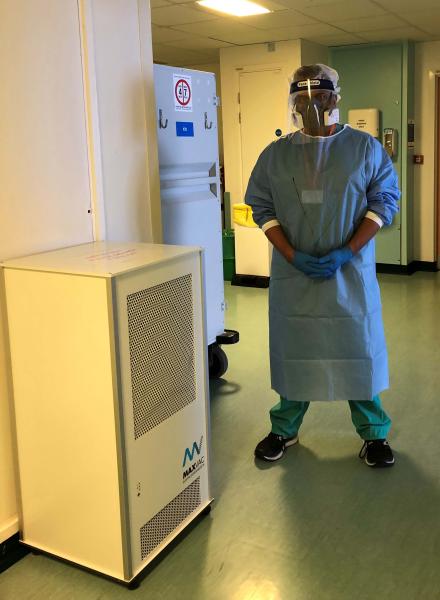
The team installed a High Efficiency Particulate Air (HEPA) air filter/UV steriliser. HEPA filters are made up of thousands of fibres knitted together to form a material that filters out particles above a certain size. The machines were placed in fixed positions and operated continuously for seven days, filtering the full volume of air in each room between five and ten times per hour.

In the surge ward, during the first week prior to the air filter being activated, the researchers were able to detect SARS-CoV-2 on all sampling days. Once the air filter was switched on and run continuously, the team were unable to detect SARS-CoV-2 on any of the five testing days. They then switched off the machine and repeated the sampling – once again, they were able to detect SARS-CoV-2 on three of the five sampling days.

On the ICU, the team found limited evidence of airborne SARS-CoV-2 in the weeks when the machine was switched off and traces of the virus on one sampling day when the machine was active.

Additionally, the air filters significantly reduced levels of bacterial, fungal and other viral bioaerosols on the both the surge ward and the ICU, highlighting an added benefit of the system.
First author Dr Andrew Conway Morris, from the Department of Medicine at the University of Cambridge, said: “We were really surprised by quite how effect air filters were at removing airborne SARS-CoV-2 on the wards. Although it was only a small study, it highlights their potential to improve the safety of wards, particularly in areas not designed for managing highly infectious diseases such as COVID-19.”

Crucially, the research team developed a robust technique for assessing the quality of air, involving placing air samplers at various points in the room and then testing the samples using PCR assays similar those used in the ‘gold standard’ COVID-19 tests.

Professor Stephen Baker, from the Cambridge Institute of Therapeutic Immunology and Infectious Disease at the University of Cambridge, said: “Cleaner air will reduce the risk of airborne disease transmission, but it’s unlikely to be the case that just installing an air filter will be enough to guarantee the air is clean enough. Every room and every situation will be different. A key part of our work has been developing a robust way of measuring air quality.”

Dr Navapurkar added: “We’re all familiar with the idea of having standards for clean water and of hygiene standards for food. We need now to agree standards for what is acceptable air quality and how we meet and monitor those standards.”

The research was supported by Wellcome, the Medical Research Council and the National Institute for Health Research Cambridge Biomedical Research Centre.

Reference
Conway Morris, A, et al. The removal of airborne SARS-CoV-2 and other microbial bioaerosols by air filtration on COVID-19 surge units. Clin Inf Dis; 30 Oct 2021; DOI: 10.1093/cid/ciab933

Image: Dr Vilas Navapurkar in ICU beside an air filter


Creative Commons License
The text in this work is licensed under a Creative Commons Attribution 4.0 International License. Images, including our videos, are Copyright ©University of Cambridge and licensors/contributors as identified.  All rights reserved. We make our image and video content available in a number of ways – as here, on our main website under its Terms and conditions, and on a range of channels including social media that permit your use and sharing of our content under their respective Terms.

Cambridge Dictionary Names ‘Perseverance’ Word of the Year 2021

NASA’s Perseverance Mars rover
source: www.cam.ac.uk


Perseverance, a word which captures the undaunted will of people across the world to never give up, despite the many challenges of the last 12 months, is Cambridge Dictionary’s Word of the Year 2021.


Just as it takes perseverance to land a rover on Mars, it takes perseverance to face challenges and disruption to our lives

Wendalyn Nichols

Perseverance has been looked up more than 243,000 times on the website in 2021, the first time it has made a noticeable appearance.

Defined by the dictionary as ‘continued effort to do or achieve something, even when this is difficult or takes a long time’, the word’s stellar performance this year may have as much to do with NASA as the pandemic. A spike of 30,487 searches for perseverance occurred between 19–25 February 2021, after NASA’s Perseverance Rover made its final descent to Mars on 18 February.

Wendalyn Nichols, Cambridge Dictionary Publishing Manager, said: “It made sense that lookups of ‘perseverance’ spiked at this time. Cambridge Dictionary is the top website in the world for learners of English, and perseverance is not a common word for students of English to have in their vocabulary. We often see spikes in lookups of words associated with current events when those words are less familiar.”

In the following months, however, perseverance continued to be looked up more frequently on the site than ever before. Nichols said: “Just as it takes perseverance to land a rover on Mars, it takes perseverance to face the challenges and disruption to our lives from COVID-19, climate disasters, political instability and conflict. We appreciated that connection, and we think Cambridge Dictionary users do, too.”

Further evidence that words looked up on Cambridge Dictionary often reflect world events is that in January searches for insurrection, impeachment, inauguration and acquit all spiked as the world closely followed the US presidential election.

In 2020, ‘quarantine’ defeated ‘lockdown’ and ‘pandemic’ to be crowned Word of the Year, attracting more than 183,000 views.

People use Cambridge Dictionary to develop their English language skills, and those who look up perseverance will find more than just the definition of the word. A new Cambridge Thesaurus article on perseverance goes beyond listing synonyms to explain the nuanced differences in meaning between perseverance, determination, persistence, doggedness, single-mindedness, tenacity, resolve, will, and the US term stick-to-it-iveness.

The Cambridge team have also created a new list of words about being determined for English learners on Cambridge Dictionary +Plus. Research shows that many people learn new vocabulary more effectively when they have a record of it, so they can go back to study and test themselves. This word list includes vocabulary related to perseverance, so English language learners can easily find out more about the word of the year while simultaneously expanding their vocabulary.

Cambridge University Press has been publishing dictionaries for learners of English since 1995. Cambridge Dictionary began offering these dictionaries completely free of charge online in 1999 and is now the top learner dictionary website in the world, serving 2.6 billion page views a year.

Find out more about Cambridge Dictionary Word of the Year 2021


Creative Commons License
The text in this work is licensed under a Creative Commons Attribution 4.0 International License. Images, including our videos, are Copyright ©University of Cambridge and licensors/contributors as identified.  All rights reserved. We make our image and video content available in a number of ways – as here, on our main website under its Terms and conditions, and on a range of channels including social media that permit your use and sharing of our content under their respective Terms.

Mystery of High-Performing Solar Cell Materials Revealed In Stunning Clarity

Artistic representation of electrons funneling into high quality areas of perovskite material
source: www.cam.ac.uk


Researchers have visualised, for the first time, why perovskites – materials which could replace silicon in next-generation solar cells – are seemingly so tolerant of defects in their structure. The findings, led by researchers from the University of Cambridge, are published in the journal Nature Nanotechnology.


We now much better understand the nanoscale landscape in these fascinating semiconductors – the good, the bad and the ugly

Sam Stranks

The most commonly used material for producing solar panels is crystalline silicon, but achieving efficient energy conversion requires an energy-intensive and time-consuming production process to create a highly ordered wafer structure.

In the last decade, perovskite materials have emerged as promising alternatives to silicon.

The lead salts used to make perovskites are much more abundant and cheaper to produce than crystalline silicon, and they can be prepared in liquid ink that is simply printed to produce a film of the material. They also show great potential for other applications, such as energy-efficient light-emitting diodes (LEDs) and X-ray detectors.

The performance of perovskites is surprising. The typical model for an excellent semiconductor is a highly ordered structure, but the array of different chemical elements in perovskites creates a much ‘messier’ landscape.

This messiness causes defects in the material that lead to tiny ‘traps’, which typically reduce performance. But despite the presence of these defects, perovskite materials still show efficiency levels comparable to their silicon alternatives.

In fact, earlier research by the same team behind the current work showed the disordered structure can actually increase the performance of perovskite optoelectronics, and their latest work seeks to explain why.

Combining a series of new microscopy techniques, the group present a complete picture of the nanoscale chemical, structural and optoelectronic landscape of these materials, that reveals the complex interactions between these competing factors and ultimately, shows which comes out on top.

“What we see is that we have two forms of disorder happening in parallel,” said first author Kyle Frohna from Cambridge’s Department of Chemical Engineering and Biotechnology (CEB). “The electronic disorder associated with the defects that reduce performance, and then the spatial chemical disorder that seems to improve it.

“And what we’ve found is that the chemical disorder – the ‘good’ disorder in this case – mitigates the ‘bad’ disorder from the defects by funnelling the charge carriers away from these traps that they might otherwise get caught in.”

In collaboration with researchers from the Cavendish Laboratory, the Diamond Light Source synchrotron facility in Didcot, and the Okinawa Institute of Science and Technology in Japan, the researchers used several different microscopic techniques to look at the same regions in the perovskite film. They could then compare the results from all these methods to present the full picture of what’s happening at a nanoscale level in these materials.

The findings will allow researchers to further refine how perovskite solar cells are made in order to maximise efficiency.

“We have visualised and given reasons why we can call these materials defect tolerant,” said co-author Miguel Anaya, also from CEB. “This methodology enables new routes to optimise them at the nanoscale to perform better for a targeted application. Now, we can look at other types of perovskites that are not only good for solar cells but also for LEDs or detectors and understand their working principles.”

“Through these visualisations, we now much better understand the nanoscale landscape in these fascinating semiconductors – the good, the bad and the ugly,” said Dr Sam Stranks from CEB, who led the research. “These results explain how the empirical optimisation of these materials by the field has driven these mixed composition perovskites to such high performances. But it has also revealed blueprints for design of new semiconductors that may have similar attributes – where disorder can be exploited to tailor performance.”

Reference:
Kyle Frohna et.al ‘Nanoscale chemical heterogeneity dominates the optoelectronic response of alloyed perovskite solar cells.’ Nature Nanotechnology (2021) DOI: 10.1038/s41565-021-01019-7


Creative Commons License
The text in this work is licensed under a Creative Commons Attribution 4.0 International License. Images, including our videos, are Copyright ©University of Cambridge and licensors/contributors as identified.  All rights reserved. We make our image and video content available in a number of ways – as here, on our main website under its Terms and conditions, and on a range of channels including social media that permit your use and sharing of our content under their respective Terms.

International Partnerships and Funding From China and Hong Kong | Blog

Senate House architectural detail
source:www.cam.ac.uk


A blog post by Professors Andy Neely and Anne Ferguson-Smith


The University of Cambridge has engaged in countless collaborations with international partners throughout our history. We have always believed that the best way to tackle seemingly intractable global issues is to work in shared research endeavours across international borders. Today, as we recover from the ravages of a pandemic and continue to focus on global challenges such as combating climate change, and ensuring food security, that approach seems more important than ever.

Global research organisations like Cambridge must always be aware that there are risks in dealing with countries that might not share some of our values. These include risks to staff or student safety, or more pernicious risks such as the theft or misuse of research for, say, military purposes. In today’s rapidly changing geo-political world there must be unprecedented focus on managing these risks.

Cambridge has long-established and robust systems for approving, rejecting and scrutinising proposed international partnerships. All projects go through a strict due diligence process, which is now enhanced by our new Principles for managing risks in international engagements. These principles, and the practical guidance that sits under them, focus on fostering a risk-aware culture and empowering our academic community to promote academic freedom and uphold our institutional values in everything we do.  We also work closely with the Government’s Export Control Joint Unit and the Investment Security Unit to ensure that any national security issues are appropriately addressed.

As a global university we do not shy away from rigorous discussions about the merits of engagement with other countries that might not share our values. One current and high profile example is China. We view collaboration with Chinese academics and funders as an important part of our mission. We also believe it is essential to be open and honest about the nature and scale of this collaboration.

Over the last five years income from China has represented less than 1 percent of research grant income, less than 9 percent of fundraising income and Chinese nationals make up around 8 percent of our student body. While not insignificant these figures do not suggest a dependency.

Breaking down these figures, our research grant income (based on expenditure) from mainland China and Hong Kong averaged £3.8m, of which an average of £2.2m per year came from Huawei (including its subsidiaries). This is against a total average research income over the same period of £539m per year. Research income from China therefore amounts to 0.7 percent of our annual research grant income over the last five years. Within that, income from Huawei represents 0.5 percent. If we were to look at the data for 20/21 only, income from China was £6.1m out of a total research grant income of £586m, this represents 1 percent of our research grant income in the last financial year.

By way of comparison, Cambridge’s research grant income from the United States of America averaged £27.9m over the past five years.

We also receive philanthropic funding from China. Since 2016/17 the University has raised £626m in philanthropic income which supports scholarships, teaching and research. Of that £54m came from donors in mainland China and Hong Kong, which represents under 9 percent. Of the £54m in philanthropic income from China since 2016/17 £7.5m was committed by Huawei.

Academic freedom is maintained at all times in every research project the University conducts. No funder has the right to direct or steer research at Cambridge. In relation to Huawei, we will not engage in any research in relation to 5G and we do not use their technology platforms.

Importantly, funding from China, as with funding from around the world, allows Cambridge to undertake exceptional research. For example, Cambridge engineers have developed a new augmented reality (AR) head-mounted display (HMD) that can deliver high quality clear images directly on the retina, even if the user is wearing glasses.

The funding also helps the University to fulfil its role in society by delivering outreach programmes such as the Faculty of Mathematics Millennium Outreach project. In the 2019/20 academic year, the project’s web-based maths resources attracted over 12 million visits from users worldwide and more than 40 million page views, while over 13,000 school students and more than 2,250 teachers were involved in our face-to-face activities and online webinars and events.

We believe that values are upheld – and improvements happen – through engagement. This is, incidentally, also the UK’s approach to foreign policy and we would encourage proactive engagement from government to navigate the evolving geopolitical landscape that seeks to balance trade relations with national security considerations. We need to maintain vigilance and be alert to the potential complications of working with international partners. The new international engagement principles we have developed at Cambridge will allow us to continue to interact on vital research with partners across the world, and to do so with a full understanding of the risks as well as the benefits.

Justinianic Plague Was Nothing Like Flu and May Have Hit England Before Constantinople

Detail of the mosaic of Justinianus I in the Basilica di San Vitale, Ravenna, Italy


‘Plague sceptics’ are wrong to underestimate the devastating impact that bubonic plague had in the 6th– 8th centuries CE, argues a new study based on ancient texts and recent genetic discoveries. The same study suggests that bubonic plague may have reached England before its first recorded case in the Mediterranean via a currently unknown route, possibly involving the Baltic and Scandinavia.


We have a lot to learn from how our forebears responded to epidemic disease

Peter Sarris

The Justinianic Plague is the first known outbreak of bubonic plague in west Eurasian history and struck the Mediterranean world at a pivotal moment in its historical development, when the Emperor Justinian was trying to restore Roman imperial power.

For decades, historians have argued about the lethality of the disease; its social and economic impact; and the routes by which it spread. In 2019-20, several studies, widely publicised in the media, argued that historians had massively exaggerated the impact of the Justinianic Plague and described it as an ‘inconsequential pandemic’. In a subsequent piece of journalism, written just before COVID-19 took hold in the West, two researchers suggested that the Justinianic Plague was ‘not unlike our flu outbreaks’.

In a new study, published in Past & Present, Cambridge historian Professor Peter Sarris argues that these studies ignored or downplayed new genetic findings, offered misleading statistical analysis and misrepresented the evidence provided by ancient texts.

Sarris says: “Some historians remain deeply hostile to regarding external factors such as disease as having a major impact on the development of human society, and ‘plague scepticism’ has had a lot of attention in recent years.”

Sarris, a Fellow of Trinity College, is critical of the way that some studies have used search engines to calculate that only a small percentage of ancient literature discusses the plague and then crudely argue that this proves the disease was considered insignificant at the time.

Sarris says: “Witnessing the plague first-hand obliged the contemporary historian Procopius to break away from his vast military narrative to write a harrowing account of the arrival of the plague in Constantinople that would leave a deep impression on subsequent generations of Byzantine readers. That is far more telling than the number of plague-related words he wrote. Different authors, writing different types of text, concentrated on different themes, and their works must be read accordingly.”

Sarris also refutes the suggestion that laws, coins and papyri provide little evidence that the plague had a significant impact on the early Byzantine state or society. He points to a major reduction in imperial law-making between the year 546, by which point the plague had taken hold, and the end of Justinian’s reign in 565. But he also argues that the flurry of significant legislation that was made between 542 and 545 reveals a series of crisis-driven measures issued in the face of plague-induced depopulation, and to limit the damage inflicted by the plague on landowning institutions.

In March 542, in a law that Justinian described as having been written amid the ‘encircling presence of death’, which had ‘spread to every region’, the emperor attempted to prop up the banking sector of the imperial economy.

In another law of 544, the emperor attempted to impose price and wage controls, as workers tried to take advantage of labour shortages. Alluding to the plague, Justinian declared that the ‘chastening which has been sent by God’s goodness’ should have made workers ‘better people’ but instead ‘they have turned to avarice’.

That bubonic plague exacerbated the East Roman Empire’s existing fiscal and administrative difficulties is also reflected in changes to coinage in this period, Sarris argues. A series of light-weight gold coins were issued, the first such reduction in the gold currency since its introduction in the 4th century and the weight of the heavy copper coinage of Constantinople was also reduced significantly around the same time as the emperor’s emergency banking legislation.

Sarris says: “The significance of a historical pandemic should never be judged primarily on the basis of whether it leads to the ‘collapse’ of the societies concerned. Equally, the resilience of the East Roman state in the face of the plague does not signify that the challenge posed by the plague was not real.”

“What is most striking about the governmental response to the Justinianic Plague in the Byzantine or Roman world is how rational and carefully targeted it was, despite the bewilderingly unfamiliar circumstances in which the authorities found themselves.

“We have a lot to learn from how our forebears responded to epidemic disease, and how pandemics impacted on social structures, the distribution of wealth, and modes of thought.”

Bubonic plague in England

Until the early 2000s, the identification of the Justinianic Plague as ‘bubonic’ rested entirely upon ancient texts which described the appearance of buboes or swellings in the groins or armpits of victims. But then rapid advances in genomics enabled archaeologists and genetic scientists to discover traces of the ancient DNA of Yersinia pestis in Early Medieval skeletal remains. Such finds have been made in Germany, Spain, France and England.

In 2018, a study of DNA preserved in remains found in an early Anglo-Saxon burial site known as Edix Hill in Cambridgeshire revealed that many of the interred had died carrying the disease. Further analysis revealed that the strain of Y. pestis found was the earliest identified lineage of the bacterium involved in the 6th-century pandemic.

Sarris says: “We have tended to start with the literary sources, which describe the plague arriving at Pelusium in Egypt before spreading out from there, and then fitted the archaeological and genetic evidence into a framework and narrative based on those sources. That approach will no longer do. The arrival of bubonic plague in the Mediterranean around 541 and its initial arrival in England possibly somewhat earlier may have been the result of two separate but related routes, occurring some time apart.”

The study suggests that the plague may have reached the Mediterranean via the Red Sea, and reached England perhaps via the Baltic and Scandanavia, and from there onto parts of the continent.

The study emphasises that despite being called the ‘Justinianic Plague’, it was “never a purely or even primarily Roman phenomenon” and as recent genetic discoveries have proven, it reached remote and rural sites such as Edix Hill, as well as heavily populated cities.

It is widely accepted that the lethal and virulent strain of bubonic plague from which the Justinianic Plague and later the Black Death would descend had emerged in Central Asia by the Bronze Age before evolving further there in antiquity.

Sarris suggests that it may be significant that the advent of both the Justinianic Plague and the Black Death were preceded by the expansion of nomadic empires across Eurasia: the Huns in the 4th and 5th centuries, and the Mongols in the 13th.

Sarris says: “Increasing genetic evidence will lead in directions we can scarcely yet anticipate, and historians need to be able to respond positively and imaginatively, rather than with a defensive shrug.”


Reference
P. Sarris, ‘New Approaches to the ‘Plague of Justinian’, Past & Present (2021); DOI: 10.1093/pastj/gtab024.


Creative Commons License
The text in this work is licensed under a Creative Commons Attribution 4.0 International License. Images, including our videos, are Copyright ©University of Cambridge and licensors/contributors as identified.  All rights reserved. We make our image and video content available in a number of ways – as here, on our main website under its Terms and conditions, and on a range of channels including social media that permit your use and sharing of our content under their respective Terms.

Students Who Self-Identify As Multilingual Perform Better At GCSE

Language dictionaries
source: www.cam.ac.uk

Young people who consider themselves ‘multilingual’ tend to perform better across a wide range of subjects at school, regardless of whether they are actually fluent in another language, new research shows.


If pupils were encouraged to see themselves as active and capable language learners, it could have a really positive impact on their wider progress at school.

Linda Fisher

The study, of just over 800 pupils in England, found a positive relationship between GCSE scores and ‘multilingual identity’: a reference to whether pupils felt a personal connection with other languages through knowledge and use. Those who self-identified as multilingual typically outperformed their peers not just in subjects such as French and Spanish, but in non-language subjects including maths, geography and science. This applied whether or not they actually spoke a second language fluently.

Perhaps surprisingly, however, not all pupils who were officially described by their schools as having ‘English as a Second Language’ (EAL) thought of themselves as multilingual, even though the term is used by schools and Government as a proxy for multilingualism. Correspondingly, these pupils did not necessarily perform better (or worse) as a group at GCSE than their non-EAL peers.

The results indicate that encouraging pupils to identify with languages and to value different styles of communication could help them to develop a mindset that supports academic progress overall.

Other recent research has argued for broadening the scope of language lessons so that, as well as studying vocabulary and grammar, pupils explore the importance of languages and their significance for their own lives. This new study was the first, however, to examine the relationship between multilingual identity and attainment. It was led by academics at the University of Cambridge and the findings are published in the Journal of Language, Identity and Education.

Dr Dee Rutgers, a Research Associate at the Faculty of Education, University of Cambridge, said: “The evidence suggests that the more multilingual you consider yourself to be, the higher your GCSE scores. While we need to understand more about why that relationship exists, it may be that children who see themselves as multilingual have a sort of ‘growth mindset’ which impacts on wider attainment.”

Dr Linda Fisher, Reader in Languages Education at the University of Cambridge, said: “There could be a strong case for helping children who think that they can’t ‘do’ languages to recognise that we all use a range of communication tools, and that learning a language is simply adding to that range. This may influence attitude and self-belief, which is directly relevant to learning at school. In other words, what you think you are may be more important than what others say you are.”

The study’s authors argue that being multilingual means far more than the official EAL definition of being ‘exposed to a language at home that is known or believed to be other than English’. They suggest that even young people who see themselves as monolingual possess a ‘repertoire’ of communication. For example, they may use different dialects, pick up words and phrases on holiday, know sign language, or understand other types of ‘language’ such as computer code.

The study involved 818 Year-11 pupils at five secondary schools in South East England. As well as establishing whether pupils were officially registered as EAL or non-EAL, the researchers asked each pupil if they personally identified as such. Separately, each pupil was asked to plot where they saw themselves on a 0-100 scale, where 0 represented ‘monolingual’ and 100 ‘multilingual’. This data was compared with their GCSE results in nine subjects.

Students who spoke a second language at home did not always personally identify either as EAL or multilingual. Conversely, pupils who saw themselves as multilingual were not always those earmarked by the school as having English as an additional language.

“The fact that these terms didn’t correlate more closely is surprising considering that they are all supposedly measuring the same thing,” Rutgers said. “Just having experience of other languages clearly doesn’t necessarily translate into a multilingual identity because the experience may not be valued by the student.”

School-reported EAL status had no impact on GCSE results, although pupils who self-identified as EAL generally did better than their peers in modern languages. Those who considered themselves ‘multilingual’ on the 0-100 scale, however, performed better academically across the board.

The strength of this relationship varied between subjects and was, again, particularly pronounced in modern languages. In all nine GCSE subjects assessed, however, each point increase on the monolingual-to-multilingual scale was associated with a fractional rise in pupils’ exam scores.

For example: a one-point increase was found to correspond to 0.012 of a grade in Science, and 0.011 of a grade in Geography. Students who consider themselves very multilingual would, by this measure, typically score a full grade higher than those who consider themselves monolingual. Positively identifying as multilingual could often therefore be enough to push students who would otherwise fall slightly short of a certain grade up to the next level.

The findings appear to indicate that the positive mentality and self-belief which typically develops among pupils with a multilingual identity has spill-over benefits for their wider education. The authors add that this could be cultivated in languages classrooms: for example, by exposing young people to learning programmes that explore different types of language and dialect, or encouraging them to think about how languages shape their lives both inside and outside school.

“Too often we think about other languages as something that we don’t need to know, or as difficult to learn,” Fisher said. “These findings suggest that if pupils were encouraged to see themselves as active and capable language learners, it could have a really positive impact on their wider progress at school.”


Creative Commons License
The text in this work is licensed under a Creative Commons Attribution 4.0 International License. Images, including our videos, are Copyright ©University of Cambridge and licensors/contributors as identified.  All rights reserved. We make our image and video content available in a number of ways – as here, on our main website under its Terms and conditions, and on a range of channels including social media that permit your use and sharing of our content under their respective Terms.

Cambridge-Built Carbon Credit Marketplace Will Support Reforestation Efforts Worldwide

View of forest

source: www.cam.ac.uk

A new Cambridge centre will bring together computer scientists and conservation scientists to build a trusted marketplace for carbon credits and support global reforestation efforts, the first initiative of its kind in the UK.


What’s needed is a decentralised marketplace where purchasers of carbon credits can confidently and directly fund trusted nature-based projects. And that’s the gap the Centre is aiming to fill

Anil Madhavapeddy

The Cambridge Centre for Carbon Credits (4C) – based in the Department of Computer Science and Technology, and the University of Cambridge Conservation Research Institute – has two primary goals: to support students and researchers in the relevant areas of computer science, environmental science, and economics; and to create a decentralised marketplace where purchasers of carbon credits can confidently and directly fund trusted nature-based projects.

The Centre will build its decentralised marketplace on the energy-efficient Tezos blockchain because it operates sustainably and allows third parties to verify all transactions, in line with the Centre’s vision to support a sustainable future through technology. The goal of the marketplace is to exponentially increase the number of real nature-based conservation and restoration projects by channelling funding towards them via market-based instruments.

Nature-based solutions, particularly forests, have a vital role to play in mitigating the worst effects of climate change. Pressure is mounting from governments and the public to rapidly roll out a global programme of well-executed nature-based solutions (NbS) to sequester several gigatons of carbon each year and protect biodiversity. However, current NbS projects are hampered by chronic underfunding.

“Current accreditation systems that measure and report the value of carbon and related benefits like biodiversity conservation and poverty reduction rendered by NbS are costly, slow and inaccurate,” said Centre Director Dr Anil Madhavapeddy. “These systems have undermined trust in NbS carbon credits. What is needed is a decentralised marketplace where purchasers of carbon credits can confidently and directly fund trusted nature-based projects. And that’s the gap the Centre is aiming to fill.”

The Centre will support 12 PhD students and postdoctoral fellows, and investment to prototype a scalable, trusted NbS marketplace. Researchers funded from the Centre will come from the Departments of Computer Science and Technology, Zoology, and Plant Sciences, as well as from the Centre for Doctoral Training in Artificial Intelligence for the study of Environment Risk.

Professor David Coomes, Director of the University of Cambridge Conservation Research Institute, said: “Conservation strategies are increasingly broadening to include large datasets, remote sensing technologies and computational approaches. The Centre for Carbon Credits is a ground-breaking initiative that will bring together computer scientists and conservation scientists in a new way.”

Andrew Balmford, Professor of Zoology, said: “The recent announcement at COP26 of the new commitment to halt and reverse forest loss and land degradation by 2030 demonstrates the crucial role forests play in carbon capture and the health of our planet. The new Centre has a significant role to play in supporting crucial research to develop new, trusted mechanisms to support reforestation projects.”

Speaking on the collaborative nature of the Centre, Professor Ann Copestake, Head of the Department of Computer Science and Technology, said: “In the last few years, we’ve been expanding our emphasis on the use of computer science techniques and technologies to help address the climate emergency and the crisis in biodiversity. We are delighted to be bringing our research strengths together with the expertise in environmental science across the University of Cambridge. We hope the work resulting from this interdisciplinary collaboration will lay the foundation for tangible solutions to some of the environmental challenges facing the world.”


Creative Commons License
The text in this work is licensed under a Creative Commons Attribution 4.0 International License. Images, including our videos, are Copyright ©University of Cambridge and licensors/contributors as identified.  All rights reserved. We make our image and video content available in a number of ways – as here, on our main website under its Terms and conditions, and on a range of channels including social media that permit your use and sharing of our content under their respective Terms.

“It’s Almost As If They Don’t Exist”: Education Policy Fails To Account For PMLD Learners

source: www.cam.ac.uk

The policy framework that supposedly guides education for pupils with Profound and Multiple Learning Disabilities (PMLD) is setting expectations and goals which are often completely at odds with their capabilities and lives, a study says.


We need a completely different kind of social contract for these young people

Andrew Colley

The research, which is published in a book launched on Tuesday 9 November, found that the key piece of statutory guidance underpinning education for PMLD learners – the Special Needs and Disabilities (SEND) Code of Practice (2015) – indicates that teachers should prepare them for a future that involves independent living, possible further education and employment.

Researchers argue that these are highly unlikely to represent realistic goals for most children with PMLD. Broadly, PMLD describes people with a combination of very severe learning difficulties, sensory impairments, physical disabilities, complex medical conditions, and challenging behaviours. Most require very high levels of care and support throughout their lives, including with tasks such as washing and eating.

The study also analysed other key health and social care policy documents on which support for children with PMLD is meant to be based. It found that these often make similarly unrealistic assumptions: “because judgements are based on the experiences and values of the policy-makers, because all types and levels of disability are seen as effectively the same, and because people with PMLD tend to be viewed as non-contributors to society”.

For example, Valuing People Now, a Government policy document published in 2009, states that people with learning difficulties – apparently including those with PMLD – “should be supported to pay taxes, vote [and] do jury duty”.

The book, Enhancing Wellbeing and Independence for Young People with Profound and Multiple Learning Difficulties, combines this policy analysis with the findings from staff surveys at more than 110 special schools in 20 countries, including 52 of around 300 schools that teach PMLD pupils in the UK.

It was co-authored by Andrew Colley, a former special education teacher and lecturer, who did the research as part of a Masters Degree at the Faculty of Education, University of Cambridge; and Julie Tilbury, Lead Teacher for children with PMLD at Chailey Heritage School, East Sussex.

Their findings highlight the outstanding practice of professionals working with pupils with PMLD pupils, but also suggest that teachers rarely refer to the existing policy guidance except when completing official documents. Asked if they felt that the SEND Code of Practice took account of learners with PMLD, teachers commented: “it doesn’t”, “not at all” and “it’s almost as if they don’t exist”.

“The way wellbeing and independence are defined in policy doesn’t appear to support these learners and ends up excluding them because of the complexity of their disability,” Colley said.

“Most of the guidance that exists assumes their education can be rooted in neurotypical expectations about employment or making an economic contribution when the reality is they will probably never be able to work. The policy covers children with PMLD, but doesn’t cater for them. We need a completely different kind of social contract for these young people.”

There are around 11,000 learners with PMLD in English schools, and an estimated 75,000 people of all ages with PMLD in the UK. Previous research has attempted to identify what ‘wellbeing’ and ‘independence’ should mean for these individuals. In general, it recommends that schools should focus on helping them to live with dignity, form social and emotional relationships, stay healthy and active, and communicate – which for people with PMLD often involves unconventional styles of communication such as blinking and physical gestures.

Contrastingly, the SEND Code of Practice, which makes just one reference to pupils with PMLD in 287 pages, states: “With high aspirations and the right support the vast majority of children and young people can go on to achieve successful long-term outcomes in adult life,” before referring to “higher education and/or employment” and “independent living” as examples.

Many practitioners working with PMLD learners treat the Code as an irrelevance, the researchers found. As much as possible, teachers create learning programmes which respond to the needs of each individual. In line with the recommendations of specialists, this often means that lessons prioritise the enhancement of wellbeing and health, communication, and the development of basic skills such as washing, eating, and independent movement. “There is fantastic work going on in schools, but it is completely separate from what policy dictates,” Colley said.

Despite the efforts of education professionals, the study also highlights the limited opportunities learners with PMLD have to engage with their wider communities. 80% of UK teachers mostly or completely agreed with the statement: “the social life of someone with PMLD is largely focused on their family or school”. Almost 50% felt that families with a member who has PMLD “live isolated and unfulfilled lives”.

The research calls for a different type of policy framework for learners with PMLD which focuses on helping them to become happy, fulfilled and empowered adults, with a sense of belonging rooted in warm and trusting relationships.

Colley added: “To demand that their education should lead to independence in a conventional sense stigmatises their condition, as well as their families. Just because pupils with PMLD are unlikely to work or own a house doesn’t make them any less worthy of our attention as human beings.”

“Addressing this also gives us an opportunity to think differently about what education for all young people really means, beyond the perspective of employment or academic attainment. A really inclusive education system that takes PMLD learners into account demands that we look for something more for everyone.”

Enhancing Wellbeing and Independence for Young People with Profound and Multiple Learning Difficulties is published by Routledge.


Creative Commons License
The text in this work is licensed under a Creative Commons Attribution 4.0 International License. Images, including our videos, are Copyright ©University of Cambridge and licensors/contributors as identified.  All rights reserved. We make our image and video content available in a number of ways – as here, on our main website under its Terms and conditions, and on a range of channels including social media that permit your use and sharing of our content under their respective Terms.

Cambridge Scientists To Take Part In Royal Institution Christmas Lectures

Audience at Royal Institution Christmas Lecture
source: www.cam.ac.uk


Three Cambridge researchers are among six leading UK scientists who will share the presenting duties with Professor Jonathan Van-Tam during this year’s Christmas Lectures from the Royal Institution.


Professors Julia Gog, Ravi Gupta and Sharon Peacock, each of whom have played a key role in the UK’s response to the on-going COVID-19 pandemic, will lead the on-screen exploration into their area of scientific expertise, with two Guest Lecturers appearing in each episode.

Together, they will offer insights to the Christmas Lectures’ young audience into the world of viruses – how they arise and proliferate, and how we humans respond – from testing and modelling to vaccine development and infection control. They will reveal why discoveries and advances made during the on-going pandemic will have an impact far beyond COVID-19 and are set to change the future of medicine.

The Guest Lecturers will support the 2021 Christmas Lecturer Jonathan Van-Tam to demonstrate that tackling pandemics is a collaborative and interdisciplinary scientific effort.

Professor Julia Gog OBE, is Professor of Mathematical Biology at the Department of Applied Mathematics and Theoretical Physics at the University of Cambridge and the David N. Moore Fellow and Director of Studies in Mathematics at Queens’ College, Cambridge. During the pandemic she has contributed to scientific advice to the UK government through SAGE and SPI-M, the group which provides input based on infectious disease modelling and epidemiology.

Professor Ravi Gupta, is Professor of Clinical Microbiology at the Cambridge Institute for Therapeutic Immunology and Infectious Disease. Using his expertise in RNA virus genetics and biology, Ravi’s work during the pandemic has included reporting the first genotypic-phenotypic evidence for immune escape of SARS-CoV-2 within an individual, defining the process by which new variants are likely to arise, and defining the immune escape and transmissibility advantage of the Delta variant as the driver behind its global expansion.

Professor Sharon Peacock CBE, is Professor of Public Health and Microbiology in the Department of Medicine at the University of Cambridge. During the pandemic Sharon has Chaired the COVID-19 Genomics UK (COG-UK) Consortium, delivering large-scale and rapid whole-genome virus sequencing to local NHS centres and the UK government, and helping to inform UK public health interventions and policies.

Also taking part as Guest Lecturers are:

  • Professor Katie Ewer, a cellular immunologist and Associate Professor at the Jenner Institute at the University of Oxford.
  • Professor Teresa Lambe OBE, an Associate Professor based in the Oxford Vaccine Group at the University of Oxford.
  • Professor Catherine Noakes OBE, Professor of Environmental Engineering for Buildings at the University of Leeds.

Lucinda Hunt, Director of the Royal Institution, said: “We are delighted that Jonathan will be joined by such an exciting and expert group of scientists during this year’s series of three Christmas Lectures.

“They will work together to take us on a journey through the world of viruses – how they arise, how they proliferate, and how science and society responds – just as they are doing in tackling the current pandemic. What a strong and positive message that will be for our young audience, about the power of collaborative science.”

Patrick Holland, BBC Director, Factual, Arts and Classical Music Television, said: “Scientists across the world have responded to the Covid crisis with expertise and ingenuity that is humbling for us all. It is no exaggeration to say that the path of history has been changed because of the work of vaccine scientists and epidemiologists.

“Jonathan and his team will give us another exciting and thought-provoking series of Lectures, covering so much more than COVID-19. This will be a celebration of science and of the scientists whose advances are shaping our world.”

In the 2021 Christmas Lectures, ‘Going viral: How Covid changed science forever’, epidemiologist and one of England’s two Deputy Chief Medical Officers, Jonathan Van-Tam, will take a deep dive into many and varied viruses, including COVID-19, and reveal why discoveries and advances made during the on-going pandemic – from early detection techniques to new vaccines – mean biological science will never be the same again.

The 2021 Christmas Lectures will be broadcast on BBC Four and iPlayer between Christmas and New Year.

The 2021 Christmas Lectures are co-produced by the Ri and Windfall Films for BBC Four and iPlayer. They were commissioned by Patrick Holland, Director, Factual, Arts and Classical Music Television and Jack Bootle, Head of Commissioning, Science and Natural History. The Commissioning Editor for the BBC is Tom Coveney. The Series Producer is Henry Fraser and the Executive Producer is David Dugan.

Adapted from a press release by the Royal Institution


Creative Commons License
The text in this work is licensed under a Creative Commons Attribution 4.0 International License. Images, including our videos, are Copyright ©University of Cambridge and licensors/contributors as identified.  All rights reserved. We make our image and video content available in a number of ways – as here, on our main website under its Terms and conditions, and on a range of channels including social media that permit your use and sharing of our content under their respective Terms.

Hungry Caterpillars An Underappreciated Driver of Carbon Emissions

source: www.cam.ac.uk


A study led by the University of Cambridge has found that periodic mass outbreaks of leaf-munching caterpillars can improve the water quality of nearby lakes – but may also increase the lakes’ carbon dioxide emissions.


From a water quality perspective they’re a good thing, but from a climate perspective they’re pretty bad

Sam Woodman

Outbreaks of caterpillars of invasive gypsy moths, Lymantria dispar dispar, and forest tent caterpillar moths, Malacasoma disstria occur at least every five years in temperate forests. The insects munch through so many leaves that the resulting decrease in leaf-fall and increase in insect excrement has been found to alter the cycling of nutrients, particularly carbon and nitrogen, between land and nearby lakes on a huge scale.

Nitrogen-rich insect excrement, called frass, can wash into lake water and act as fertiliser for microbes, which then release carbon dioxide into the atmosphere as they metabolise. The researchers suggest that in outbreak years the large quantities of frass will favour the growth of greenhouse gas-producing bacteria in lakes at the expense of algae that remove CO2 from the atmosphere.

“These insects are basically little machines that convert carbon-rich leaves into nitrogen-rich poo. The poo drops into lakes instead of the leaves, and this significantly changes the water chemistry – we think it will increase the extent to which lakes are sources of greenhouse gases,” said Professor Andrew Tanentzap in the University of Cambridge’s Department of Plant Sciences, senior author of the paper.

Northwards range expansion and increased insect population growth is anticipated as the climate changes. This puts northern forests at increased risk of defoliator outbreaks in the future, potentially causing greater quantities of CO2 to be released from nearby lakes.

This northwards shift is also concerning because there are more freshwater lakes further north. And climate change is also expected to favour broadleaved deciduous trees around the lakes, which will amplify the effect of the insects.

The study found that in years with insect outbreaks, the leaf area of forests was reduced by an average of 22%. At the same time, nearby lakes contained 112% more dissolved nitrogen and 27% less dissolved carbon compared to non-outbreak years. The effects were greatest when lake catchments contained higher proportions of deciduous broadleaved trees, such as oaks and maples, which the caterpillars favour over coniferous trees like pines.

To get their results, researchers combined 32 years of government data from insect outbreak surveys and lake water chemistry in 12 lake catchments across Ontario, Canada, and satellite remote sensing data on forest type and monthly leaf area cover. The results are published today in the journal Nature Communications.

This is believed to be the most extensive study ever undertaken into how insect outbreaks impact freshwater carbon and nitrogen dynamics. Previous studies have been so small that it has been difficult to extract wider generalities.

A previous 26-year study of 266 lakes across the northern hemisphere has shown that carbon is naturally accumulating in these lake waters, in a process called browning. The trend is attributed to a variety of factors including climate change, and recovery from historical acid rain and logging activities. Comparing the new results to this data showed that an outbreak of leaf-munching caterpillars can effectively offset an entire year’s worth of carbon accumulation in nearby lakes – significantly improving water quality.

In years without outbreaks of leaf-eating insects, carbon and nitrogen entering lakes usually comes from decaying leaf and needle litter, and peaks in quantity in autumn. In outbreak years, the study found that nearby freshwater lakes contained an average of 27% less dissolved carbon.

“Outbreaks of leaf-eating insects can reduce the carbon dissolved in lake water by almost a third when the trees around the lake are mainly deciduous. It’s just amazing that these insects can have such a pronounced effect on water quality,” said Sam Woodman, a researcher in the University of Cambridge’s Department of Plant Sciences and first author of the report.

He added: “From a water quality perspective they’re a good thing, but from a climate perspective they’re pretty bad – yet they’ve been completely overlooked in climate models.”

This research was funded by the Natural Environment Research Council (NERC).

Reference

Woodman, S. G. et al: ‘Forest defoliator outbreaks alter nutrient cycling in northern waters’, Nature Communications, November 2021. DOI: 10.1038/s41467-021-26666-1


Creative Commons License
The text in this work is licensed under a Creative Commons Attribution 4.0 International License. Images, including our videos, are Copyright ©University of Cambridge and licensors/contributors as identified.  All rights reserved. We make our image and video content available in a number of ways – as here, on our main website under its Terms and conditions, and on a range of channels including social media that permit your use and sharing of our content under their respective Terms.

Cambridge Confers Law Degree On UN Secretary-General António Guterres


The University of Cambridge on Wednesday held a special Congregation of its Regent House, for its Chancellor, Lord Sainsbury of Turville, to confer the honorary degree of Doctor of Law on His Excellency António Guterres, Secretary-General of the United Nations.


In an address to the Chancellor, Vice-Chancellor, academics, students and civic guests, given in the University’s Senate House after being admitted to his degree, the Secretary-General spoke of the urgent need for global research institutions like Cambridge to find scientific solutions, to produce solid facts, to enlighten people through education and learning; to drive change and offer discoveries that can benefit the entire world.

UN Secretary-General António Guterres said: “We are careering toward climate catastrophe, unless we act now to keep temperature rises to the 1.5-degree target of the Paris Agreement.

“Current pledges put us on course for an uninhabitable world, with temperatures at least two degrees higher than they were in pre-industrial times.

“Biodiversity is collapsing, with a million species at risk of extinction.

“And we are polluting and poisoning air, water and land.

“Cambridge University is at the forefront of efforts to tackle these crises, through Cambridge Zero and the Cambridge Conservation Initiative.

“And the Cambridge Institute for Sustainability Leadership is demonstrating that academia and the corporate sector can work together to drive transformative change.”

The Vice-Chancellor, Professor Stephen J. Toope, OC said: “I am delighted that the University has today honoured the Secretary-General, António Guterres with an honorary degree. In doing so, Cambridge is also recognising the work of his UN colleagues around the globe. The Secretary-General is playing a crucial role in the arduous negotiations taking place at COP26, and has been stark in his warning about the risks we are up against. But he has also given us hope. The UN’s ‘Our Common Agenda’ initiative is a rousing call to strengthen multilateralism.

“In emphasising the importance of long-term thinking, and in proposing a greater focus on facts and science, it aligns with our University’s approach to tackling some of the world’s most complex challenges. I am very grateful to the Secretary-General for acknowledging that, in the face of such challenges, universities “hold many of the solutions we need. Not only climate scientists and pharmacologists, but sociologists, lawyers, economists and experts in every discipline (…) researching ideas that can lead to breakthroughs for the common good.” Cambridge will do its utmost to live up to that expectation.”

The Director of Cambridge Zero, Professor Emily Shuckburgh, OBE said:

“The Secretary-General has said we need institutions dedicated to learning, critical thinking and pushing the boundaries of human understanding. We are responding to that by channeling ideas and innovations from Cambridge to shape climate-resilient net-zero futures for every citizen of the world.”

The University of Cambridge traces its beginnings back to 1209 and its mission is to contribute to society through the pursuit of education, learning and research at the highest international levels of excellence. Cambridge is one of the top three global research universities addressing some of the world’s greatest challenges, from climate change and the genomics of human viruses, to food security and anti-microbial resistance. The University attracts some of the most able undergraduate and postgraduate students and its graduates are highly sought after for leading roles in industry, academia and government. Cambridge is ranked third in the QS World Rankings and has the maximum Employer Reputation score of 100.

According to an in-depth MIT study on entrepreneurial ecosystems, Cambridge is also one of the world’s top three university innovation hubs, supporting a high-tech local economy in the East of England with a turnover of £48 billion [2020], where the University acts as a catalyst providing ideas for commercialisation, early stage funding, venture capital, incubation for start-up companies and a well-educated workforce to power them as they scale up. Cambridge University Press & Assessment publishes more than 380 academic journals and thousands of books for research and higher education, as well as providing assessment for more than eight million learners in more than 170 countries every year.

Read the UN Secretary-General’s remarks in full

View the ceremony in full


Creative Commons License
The text in this work is licensed under a Creative Commons Attribution 4.0 International License. Images, including our videos, are Copyright ©University of Cambridge and licensors/contributors as identified.  All rights reserved. We make our image and video content available in a number of ways – as here, on our main website under its Terms and conditions, and on a range of channels including social media that permit your use and sharing of our content under their respective Terms.

Scientists Discover How Our Brain Uses Nutritional State To Regulate Growth and Age at Puberty

Young girl
source: www.cam.ac.uk


Cambridge scientists have discovered how a receptor in the brain, called MC3R, detects the nutritional state of the body and regulates the timing of puberty and rate of growth in children and increases in lean muscle mass.


This discovery shows how the brain can sense nutrients and interpret this to make subconscious decisions that influence our growth and sexual development

Sir Stephen O’Rahilly

These findings, published today in the journal Nature, may explain how humans have been growing taller and reaching sexual maturity earlier over the past century. Over the 20th century, average height increased by about 10 cm in the UK, and up to 20 cm in other countries.

While scientists have long suggested that this phenomenon could be related to more reliable access to food for pregnant women and children, until now, precisely how the body senses its state of nutrition and turns that information into growth and sexual maturation had not been understood.

It was already known that signals reach the brain to indicate the body’s nutritional state, such as the hormones leptin, produced in adipose (fat) cells, and insulin, produced in response to increases in blood sugar levels. In a part of the brain called the hypothalamus, these hormones act on a small group of neurons that produce signals called melanocortins.

The melanocortins act on a variety of receptors, two of which are present in the brain. One of these, the melanocortin 4 receptor (MC4R) has previously been shown to regulate appetite and lack of MC4R results in obesity; however, the MC4R system does not control the effect of nutrition on growth and timing of puberty.

Now, a study, led by researchers from the MRC Metabolic Diseases Unit and the MRC Epidemiology Unit (both part of the Wellcome-MRC Institute of Metabolic Science) at the University of Cambridge, with collaborators from Queen Mary University of London, University of Bristol, University of Michigan and Vanderbilt University, has discovered a role for the brain’s other melanocortin receptor, which is known as the melanocortin 3 receptor (MC3R).

They found that in response to nutritional signals the MC3R system controls the release of key hormones regulating growth and sexual maturation.

To show the link in humans, the scientists searched amongst the half a million volunteers in UK Biobank for people with naturally occurring genetic mutations that disrupt the function of the MC3R. They identified a few thousand people who carried various mutations in the gene for MC3R and found these people were on average shorter and went into puberty later than those with no mutation.

For example, they identified 812 women who had the same mutation in one of their two copies of the MC3R gene. This mutation only partly reduced the ability of the receptor to work. Despite this subtle effect, women who carried this were on average 4.7 months older at puberty than those without the mutation.

People with mutations that reduced the function of MC3R were also shorter and had lower amounts of lean tissue, such as muscle, but it had no influence on how much fat they carried.

To confirm these findings in children, they studied almost 6,000 participants from the Avon Longitudinal Study of Parents and Children (ALSPAC) and identified six children with mutations in MC3R. The six children were shorter and had lower lean mass and weight throughout childhood, showing that this effect starts very early in life.

All the people identified in these studies had a mutation in only one of the two copies of the gene. Finding mutations in both copies of the gene is vanishingly rare, but in another cohort the researchers were able to identify an individual in the Genes and Health study with a very damaging mutation in both copies of the gene. This person was very short and went into puberty after the age of 20.

This same phenomenon linking adequate nutritional body stores to reproductive maturity is seen right across the animal kingdom, so the researchers conducted studies in mice to confirm that the MC3R pathway operates across species. Work in the laboratory of Dr Roger Cone at the University of Michigan, who had previously demonstrated a role for the MC3R in the control of growth and lean mass in mice, showed that while normal mice shut off their reproductive cycle when they underwent a period of food deprivation, mice engineered to lack the MC3R did not. This confirmed that MC3R is a necessary part of how the nutritional state controls sex hormone production.

Professor Sir Stephen O’Rahilly, a senior author on the study and Director of the MRC Metabolic Diseases Unit at the University of Cambridge, said: “This discovery shows how the brain can sense nutrients and interpret this to make subconscious decisions that influence our growth and sexual development. Identifying the pathway in the brain whereby nutrition turns into growth and puberty explains a global phenomenon of increasing height and decreasing age at puberty that has puzzled scientists for a century.

“Our findings have immediate practical implications for the testing of children with serious delays in growth and pubertal development for mutations in the MC3R.

“This research may have wider implications beyond child development and reproductive health. Many chronic diseases are associated with the loss of lean mass, including muscle, with resultant frailty. This responds poorly to simple nutritional supplements such as protein-rich drinks. The finding that the activity of the MC3R pathway influences the amount of lean mass carried by a person suggests that future research should investigate if drugs that selectively activate the MC3R might help redirect calories into muscle and other lean tissues with the prospect of improving the physical functional of such patients.”

Professor John Perry, a senior author on the study from the MRC Epidemiology Unit at the University of Cambridge, said: “This is such an exciting time for human genetics. By analysing the genetic sequences of large numbers of research participants, we can now understand fundamental biological processes that have remained elusive until now. By combining these studies with experiments in cellular and animal models, we will continue to uncover new insights and understand the mechanisms behind human growth and metabolic disease.”

The research was funded by the UK Medical Research Council, Wellcome and the National Institute for Health Research.

Dr Rob Buckle, Chief Science Officer at the Medical Research Council, which was a funder of the research, said: “These findings have the potential to make a significant step forward in future management of disorders of growth and puberty, and improvements in the health of those suffering from frailty caused by chronic conditions. This study shows the value of long-term investment in both large UK population cohorts and multidisciplinary research to discover the underpinning causes of human health and disease.”

Reference
Lam BYH et al. MC3R links nutritional state to childhood growth and the timing of puberty. Nature; 3 Nov 2021

Adapted from a press release by the Medical Research Council


Creative Commons License
The text in this work is licensed under a Creative Commons Attribution 4.0 International License. Images, including our videos, are Copyright ©University of Cambridge and licensors/contributors as identified.  All rights reserved. We make our image and video content available in a number of ways – as here, on our main website under its Terms and conditions, and on a range of channels including social media that permit your use and sharing of our content under their respective Terms.

Study Reveals ‘Drastic Changes’ To Daily Routines During UK Lockdowns

Child and mother during lockdown
source: www.cam.ac.uk

Some spent an extra hour a day on chores and childcare during lockdowns, while others got an added daily hour of solo leisure time – and most of us reduced time spent on paid work by around half an hour a day.


The lockdowns resulted in drastic changes to patterns of time use, disrupting routines and blurring the distinction between work and family life

Ines Lee

This is according to a new study of “time-use diaries” kept by 766 UK citizens from across the social spectrum during three points in time: the last month of normality, the first lockdown, and the last lockdown in March of this year.

Economists from the University of Cambridge and Queen Mary University of London collected data that charted time spent on activities during both typical work and nonwork days to map changes to the rhythm of life for millions.

The study, published today in the journal PLOS ONE, found marked differences between genders, particularly parents of young children, and that increases in odd working hours and downtime spent alone were detrimental to wellbeing.

“The lockdowns resulted in drastic changes to patterns of time use, disrupting routines and blurring the distinction between work and family life,” said co-author Dr Ines Lee from Cambridge’s Faculty of Economics.

“We have hopefully seen the end of lockdowns, but our study holds lessons for hybrid working, as splitting time between home and office becomes more common.”

“Employers should promote better work-life balance in the post-pandemic world. This could include limits on emails outside working hours, home-working schedules that suit parents, and options for younger workers left isolated by reduced in-person networking,” said Lee.

The researchers looked at amounts of time each individual spent on activities in four broad categories: employment (excluding commutes); “housework” (from shopping to childcare); leisure (e.g. hobbies or home entertainment); subsistence (meals, sleeping, personal care).

While previous studies have focused on the initial lockdown, this is one of the first to examine the effects of repeated COVID-19 containment measures on our lives and routines.

Before Covid arrived, 86% of the sample was employed, but this fell to 63% in the first lockdown and 74% in the third. Mothers of young children were significantly less likely to be employed than fathers by the third lockdown.

For those employed before and during lockdowns, people with at least one young child spent an average of 43 fewer minutes a day on their paid job in the first lockdown, and 32 fewer minutes in the third, compared to pre-pandemic.

For those without young children it was an average decrease of 28 minutes and 22 minutes a day on paid work respectively.

Women with young children spent around an hour less on paid work a day than men and women without young children. This was mainly a reduction in time spent on actual work tasks rather than, for example, meetings.

During the first lockdown, the average time women spent on housework increased by 28 minutes a day, while for men the average time spent on subsistence activities (e.g. sleeping and eating) increased by 30 minutes. By 2021 these changes had evened out.

Life with small children during this year’s lockdown meant an extra hour of housework a day over pre-pandemic levels. Mothers of young kids did 67 more minutes of housework a day than fathers. Only women saw an increase in cooking and cleaning (time spent on caring duties was spread across genders).

The study suggests that parents often forfeited leisure time. Living with young kids was associated with a drop in leisure activities of almost an hour a day in both lockdowns – and income levels made no difference to this loss of downtime.

For those without young kids, leisure time increased – but much of it was spent alone. By the third lockdown, people with no small children had around an extra hour of solitary leisure time a day over pre-pandemic levels.

However, in terms of quality – the self-reported “enjoyment” of given activities – this solo leisure time felt less pleasurable during the last lockdown than it had prior to the pandemic.

The third lockdown also saw around 20% of individuals spend more time working unusual hours (outside 0830-1730) compared to the pre-pandemic period, which reduced the reported enjoyment of their day overall.

Those earning £5k a month or more, worked almost two extra hours a day than people earning less than £1k a month by the last lockdown. High earners also spent less time on subsistence activities during both lockdowns.

Overall, the third lockdown felt a bit more miserable than the first, according to the research.

While there was little change in the enjoyment of various activities in the early days of Covid, with men even reporting slightly higher “quality” of time during lockdown one, by March of this year enjoyment of activities was around 5% lower than pre-pandemic levels across the board.

Dr Eileen Tipoe, co-author from Queen Mary University of London, said: “It is no surprise that having to do more work outside of typical working hours meant that people were substantially unhappier during the third lockdown.

“And it was concerning to find that women, and especially those with young children, were disproportionately affected by lockdown – for example being less likely to be employed and the fact that only women spent more time cooking and cleaning.”


Creative Commons License
The text in this work is licensed under a Creative Commons Attribution 4.0 International License. Images, including our videos, are Copyright ©University of Cambridge and licensors/contributors as identified.  All rights reserved. We make our image and video content available in a number of ways – as here, on our main website under its Terms and conditions, and on a range of channels including social media that permit your use and sharing of our content under their respective Terms.

Cambridge Students Urged To Take Part in Innovative COVID-19 Screening Programme

Student talking a COVID-19 test
source: www.cam.ac.uk


An estimated 7,000 students are already taking part each week in the University of Cambridge’s Asymptomatic COVID-19 Screening Programme, but the team running the programme are encouraging as many students as possible to join in, and help keep Cambridge safe.


The more students that participate, the less transmission and fewer cases we’ll see, and the less likely students will be to have to self-isolate. It’s a win-win situation

Isobel Ramsay

This is particularly important as UK cases continue to rise, and evidence shows that even people who have been fully vaccinated or previously infected are at risk of infection.

At the start of Michaelmas term in October 2020, the University of Cambridge introduced a free weekly asymptomatic screening programme for all students resident in its Colleges, later extended to include students living in private accommodation. It is complemented by a testing programme for staff and students with symptoms of possible COVID-19. Both programmes use PCR tests – still considered the gold standard. For asymptomatic screening, up to ten students pool their swabs in a single sample tube – making the available tests go further.

According to the latest report from the team, in the week 18-24 October 2021, around 5,200 students contributed swabs to pooled sample collection and registered their tests. However, the actual number of students taking part is thought to be higher – about 7,000 students each week – because a significant number of students contribute unregistered swabs. Those swabs are still tested, but it makes the task of contacting students in positive pools take more time.

In that same week, preliminary analysis suggests the Asymptomatic COVID-19 Screening Programme identified eight positive cases from across the student population. A further four were identified by the University’s symptomatic testing programme. These numbers are down from 16 asymptomatic and 13 symptomatic positive cases the previous week.

Dr Nicholas Matheson, from the Cambridge Institute of Therapeutic Immunology and Infectious Disease (CITIID), designed the screening programme. He said: “It’s great that so many students are taking part every week, but we’d like to encourage even more to join in. The number of COVID-19 cases among our students is still, thankfully, relatively low – but across the UK, we’re seeing numbers increase. None of us can afford to be complacent – even if you’re fully vaccinated, it’s still possible to get infected with the Delta variant, and pass it on to others.

“Young people are at risk of ‘long COVID’, with some people experiencing symptoms lasting weeks or months. We are also seeing a small number of young people with COVID-19 admitted to our hospital – even to intensive care. It’s therefore incredibly important that we do everything we can to keep numbers low.”

By identifying infected students early, before they develop symptoms, Dr Matheson and colleagues can help students avoid unwittingly infecting others. This breaks chains of transmission, reduces the risk of outbreaks, and limits disruption to University and College life. By participating in the programme, students can therefore help keep their friends, colleagues, and the wider community safe – this is especially important for those people who remain vulnerable to COVID-19, despite being vaccinated themselves.

Dr Isobel Ramsay, Clinical Lead for the screening programme, is keen to allay concerns about the risk of unnecessary self-isolation. “Because we use PCR tests and a two-step testing strategy, with individual confirmatory tests for positive pools, you’re exceptionally unlikely to test positive unless you’re genuinely infected. And if you do test positive, your friends and contacts won’t be required to self-isolate if they’ve been fully vaccinated by the NHS.

“In short, the more students that participate, the less transmission and fewer cases we’ll see, and the less likely students will be to have to self-isolate. It’s a win-win situation.”

The Asymptomatic COVID-19 Screening Programme is supported by Cambridge Students’ Union (SU), whose Undergraduate and Postgraduate Presidents are part of the team running the programme.

“The level of participation from Cambridge students is something that we’re really proud of,” said Anjum Nahar, Postgraduate President of Cambridge SU. “Everyone wants to have the best possible experience during their time at Cambridge, and that means keeping the number of cases as low as possible. We all need to do our bit. We’re taking part not just because it protects us, but because it helps protect everyone around us.”

Students who have not yet signed up to the programme can do so on the University website. Further information about the programme is available on the Asymptomatic COVID-19 Screening Programme pages.


Creative Commons License
The text in this work is licensed under a Creative Commons Attribution 4.0 International License. Images, including our videos, are Copyright ©University of Cambridge and licensors/contributors as identified.  All rights reserved. We make our image and video content available in a number of ways – as here, on our main website under its Terms and conditions, and on a range of channels including social media that permit your use and sharing of our content under their respective Terms.

LEDs and Smartphone Screens Could Be Made From Next-Generation Glass

Luminating composite glass
source: www.cam.ac.uk


Cracked and blurry phone screens could someday be a thing of the past, suggests a new study from the University of Cambridge and the University of Queensland, Australia.


This is an example of how fundamental science leads to fantastic discoveries and possible real-life applications

Thomas Bennett

The international team of researchers has developed technology for next-generation composite glass, for use in lighting LEDs, smartphones, TVs and computer screens.

The materials are based on materials called lead-halide perovskites, which can trap light and store energy, like miniature solar panels.

The results, published in the journal Science, could enable the manufacture of glass screens that are less prone to cracking, but also deliver crystal clear image quality.

The results are a step forward in perovskite nanocrystal technology as previously, researchers were only able to produce this technology in the bone-dry atmosphere of a laboratory setting.

“These nanocrystals are extremely sensitive to light, heat, air and water – even water vapour in our air would kill the current devices in a matter of minutes,” said Dr Jingwei Hou from the University of Queensland (UQ), the paper’s first author.

The team of chemical engineers and material scientists has developed a process to wrap or bind the nanocrystals in porous glass. This process is key to stabilising the materials, enhancing their efficiency and preventing the toxic lead ions from leaching out from the materials.

“It was surprising to see the retention of the high temperature functional form in the glass,” said co-senior author Dr Thomas Bennett from Cambridge’s Department of Materials Science and Metallurgy. “This is an example of how fundamental science leads to fantastic discoveries and a possible real-life application of metal-organic framework glasses.”

The researchers say the technology is scalable and opens the door for many potential applications.

“At present QLED or quantum dot light-emitting diode screens are considered the top performer for image display and performance,” said Hou. “This research will enable us to improve on this nanocrystal technology by offering stunning picture quality and strength.”

“Not only can we make these nanocrystals more robust but we can tune their opto-electronic properties with fantastic light emission efficiency and highly desirable white light LEDs.” said co-author Professor Vicki Chen, also from UQ. “This discovery opens up a new generation of nanocrystal-glass composites for energy conversion and catalysis.”

The researchers say that a lot of optimisation work still needs to be carried out before any products based on the material could be made commercially available. “There are a huge amount of different combinations and it’s definitely going to be a big effort to determine which components seem to give the best combinations,” said Bennett.

The research is a collaborative effort from UQ, the University of Leeds, Université Paris-Saclay and the University of Cambridge.

Reference:
Jingwei Hou et al. ‘Liquid-phase sintering of lead halide perovskites and metal-organic framework glasses.’ Science (2021). DOI: 10.1126/science.abf4460

Adapted from a UQ press release.


Creative Commons License
The text in this work is licensed under a Creative Commons Attribution 4.0 International License. Images, including our videos, are Copyright ©University of Cambridge and licensors/contributors as identified.  All rights reserved. We make our image and video content available in a number of ways – as here, on our main website under its Terms and conditions, and on a range of channels including social media that permit your use and sharing of our content under their respective Terms.
International Group of Citizens and Scientists Creates Feasible Visions of a Resilient, Net Zero Future

Planting mangroves in Jamaica
source: www.cam.ac.uk


As part of COP26, we asked people in six regions to imagine a globally net zero, climate-resilient future. Here’s what they came up with.


Together, we visualised a set of possible desirable futures by identifying many of the challenges and solutions that must be addressed to achieve a global zero-carbon future that is just and beneficial for all

Emily Shuckburgh

To create a globally net zero, climate-resilient world by 2050, there are two things we need to know: what solutions are feasible, and what is desirable. The COP26 Futures We Want project brings these things together.

Six groups of academic experts collated existing research and evidence on relevant risks, mitigation, adaptation and resilience solutions within the context of their region. Then, based on this evidence, six groups of citizens came together to share their hopes and ideas for the future. This gives us something new: visions of a globally net zero, climate-resilient world that people actually want to live in.

The COP26 Futures We Want project is releasing its findings just before the start of the international climate summit in Glasgow. The project was commissioned by UK Government in their role as COP26 President and has been coordinated by Cambridge Zero, the University of Cambridge’s climate initiative.

This collaboration involved communities from the UK, Jamaica, Brazil, Kenya, United Arab Emirates, Saudi Arabia, and India, and explored diverse views and solutions to address the real impacts of climate change, such as electricity generation, agriculture, waste and water management, building design, reforestation and ocean conservation.

“Work which addresses the global emergency of climate change at the regional level, and brings together academic and community perspectives, is a crucial part of building a climate-resilient world,” said Emily Marchant, Cambridge Open Engage Programme Manager, Cambridge University Press.

Dr Emily Shuckburgh, director of Cambridge Zero, and chair of the project’s International Expert Committee said: “COP26 can be the start of building a new, positive future if there is sufficient ambition. Partners and collaborators from around the world helped us to put citizens and evidence at the heart of informing policy.

“Together, we visualised a set of possible desirable futures by identifying many of the challenges and solutions that must be addressed to achieve a global zero-carbon future that is just and beneficial for all.”

The final visions can be found on www.FuturesWeWant.world. Following on from the Visions, Cambridge Zero collaborated with the project’s International Expert Committee, the Met Office and academics in each region to compile the scientific evidence underlying the visions of each region into detailed papers, which are now freely available on Cambridge Open Engage via the links below. These peer-reviewed technical reports highlight many of the challenges and threats posed by the climate crisis, but also the wider benefits of ambitious climate action:

Arabian Peninsula (United Arab Emirates & Saudi Arabia):

  • Climate change will exacerbate already extreme weather conditions and could make parts of the region uninhabitable by late-century, and adaptation will be essential.
  • As a largely hot arid desert region, water scarcity is a critical issue and habitability is highly energy intensive, due to demands for cooling and water desalination/ irrigation, and heavy dependence on imports. Significant innovation across all sectors of the economy, including energy and water, the built-environment, food and agriculture, and transportation are required to tackle the high carbon footprint.
  • Abundant renewable sources of energy, and energy systems expertise available in the region, combined with significant sovereign wealth available for investment, present unique opportunities to benefit from the net zero transition and position the region as a leader in the energy transition.

Brazil:

  • Agriculture and livestock contribute the most to Brazil’s carbon emissions and are the largest drivers of deforestation and land-use change.
  • Brazil is one of the world’s most unequal countries in terms of access to productive resources, especially in rural areas; the ‘Future We Want’ in Brazil must consider structural inequalities to provide a just transition for the poorest Brazilians under principles of sustainable production.
  • The energy sector in Brazil primarily relies on hydroelectric power, which is promising in terms of low carbon emissions, but it is also vulnerable to changing rainfall patterns caused by climate change.

India:

  • India has made considerable progress in its efforts towards decoupling economic growth from greenhouse gas emissions. Between 2005 and 2016, India’s emission intensity of gross domestic product (GDP) has reduced by 24%, earlier than the target year of 2020.
  • Over half of country’s 1.3 billion people are dependent on climate-sensitive sectors for their livelihoods. It’s vital that India sets a net zero target in a manner that also supports its development priorities.
  • Greater uptake of nature-based solutions can provide a range of environmental, social and economic benefits while combatting the accelerating loss of biodiversity.

Jamaica:

  • There is considerable potential for nature-based solutions to provide benefits for both climate change adaptation and sustainable development in Jamaica.
  • Following a ‘late, disorderly transition pathway’ as opposed to a ‘steady, orderly, persistent transition pathway’ for climate change adaptation will lead to substantially greater risk to the environmental, economic and social stability of Jamaica.
  • Developing and strengthening governance and authorities is key to enabling a coordinated climate response, enabling economic and social improvements and aiding in preventing unequal distribution of transition benefits across the Jamaican population, leaving people behind and causing a serious risk to life.

Kenya:

  • In Kenya, a development-compatible pathway to net zero emissions needs strong support from the global community to ensure that economic value chains, particularly in transport, agriculture, industry standards, and financial services are climate-proofed.
  • There is a need for strong local leadership to implement appropriate regulatory frameworks and industry standards, and to support community-oriented data generation and scenario building.
  • It’s vital to connect climate-friendly innovations and investments with socioeconomic inclusion, with a particular focus on young people, women, remote populations, and informal settlements.

United Kingdom:

  • The UK is a world leader in finance and innovation – both of which will prove key in reducing emissions.
  • The UK has a large role to play in developing, and re-directing capital toward greener technologies.
  • Solutions must also be accompanied by behaviour change, such as encouraging active travel, and nature-based solutions, such as extending the coverage of hedgerows and diverse forests.

Creative Commons License
The text in this work is licensed under a Creative Commons Attribution 4.0 International License. Images, including our videos, are Copyright ©University of Cambridge and licensors/contributors as identified.  All rights reserved. We make our image and video content available in a number of ways – as here, on our main website under its Terms and conditions, and on a range of channels including social media that permit your use and sharing of our content under their respective Terms.

New Results Deal a Blow to the Theoretical Sterile Neutrino

Teams prepare to move the MicroBooNE cryostat from DZero to the Liquid Argon Test Facility (LArTF).
source: www.cam.ac.uk


Results from a global science experiment have cast doubt on the existence of a theoretical particle beyond the Standard Model.


The results were gathered by an international team at the MicroBooNE experiment in the United States, with leadership from a UK team including researchers from the University of Cambridge.

The two most likely explanations for anomalies that were seen in two previous physics experiments: one which suggests a sterile neutrino, and one which points at limitations in those experiments, have been ruled out by MicroBooNE.

The fourth neutrino

For more than two decades, this proposed fourth neutrino has remained a promising explanation for anomalies seen in earlier physics experiments. In these previous experiments, neutrinos were observed acting in a way not explained by the Standard Model of Physics – the leading theory to explain the building blocks of the universe and everything in it.

Neutrinos are the most abundant particle with mass in our universe, but they rarely interact with other matter, making them hard to study. But these elusive particles seem to hold answers to some of the biggest questions in physics – such as why the universe is made up of more matter than antimatter.

A 170-ton neutrino detector the size of a bus was created to study these particles – and became known as MicroBooNE. The international experiment has close to 200 collaborators from 36 institutions in five countries, and is supported by the Science and Technology Facilities Council (STFC) in the UK.

Standard Model holds up

The team used cutting-edge technology to record precise 3D images of neutrino events and examine particle interactions in detail. Four complementary analyses released by the international MicroBooNE collaboration, at the Fermi National Accelerator Laboratory (Fermilab), deal a blow to the fourth neutrino hypothesis.

All four analyses show no sign of the sterile neutrino, and instead the results align with the Standard Model. The data is consistent with what the Standard Model predicts: three kinds of neutrinos only. But the anomalies are real and still need to be explained. Crucially, MicroBooNE has also ruled out the most likely explanation to explain these anomalies without requiring new physics.

These results mark a turning point in neutrino research. With the evidence for sterile neutrinos becoming weaker, scientists are investigating other possibilities for anomalies in perceived neutrino behaviour.

“This result is incredibly exciting as suggests something far more interesting than we expected is happening – it’s now our goal to find out what this could be,” said Dr Melissa Uchida, who leads the Neutrino Group at Cambridge’s Cavendish Laboratory.

“This heralds the start of a new era of precision for neutrino physics, in which we will deepen our understanding of how the neutrino interacts, how it impacted the evolution of the universe, and what it can reveal to us about physics beyond our current Standard Model of how the universe behaves at the most fundamental level,” said Professor Justin Evans from the University of Manchester, co-spokesperson of the experiment.

“Cambridge has played an integral part in this experiment both through the software — the reconstruction algorithms that allow us to distinguish particles and their interactions in MicroBooNE and through the analysis itself,” said Uchida. “With half the data still to analyse and more exotic avenues to pursue, there is an exciting journey ahead.”

The UK at MicroBooNE

The UK has taken a leading role in MicroBooNE, leading the development of state-of-the-art pattern recognition algorithms, making world-leading contributions to the understanding of neutrino interactions in the argon, and bringing a broad range of expertise to these searches for the elusive sterile neutrinos.

UK universities involved in MicroBooNE are Manchester, Edinburgh, Cambridge, Lancaster, Warwick and Oxford.

Mission to understand neutrinos

With our understanding of neutrinos still incomplete, the UK through STFC has invested in a science programme to address these key science questions, as well as invest in new technologies.

The UK government has already invested £79 million in the Deep Underground Neutrino Experiment, Long-Baseline Neutrino Facility (LBNF), and the new PIP-II accelerator, all hosted by Fermilab.

This investment has given UK scientists and engineers the chance to take leading roles in the management and development of the DUNE far detector, the LBNF neutrino beam targetry and PIP-II accelerator.

Professor Mark Thomson, Executive Chair of STFC and one of the first UK physicists to join MicroBooNE, said: “This much-awaited result is a significant step our understanding of neutrinos. This extremely challenging measurement is also important in that the MicroBooNE experiment used a new technology to record detailed images of individual neutrino interactions.

“The successful use the liquid argon imaging technology is a major stepping stone towards DUNE.

“Once complete by the end of this decade, DUNE will use several detectors each of the size of an extra-deep Olympic swimming pool, but with liquid argon replacing the water, to measure the movements and behaviours of neutrinos.”

Adapted from an STFC press release


Creative Commons License
The text in this work is licensed under a Creative Commons Attribution 4.0 International License. Images, including our videos, are Copyright ©University of Cambridge and licensors/contributors as identified.  All rights reserved. We make our image and video content available in a number of ways – as here, on our main website under its Terms and conditions, and on a range of channels including social media that permit your use and sharing of our content under their respective Terms.
Scientists Identify The Cause of Alzheimer’s Progression in the Brain

SumaLateral Whole Brain Image
source: www.cam.ac.uk


For the first time, researchers have used human data to quantify the speed of different processes that lead to Alzheimer’s disease and found that it develops in a very different way than previously thought. Their results could have important implications for the development of potential treatments.


This research shows the value of working with human data instead of imperfect animal models

Tuomas Knowles

The international team, led by the University of Cambridge, found that instead of starting from a single point in the brain and initiating a chain reaction which leads to the death of brain cells, Alzheimer’s disease reaches different regions of the brain early. How quickly the disease kills cells in these regions, through the production of toxic protein clusters, limits how quickly the disease progresses overall.

The researchers used post-mortem brain samples from Alzheimer’s patients, as well as PET scans from living patients, who ranged from those with mild cognitive impairment to those with late-stage Alzheimer’s disease, to track the aggregation of tau, one of two key proteins implicated in the condition.

In Alzheimer’s disease, tau and another protein called amyloid-beta build up into tangles and plaques – known collectively as aggregates – causing brain cells to die and the brain to shrink. This results in memory loss, personality changes and difficulty carrying out daily functions.

By combining five different datasets and applying them to the same mathematical model, the researchers observed that the mechanism controlling the rate of progression in Alzheimer’s disease is the replication of aggregates in individual regions of the brain, and not the spread of aggregates from one region to another.

The results, reported in the journal Science Advances, open up new ways of understanding the progress of Alzheimer’s and other neurodegenerative diseases, and new ways that future treatments might be developed.

For many years, the processes within the brain which result in Alzheimer’s disease have been described using terms like ‘cascade’ and ‘chain reaction’. It is a difficult disease to study, since it develops over decades, and a definitive diagnosis can only be given after examining samples of brain tissue after death.

For years, researchers have relied largely on animal models to study the disease. Results from mice suggested that Alzheimer’s disease spreads quickly, as the toxic protein clusters colonise different parts of the brain.

“The thinking had been that Alzheimer’s develops in a way that’s similar to many cancers: the aggregates form in one region and then spread through the brain,” said Dr Georg Meisl from Cambridge’s Yusuf Hamied Department of Chemistry, the paper’s first author. “But instead, we found that when Alzheimer’s starts there are already aggregates in multiple regions of the brain, and so trying to stop the spread between regions will do little to slow the disease.”

This is the first time that human data has been used to track which processes control the development of Alzheimer’s disease over time. It was made possible in part by the chemical kinetics approach developed at Cambridge over the last decade which allows the processes of aggregation and spread in the brain to be modelled, as well as advances in PET scanning and improvements in the sensitivity of other brain measurements.

“This research shows the value of working with human data instead of imperfect animal models,” said co-senior author Professor Tuomas Knowles, also from the Department of Chemistry. “It’s exciting to see the progress in this field – fifteen years ago, the basic molecular mechanisms were determined for simple systems in a test tube by us and others; but now we’re able to study this process at the molecular level in real patients, which is an important step to one day developing treatments.”

The researchers found that the replication of tau aggregates is surprisingly slow – taking up to five years. “Neurons are surprisingly good at stopping aggregates from forming, but we need to find ways to make them even better if we’re going to develop an effective treatment,” said co-senior author Professor Sir David Klenerman, from the UK Dementia Research Institute at the University of Cambridge. “It’s fascinating how biology has evolved to stop the aggregation of proteins.”

The researchers say their methodology could be used to help the development of treatments for Alzheimer’s disease, which affects an estimated 44 million people worldwide, by targeting the most important processes that occur when humans develop the disease. In addition, the methodology could be applied to other neurodegenerative diseases, such as Parkinson’s disease.

“The key discovery is that stopping the replication of aggregates rather than their propagation is going to be more effective at the stages of the disease that we studied,” said Knowles.

The researchers are now planning to look at the earlier processes in the development of the disease, and extend the studies to other diseases such as Frontal temporal dementia, traumatic brain injury and progressive supranuclear palsy where tau aggregates are also formed during disease.

The study is a collaboration between researchers at the UK Dementia Research Institute, the University of Cambridge and Harvard Medical School. Funding is acknowledged from Sidney Sussex College Cambridge, the European Research Council, the Royal Society, JPB Foundation, the Rainwater Foundation, the NIH, and the NIHR Cambridge Biomedical Research Centre which supports the Cambridge Brain Bank.

Reference:
Georg Meisl et al. ‘In vivo rate-determining steps of tau seed accumulation in Alzheimer’s disease.’ Science Advances (2021). DOI: 10.1126/sciadv.abh1448


Creative Commons License
The text in this work is licensed under a Creative Commons Attribution 4.0 International License. Images, including our videos, are Copyright ©University of Cambridge and licensors/contributors as identified.  All rights reserved. We make our image and video content available in a number of ways – as here, on our main website under its Terms and conditions, and on a range of channels including social media that permit your use and sharing of our content under their respective Terms.

The Internet of Stings: Research Will Probe Privacy and Legal Concerns of Smart Devices

Smart speaker


What happens to all the sensitive personal information our smart devices collect from us? Where does the data picked up by our smart watches, speakers and TVs go, who has access to it and how is it used?


It’s often unclear what happens with the data these devices collect: where that data goes and how it is used. This is concerning, given these devices can often collect highly personal, private and sensitive information about ourselves and our lives

Jat Singh

These questions have been worrying researchers at the University of Cambridge Department of Computer Science and Technology. Now they are launching a year-long investigation into the ways our information is being collected and whether or not these always comply with regulations and the law.

Working in collaboration with colleagues at Imperial College London, they will probe the data that flows from the Internet of Things – the networked consumer devices, such as smart printers, doorbells and toys, that are an increasing presence in our homes.

Backed by a grant from the Information Commissioner’s Office, the UK’s data protection regulator, they will be investigating what Dr Jat Singh describes as ‘the Internet of Stings’.

Research shows that information from our devices often finds its way to a range of third parties, such as user-tracking and advertising networks that may mine it for valuable information about consumer behaviour. He’s also worried about the occasions when data is transmitted from one country to another where there may be different rules, rights and restrictions around data and its use.

So Singh and the research team want to investigate the transmission of data from our devices to find out if it is in line with relevant law – and to inform consumers about the potential of what we can do to have better control over our information.

“We see ‘smart’ devices increasingly being worn on people’s bodies and used in people’s homes,” said Singh. “However, it’s often unclear what happens with the data these devices collect: where that data goes and how it is used. This is concerning, given these devices can often collect highly personal, private and sensitive information about ourselves and our lives.

“This project seeks to shed light on the state of current commercial data practices by analysing the nature of data flows from both a technical and a data rights, perspective. We aim to show if there are any data protection implications and concerns in the consumer smart device landscape so that we can empower policymakers, regulators, and individuals alike.”

Dr Singh leads the Compliant & Accountable Systems Research group, a team of researchers working at the intersection of technology and law. They consider ways in which technology could be better designed and deployed to meet legal and regulatory concerns and work to inform policymakers and regulators about the technical realities of new and emerging technologies.

Technical network-monitoring mechanisms have been used to establish the ways in which data is transmitted, the patterns of transmissions, and the destinations it ended up in. “This showed that potentially problematic data-flow appears to be rife in the Internet of Things,” said Singh.

Over the next year, they’ll be taking a detailed look at whether devices actually transmit data in accordance with the privacy policies and other legal obligations of the companies that sell them.

They will also explore the implications of mitigations that consumers might use, such as the implications of blocking particular data flows.

They want to establish the nature and scale of any problems and see if vendor companies are being honest and fully transparent with their consumers and compliant with data protection and other laws. They also want to better inform not only device owners but also regulators and policy-makers about the suspected issues, which may help inform future interventions.

“Problems with the data practices of the consumer smart devices have been suspected for some time, but not fully examined – from both a technical and legal perspective,” said Singh. “We need to do so if we want a better, fairer and more compliant Internet of Things.”


Originally published on the Computer Science and Technology website.


Creative Commons License
The text in this work is licensed under a Creative Commons Attribution 4.0 International License. Images, including our videos, are Copyright ©University of Cambridge and licensors/contributors as identified.  All rights reserved. We make our image and video content available in a number of ways – as here, on our main website under its Terms and conditions, and on a range of channels including social media that permit your use and sharing of our content under their respective Terms.
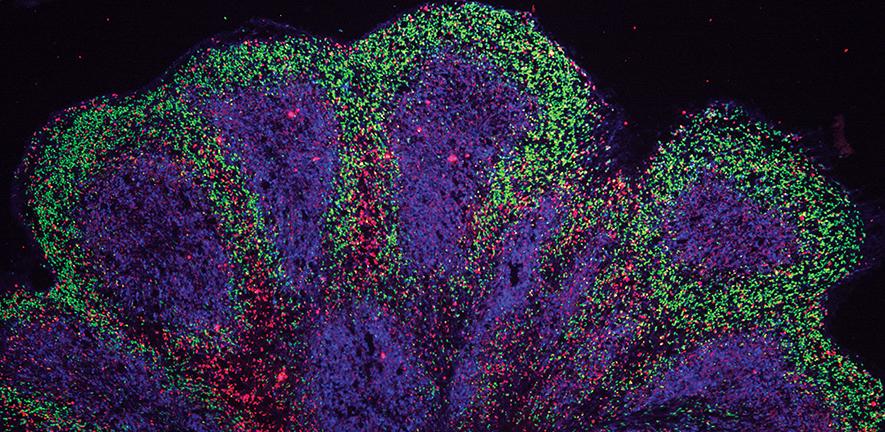
Lab-Grown ‘Mini Brains’ Hint at Treatments For Neurodegenerative Diseases

Mini brain organoids showing cortical-like structures
source: www.cam.ac.uk


Cambridge researchers have developed ‘mini brains’ that allow them to study a fatal and untreatable neurological disorder causing paralysis and dementia – and for the first time have been able to grow these for almost a year.


Not only can we see what may happen early on in the disease – long before a patient might experience any symptoms – but we can also begin to see how the disturbances change over time in each cell

András Lakatos

A common form of motor neurone disease, amyotrophic lateral sclerosis, often overlaps with frontotemporal dementia (ALS/FTD) and can affect younger people, occurring mostly after the age of 40-45. These conditions cause devastating symptoms of muscle weakness with changes in memory, behaviour and personality. Being able to grow small organ-like models (organoids) of the brain allows the researchers to understand what happens at the earliest stages of ALS/FTD, long before symptoms begin to emerge, and to screen for potential drugs.

In general, organoids, often referred to as ‘mini organs’, are being used increasingly to model human biology and disease. At the University of Cambridge alone, researchers use them to repair damaged livers, study SARS-CoV-2 infection of the lungs and model the early stages of pregnancy, among many other areas of research.

Typically, researchers take cells from a patient’s skin and reprogramme the cells back to their stem cell stage – a very early stage of development at which they have the potential to develop into most types of cell. These can then be grown in culture as 3D clusters that mimic particular elements of an organ. As many diseases are caused in part by defects in our DNA, this technique allows researchers to see how cellular changes – often associated with these genetic mutations – lead to disease.

Scientists at the John van Geest Centre for Brain Repair, University of Cambridge, used stem cells derived from patients suffering from ALS/FTD to grow brain organoids that are roughly the size of a pea. These resemble parts of the human cerebral cortex in terms of their embryonic and fetal developmental milestones, 3D architecture, cell-type diversity and cell-cell interactions.

Although this is not the first time scientists have grown mini brains from patients with neurodegenerative diseases, most efforts have only been able to grow them for a relatively short time frame, representing a limited spectrum of dementia-related disorders. In findings published today in Nature Neuroscience, the Cambridge team reports growing these models for 240 days from stem cells harbouring the commonest genetic mutation in ALS/FTD, which was not previously possible – and in unpublished work the team has grown them for 340 days.

Dr András Lakatos, the senior author who led the research in Cambridge’s Department of Clinical Neurosciences, said: “Neurodegenerative diseases are very complex disorders that can affect many different cell types and how these cells interact at different times as the diseases progress.

“To come close to capturing this complexity, we need models that are more long-lived and replicate the composition of those human brain cell populations in which disturbances typically occur, and this is what our approach offers. Not only can we see what may happen early on in the disease – long before a patient might experience any symptoms – but we can also begin to see how the disturbances change over time in each cell.”

While organoids are usually grown as balls of cells, first author Dr Kornélia Szebényi generated patient cell-derived organoid slice cultures in Dr Lakatos’ laboratory. This technique ensured that most cells within the model could receive the nutrients required to keep them alive.

Dr Szebényi said: “When the cells are clustered in larger spheres, those cells at the core may not receive sufficient nutrition, which may explain why previous attempts to grow organoids long term from patients’ cells have been difficult.”

Using this approach, Dr Szebényi and colleagues observed changes occurring in the cells of the organoids at a very early stage, including cell stress, damage to DNA and changes in how the DNA is transcribed into proteins. These changes affected those nerve cells and other brain cells known as astroglia, which orchestrate muscle movements and mental abilities.

“Although these initial disturbances were subtle, we were surprised at just how early changes occurred in our human model of ALS/FTD,” added Dr Lakatos. “This and other recent studies suggest that the damage may begin to accrue as soon as we are born. We will need more research to understand if this is in fact the case, or whether this process is brought forward in organoids by the artificial conditions in the dish.”

As well as being useful for understanding disease development, organoids can be a powerful tool for screening potential drugs to see which can prevent or slow disease progression. This is a crucial advantage of organoids, as animal models often do not show the typical disease-relevant changes, and sampling the human brain for this research would be unfeasible.

The team showed that a drug, GSK2606414, was effective at relieving common cellular problems in ALS/FTD, including the accumulation of toxic proteins, cell stress and the loss of nerve cells, hence blocking one of the pathways that contributes to disease. Similar drugs that are more suitable as medications and approved for human use are now being tested in clinical trials for neurodegenerative diseases.

Dr Gabriel Balmus from the UK Dementia Research Institute at the University of Cambridge, collaborating senior author, said: “By modelling some of the mechanisms that lead to DNA damage in nerve cells and showing how these can lead to various cell dysfunctions, we may also be able to identify further potential drug targets.”

Dr Lakatos added: “We currently have no very effective options for treating ALS/FTD, and while there is much more work to be done following our discovery, it at least offers hope that it may in time be possible to prevent or to slow down the disease process.

“It may also be possible in future to be able to take skin cells from a patient, reprogramme them to grow their ‘mini brain’ and test which unique combination of drugs best suits their disease.”

The study was primarily funded by the Medical Research Council UK, Wellcome Trust and the Evelyn Trust.

Reference

Szebényi, K et al. Human ALS/FTD Brain Organoid Slice Cultures Display Distinct Early Astrocyte and Targetable Neuronal Pathology. Nature Neuroscience; 21 Oct 2021; DOI: 10.1038/s41593-021-00923-4


Creative Commons License
The text in this work is licensed under a Creative Commons Attribution 4.0 International License. Images, including our videos, are Copyright ©University of Cambridge and licensors/contributors as identified.  All rights reserved. We make our image and video content available in a number of ways – as here, on our main website under its Terms and conditions, and on a range of channels including social media that permit your use and sharing of our content under their respective Terms.
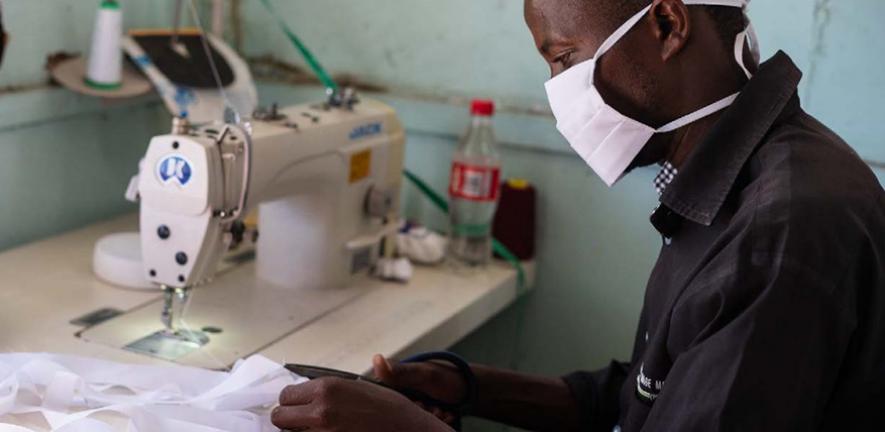
‘Generation Lockdown’ Needs Targeted Help-To-Work Policies – Global Report

source: www.cam.ac.uk


Nations the world over are guilty of “policy inertia” when it comes to supporting young people who lost work or will struggle to enter the labour market as a result of the pandemic, according to new University of Cambridge research.


Repeated outbreaks… will deplete household savings, shrink opportunities and diminish the aspirations of generation lockdown

Anna Barford

Experts argue that many countries simply “repackaged” existing – and often already failing – policies without the necessary funding or retooling to benefit under 24-year-olds: the global demographic hit hardest by the economic consequences of COVID-19.

In the report commissioned by the UN’s International Labour Organization, the Cambridge team calls on countries to go beyond employment policies that “yo-yo” with each virus surge, and implement longer-term interventions aimed squarely at the young.

The report suggests that, since the pandemic began, more than one in six young people globally were made redundant, with severe impacts on their mental health and wellbeing.

It is estimated that over 40% of all young people with a job pre-pandemic – some 178 million young workers – worked in the most affected sectors: tourism, services and retail. Tourism alone saw financial losses eleven times greater than the 2008 financial crash.

Global youth employment fell by more than double the rate of older adults in 2020 (8.7% compared to 3.7%), with loss of work particularly concentrated among young women in middle-income countries. Global female employment rates fell by 5% over the last year, compared to 3.9% for men.

In the 132 countries that adopted 580 fiscal and economic measures to support businesses during the Covid crisis, only 12% aimed to improve women’s economic security by ensuring that female-dominated sectors received financial support – mainly in Latin America, the Caribbean and sub-Saharan Africa.

In some lower-income countries, there are reports of more young women turning to sex work as a result, contributing to rising HIV cases as well as unintended pregnancies.

Even among high-income nations, the impact on young people’s livelihoods has varied dramatically. For example, between February and April 2020 – as the virus took hold – there was an 11.7 percentage point reduction in labour participation among Canada’s young people, a 7.5 point drop in the US, but just a 1.9 point drop in South Korea.

Many of those lucky enough to hold onto work saw their incomes fall substantially. By May last year, young people around the world still in work had almost a quarter of their hours cut on average (23%).

“Young people face distinct challenges which disadvantage them compared to older adults when it comes to finding work post-pandemic,” said report co-author Dr Adam Coutts, from Cambridge’s Department of Sociology.

“These include less work experience and financial capital, weaker social networks, and higher levels of in-work poverty. They are also much more likely to have to make ends meet via informal cash-in-hand work.

“Recent school leavers are often ineligible for unemployment benefits or furlough schemes. This left many young people falling through the cracks of policy interventions,” said Coutts.

Co-author Dr Garima Sahai from Cambridge’s Department of Geography said: “Young women have been especially hit by the pandemic who have experienced higher job losses, increased unpaid care work, the shadow pandemic of gender-based violence to name only a few effects.”

Researchers argue that “generation lockdown” could face protracted periods of unemployment, making it hard to re-enter the labour market, and get overtaken by “younger and better qualified cohorts”.

“Young people have been forced to remain at home, stuck with their parents, cut off from friends and partners,” said University of Cambridge co-author Dr Anna Barford. “Anxiety, stress and depression skyrocketed among young people around the world.”

“For those without ready access to internet connections or laptops, finishing school or hunting for work has been almost impossible at times,” she said.

“Repeated outbreaks in areas from Europe to sub-Saharan Africa and Latin America will deplete household savings, shrink opportunities and diminish the aspirations of generation lockdown.”

The report highlights that fact that young people migrate to find work and their place in the world. The pandemic shut down long-established migratory patterns: from young Guatemalans heading north to Mexico, to young Zimbabweans moving to South Africa. Young immigrants were also much more likely to lose work as average incomes fell.

Most national governments have offered economy-wide fiscal stimulus as well as labour market interventions, from reduced working weeks to temporary furlough schemes and increased social protection.

Some governments offered lifelines directly to sectors that prop up the youth labour market, such as India’s emergency loan support, which focused on the wholesale and retail trade, manufacturing, rental and business services (with some 100 million young people in the Asia and Pacific region estimated to be employed in these sectors).

However, the researchers say that only a few nations deployed policy responses tailored to the specific needs of young people affected by the economic fallout of COVID-19.

These included South Korea’s one-off cash transfers to young jobseekers and government-backed paid apprenticeships in Malaysia, while the EU reinforced its “Youth guarantee” scheme: with member states aiming to provide everyone under the age of 30 with education, traineeship or a job within four months of becoming unemployed.

The researchers argue that, without “youth-sensitive” employment policies, intergenerational inequalities will be further exacerbated during the pandemic recovery period.

They call for more youth-targeted ALMPs – Active Labour Market Policies – that provide support to boost employability, from vocational training to one-on-one jobseeker counselling, alongside mental health and wellbeing assistance for young people.

One example highlighted by the report’s authors is the Indonesian ‘pre-employment card’, the Kartu Pre-Kerja, with $1.3bn allocated to fund skills training for two million young workers. By contrast, Mexico reduced its ALMPs spending to move funding to other parts of the pandemic response.

“Holistic policy responses require health and non-health government departments and ministries to work together more effectively,” said Coutts. “The pandemic forced them to work together. These new networks and cross-departmental links need to be maintained.”

“Coordination should extend outside government to NGOs, trade unions, employer organisations, policy makers and young people themselves, in order to design better quality and more effective post-pandemic support for young people who have faced 18 months of social and economic chaos,” he added.


Creative Commons License
The text in this work is licensed under a Creative Commons Attribution 4.0 International License. Images, including our videos, are Copyright ©University of Cambridge and licensors/contributors as identified.  All rights reserved. We make our image and video content available in a number of ways – as here, on our main website under its Terms and conditions, and on a range of channels including social media that permit your use and sharing of our content under their respective Terms.

Cambridge Enterprise Invests In A Technology Start-Up Aiming To Cut CO₂ Emissions By Gigatonnes

source: www.cam.ac.uk


The investment will accelerate the development of AI technology start-up Carbon Re to help the global cement industry and other energy-intensive industries reach net zero targets.


Energy intensive industries, like cement, are among the hardest sectors to decarbonise. Carbon Re has a great team and a great technology that can be deployed today to save millions in energy and greenhouse gas emissions.

Chris Gibbs, Investment Manager, Cambridge Enterprise

The University of Cambridge Enterprise Fund has joined in a £1 million investment in Carbon Re, a UK climate tech start-up that uses artificial intelligence to cut CO₂ emissions in the global cement industry and other hard-to-abate industrial processes.

Carbon Re combines world-class deep reinforcement learning—a field of artificial intelligence best suited to managing complex decision-making—and industrial sustainability expertise from the University of Cambridge’s Institute for Manufacturing and UCL’s Energy Institute.

Carbon Re’s cloud-based platform, Delta Zero, uses powerful AI tools to achieve operational efficiencies in energy intensive industries, such as cement production, reducing operational costs and carbon emissions to otherwise unachievable levels. Delta Zero enables immediate reductions in energy consumption, cost and carbon emissions, with no capital expenditure.

Carbon Re is currently running pilot projects at cement plants in the EU, Turkey, India, Thailand, and Vietnam. Studies indicate that the Delta Zero platform could save a single cement plant US$2.3–5.9 million per annum and provide a 20% reduction in CO₂ emissions from fuel.

Using AI to analyse a customer’s manufacturing data, Carbon Re recommends ways to cut emissions during cement production by modelling the production environment and dynamically identifying the optimal process for the lowest possible carbon dioxide output and fuel use.

Currently the cement industry is Carbon Re’s primary area of focus, but the company plans to expand into other energy intensive industries, including steel and glass, over the next 12-18 months.

The investment is co-led by the Clean Growth Fund, the UK venture capital fund; the UCL Technology Fund and UCL Business Ltd’s Portico Ventures; and Blue Impact Ventures.

Sherif Elsayed-Ali, CEO of Carbon Re, said: “Our mission is to reduce global emissions at the Gigatonne scale, starting with the cement industry, and to become the leading global AI company to deliver industrial decarbonisation.”

“Energy intensive industries, such as cement, steel and chemicals, are vital to the global economy, producing 75% of all the material in the manufacturing and construction sectors. They also represent more than 20% of global greenhouse gas emissions. Our advanced software helps these industries cut their energy costs and crucially reduce their carbon emissions. Carbon Re’s AI technology provides heavy industry with an effective solution to address their critical challenges of energy costs and emissions reduction.”

“The road to a zero-carbon world will be long but with the support of the Clean Growth Fund and our other investors, our AI-products and solutions will evolve to accelerate the transition of energy intensive industries.”

Stephen Price, Clean Growth Fund’s Investment Director, said: “We are all really excited about Carbon Re’s ability to make a huge and positive impact across the world. The pressure is on the hard-to-abate heavy industries, like cement, to cut their emissions, and to do so much faster if Net Zero is to be achieved. By applying Carbon Re’s leading edge AI technology, heavy industry’s transition to more sustainable practices can be accelerated.”

Chris Gibbs, Cambridge Enterprise, said: “Energy intensive industries, like cement, are among the hardest sectors to decarbonise. Carbon Re has a great team and a great technology that can be deployed today to save millions in energy and greenhouse gas emissions. Two prestigious UK universities, the University of Cambridge and UCL, alongside a tremendous group of investors are pleased to back an outstanding business that will bring real value to industry and real value to the planet too.”


Creative Commons License
The text in this work is licensed under a Creative Commons Attribution 4.0 International License. Images, including our videos, are Copyright ©University of Cambridge and licensors/contributors as identified.  All rights reserved. We make our image and video content available in a number of ways – as here, on our main website under its Terms and conditions, and on a range of channels including social media that permit your use and sharing of our content under their respective Terms.
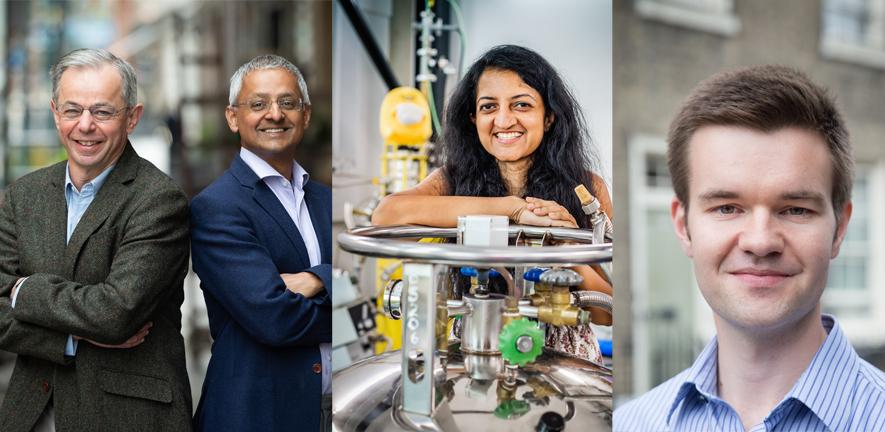
Four Cambridge Researchers Recognised In The 2022 Breakthrough Prizes

source: www.cam.ac.uk


Four University of Cambridge researchers – Professors Shankar Balasubramanian, David Klenerman, Suchitra Sebastian and Jack Thorne – have been recognised by the Breakthrough Prize Foundation for their outstanding scientific achievements.


Professors Shankar Balasubramanian and David Klenerman, from Cambridge’s Yusuf Hamied Department of Chemistry, have been awarded the 2022 Breakthrough Prize in Life Sciences – the world’s largest science prize – for the development of next-generation DNA sequencing. They share the award with Pascal Mayer, from the French company Alphanosos.

In addition, Professor Suchitra Sebastian, from the Cavendish Laboratory, and Professor Jack Thorne, from the Department of Pure Mathematics and Mathematical Statistics, have been recognised with the New Horizons Prize, awarded to outstanding early-career researchers.

Professor Suchitra Sebastian has been awarded the 2022 New Horizons in Physics Prize for high precision electronic and magnetic measurements that have profoundly changed our understanding of high temperature superconductors and unconventional insulators.

Professor Jack Thorne has been awarded the 2022 New Horizons in Mathematics Prize, for transformative contributions to diverse areas of algebraic number theory, and in particular for the proof, in collaboration with James Newton, of the automorphy of all symmetric powers of a holomorphic modular newform.

Professors Balasubramanian and Klenerman co-invented Solexa-Illumina Next Generation DNA Sequencing (NGS), technology that has enhanced our basic understanding of life, converting biosciences into ‘big science’ by enabling fast, accurate, low-cost and large-scale genome sequencing – the process of determining the complete DNA sequence of an organism’s make-up. They co-founded the company Solexa to make the technology available to the world.

The benefits to society of rapid genome sequencing are huge. The almost immediate identification and characterisation of the virus which causes COVID-19, rapid development of vaccines, and real-time monitoring of new genetic variants would have been impossible without the technique Balasubramanian and Klenerman developed.

The technology has had – and continues to have – a transformative impact in the fields of genomics, medicine and biology. One measure of the scale of change is that it has allowed a million-fold improvement in speed and cost when compared to the first sequencing of the human genome. In 2000, sequencing of one human genome took over 10 years and cost more than a billion dollars: today, the human genome can be sequenced in a single day at a cost of less than $1,000. More than a million human genomes are sequenced at scale each year, thanks to the technology co-invented by Professors Balasubramanian and Klenerman, meaning we can understand diseases much better and much more quickly. Earlier this year, they were awarded the Millennium Technology Prize. Balasubramanian is also based at the Cancer Research UK Cambridge Institute, and is a Fellow of Trinity College. Klenerman is a Fellow of Christ’s College.

Professor Sebastian’s research seeks to discover exotic quantum phases of matter in complex materials. Her group’s experiments involve tuning the co-operative behaviour of electrons within these materials by subjecting them to extreme conditions including low temperature, high applied pressure, and intense magnetic field.

Under these conditions, her group can take materials that are quite close to behaving like a superconductor – perfect, lossless conductors of electricity – and ‘nudge’ them, transforming their behaviour.

“I like to call it quantum alchemy – like turning soot into gold,” Sebastian said. “You can start with a material that doesn’t even conduct electricity, squeeze it under pressure, and discover that it transforms into a superconductor. Going forward, we may also discover new quantum phases of matter that we haven’t even imagined.”

In addition to her physics research, Sebastian is also involved in theatre and the arts. She is Director of the Cavendish Arts-Science Project, which she founded in 2016. The programme has been conceived to question and explore material and immaterial universes through a dialogue between the arts and sciences.

“Being awarded the New Horizons Prize is incredibly encouraging, uplifting and joyous,” said Sebastian. “It recognises a discovery made by our team of electrons doing what they’re not supposed to do. It’s gone from the moment of elation and disbelief at the discovery, and then trying to follow it through, when no one else quite thinks it’s possible or that it could be happening. It’s been an incredible journey, and having it recognised in this way is incredibly rewarding.”

Professor Jack Thorne is a number theorist in the Department of Pure Mathematics and Mathematical Statistics. One of the most significant open problems in mathematics is the Riemann Hypothesis, which concerns Riemann’s zeta function. Today we know that the zeta function is intimately tied up with questions concerning the statistical distribution of prime numbers, such as how many prime numbers there are, how closely they can be found on the number line. A famous episode in the history of the Riemann Hypothesis is Freeman Dyson’s observation that the zeroes of the zeta function appear to obey statistical laws arising from the theory of random matrices, which had first been studied in theoretical physics.

In 1916, during his time in Cambridge, Ramanujan wrote down an analogue of the Riemann zeta function, inspired by his work on the number of ways of expressing a given number as a sum of squares (a problem with a rich classical history), and made some conjectures as to its properties, which have turned out to be related to many of the most exciting developments in number theory in the last century. Actually, there are a whole family of zeta functions, the properties of which control the statistics of the sums of squares problem. Thorne’s work, recognised in the prize citation, essentially shows for Ramanujan’s zeta functions what Riemann proved for his zeta function in 1859.

Taking a broader view, Ramanujan’s zeta functions are now seen to fit into the framework of the Langlands Program. This is a series of conjectures, made by Langlands in the 1960’s, which have been described as a “grand unified theory of mathematics”, and which can be used to explain any number of phenomena in number theory. Another famous example is Wiles proof, in 1994, of Fermat’s Last Theorem. Nowadays the essential piece of Wiles’ work is seen as progress towards a small part of the Langlands program. Thorne’s work establishes part of Langlands’ conjectures for a class of objects including Ramanujan’s Delta function.

“I am deeply honoured to be awarded the New Horizons Prize for my work in number theory,” said Thorne. “Number theory is a subject with a rich history in Cambridge and I feel very fortunate to be able to make my own contribution to this tradition.”

For the tenth year, the Breakthrough Prize recognises the world’s top scientists. Each prize is US $3 million and presented in the fields of Life Sciences, Fundamental Physics (one per year) and Mathematics (one per year). In addition, up to three New Horizons in Physics Prizes, up to three New Horizons in Mathematics Prizes and up to three Maryam Mirzakhani New Frontiers Prizes are given out to early-career researchers each year, each worth US $100,000. The Breakthrough Prizes were founded by Sergey Brin, Priscilla Chan and Mark Zuckerberg, Yuri and Julia Milner, and Anne Wojcicki.


Creative Commons License
The text in this work is licensed under a Creative Commons Attribution 4.0 International License. Images, including our videos, are Copyright ©University of Cambridge and licensors/contributors as identified.  All rights reserved. We make our image and video content available in a number of ways – as here, on our main website under its Terms and conditions, and on a range of channels including social media that permit your use and sharing of our content under their respective Terms.

Queen Elizabeth I Would Tell Boris To Tax The Rich Rather Than Cut Universal Credit, a New Book Argues

Queen Elizabeth I by unknown continental artist (c.1575), NPG 2082. Image: The National Portrait Gallery, London
source: www.cam.ac.uk


A new book about how Covid-19 rocked the world argues that Elizabeth I would have supported the poor in the aftermath of the pandemic.


The evidence of history is that societies and economies fare much better with a strong welfare state

Simon Szreter

The Tudor Monarch introduced the world’s first universal welfare state in 1601, groundbreaking at the time, in response to repeated plague outbreaks and famines. The ‘Poor Laws’ required all of England’s 10,000 parishes to take responsibility for their poor – anyone who refused to contribute could face prison. For the next 200 years, England was better placed to weather plagues, crop failures, and recessions than anywhere else in Europe and it laid the foundations for the Industrial Revolution.

Simon Szreter, Professor of History and Public Policy at Cambridge and co-author of After The Virus – Lessons from the Past for a Better Future, said: “The evidence of history is that societies and economies fare much better with a strong welfare state and when you cut welfare to make savings, you damage society and the economy.

“Elizabeth was able to introduce an extraordinary and comprehensive response to the problems that had worried her for so long. Her ‘Poor Laws’ of 1598 and 1601 put the responsibility on local communities to care for their neighbours to make sure no one would fall into destitution. This included orphans, widows, the old, infirm, sick, involuntarily unemployed and single mothers and their children. This was the world’s first social security and welfare system – nothing like this had existed before.”

In After The Virus, Szreter and his co-author Hilary Cooper, a former government economist and senior policy maker, explore why the UK was so unprepared for the Covid-19 pandemic and suffered one of the highest death rates and worst economic contractions of the major world economies.

The book draws lessons from history and its authors say that ‘Good Queen Bess’, as Elizabeth I became known, was truly revolutionary and would not have accepted Boris Johnson’s government’s cut to universal credit. The £20 weekly increase to universal credit was introduced last year in response to the Covid-19 pandemic, but it has been controversially halted in October 2021.

Cooper, an expert in labour markets, children’s services and local development, said: “Elizabeth would absolutely have taxed the rich to support the poor in the aftermath of a virus that has claimed the lives of nearly 140,000 people in the UK.

Cooper said: “The lesson today is the same: we cut welfare – including education and health – at our peril. Covid-19 hit the poorest the hardest, with death rates highest in deprived areas and among people of colour. We must learn from the successes from our past and start investing in our population’s wellbeing instead of repeating the mistakes of austerity.”

Szreter, Fellow at St John’s College, said: “Britain had the world’s first welfare state – put in place 400 years ago by Elizabeth I – and the country actually became richer for it. With an unavoidable responsibility to provide for the poor the wealthy increased their philanthropy, funding alms houses, schools, apprenticeships and hospitals to prevent them falling into hardship in the first place.

“It was a welfare system that worked because the prosperous set about contributing and investing in their fellow citizens while Justices of the Peace rigorously enforced payments into the poor law funds. With the old and the sick cared for, the young in particular were liberated to follow the work, migrating to towns and cities where new jobs were becoming available, secure, too, in the knowledge that their parish would support them if things didn’t work out.

“This security ended famine nearly 150 years ahead of other European nations and paved the basis for Britain to emerge as the world’s first industrial nation. The labour mobility and rapid urban growth that was unique to Britain in the seventeenth and eighteenth centuries was facilitated by the security the poor law provided.”

Szreter’s research encompasses economic, social and public health history. He was the first non-American to win the American Public Health Association’s Viseltear Prize. He added: “This week’s cuts to universal credit and the continued inflexibility of the five-week wait to receive benefits will not encourage anyone to take risks in today’s labour market, while the dire state of social care leaves many unable to move from where they can easily care for ageing relatives. Welfare savings are simply a false economy.”

Although the book offers optimism and a clear manifesto for change, it also offers a warning – that Covid-19 is a ‘dress rehearsal’ for bigger crises ahead. Cooper explained: “Covid-19 is a warning shot across our bows, there are going to be many more global crises – climate change and biodiversity collapse are the big threats. Perhaps Covid-19 will be the warning the world needed to learn lessons from the past.”

Reference

After the Virus: Lessons from the Past for a Better Future by Hilary Cooper and Simon Szreter is published by Cambridge University Press.


Creative Commons License
The text in this work is licensed under a Creative Commons Attribution 4.0 International License. Images, including our videos, are Copyright ©University of Cambridge and licensors/contributors as identified.  All rights reserved. We make our image and video content available in a number of ways – as here, on our main website under its Terms and conditions, and on a range of channels including social media that permit your use and sharing of our content under their respective Terms.

Crayfish and Carp Among Invasive Species Pushing Lakes Towards Ecosystem Collapse

American signal crayfish
source: www.cam.ac.uk


Certain invasive, non-native species can disrupt lakes to the point of rapid ecosystem collapse, contaminating water for drinking, aquaculture and recreation, a new study has found.


Simply undoing the circumstances that triggered a tipping point will not restore the ecosystem – the road to recovery is slow and steep.

Sam Reynolds

Human activity and climate change are causing invasive non-native species to spread rapidly across the globe. Researchers have found that certain invasive species can push lake ecosystems beyond a critical ‘tipping point’, causing a sudden shift from healthy to degraded conditions that is difficult to reverse.

Invasive fish such as Asian silver carp Hypophthalmichthys molitrix, and crustaceans such as American signal crayfish Pacifastacus leniusculus, were found to significantly reduce the abundance of other important organisms in lakes and degrade water quality. The findings, published today in the journal Global Change Biology, also provide guidance on the best ways to manage waterbodies.

Shallow lakes naturally exist in one of two alternative stable states: either healthy – with clear water with an abundance of vegetation, or degraded – with cloudy water dominated by algae. When a lake is in the latter state, algae use up all the nutrients in the water and block sunlight, preventing the growth of aquatic vegetation that would aid ecosystem recovery.

Deteriorated, algae-dominated freshwater ecosystems also threaten the health and water security of human populations. Blooms of cyanobacteria, known as ‘blue-green algae’ can produce toxins that contaminate food webs and poison water supplies.

“Algal blooms represent one of the most significant threats to the security of the Earth’s surface freshwaters. Simply undoing the circumstances that triggered a tipping point will not restore the ecosystem – the road to recovery is slow and steep,” said Dr Sam Reynolds in the University of Cambridge’s Department of Zoology, first author of the report.

However, although invasive species are recognised as a significant threat to global biodiversity, their impacts on ecosystem services may not be uniformly negative. Invasive molluscs, including the zebra mussel Dreissena polymorpha, were found to engineer the opposite biological and environmental response: they delay ecosystem collapse and potentially aid the recovery of degraded lake ecosystems.

“Managers of drinking water reservoirs, for example, may be able to avoid the cost of dealing with blooms of harmful algae, by removing invasive crayfish but allowing established non-native zebra mussels to remain and act as biological filters,” said Professor David Aldridge, senior author of the report.

He added: “Early detection and rapid response plans should always be our first line of attack. But in situations where invaders have already established and can no longer be eradicated, it may be appropriate to embrace their positive effects.”

The researchers focused on shallow lake ecosystems, but say that their framework could be applied to other critical ecosystems that experience catastrophic tipping points – such as coral reefs, kelp forests and desert shrublands.

This research was funded by the Biotechnology and Biological Sciences Research Council (BBSRC).

Reference
Reynolds, S. A. & Aldridge, D. C.: ‘Global impacts of invasive species on the tipping points of shallow lakes‘. Global Change Biology, October 2021. DOI 10.1111/gcb.15893


Creative Commons License
The text in this work is licensed under a Creative Commons Attribution 4.0 International License. Images, including our videos, are Copyright ©University of Cambridge and licensors/contributors as identified.  All rights reserved. We make our image and video content available in a number of ways – as here, on our main website under its Terms and conditions, and on a range of channels including social media that permit your use and sharing of our content under their respective Terms.